Laboratory of Human Genetics of Infectious Diseases, Necker Branch, INSERM U1163, Necker Hospital for Sick Children, Paris, France; University of Paris, Imagine Institute, Paris, France; St. Giles Laboratory of Human Genetics of Infectious Diseases, Rockefeller Branch, The Rockefeller University, New York, NY, USA; Department of Pediatrics, Necker Hospital for Sick Children, AP-HP, Paris, France.
Laboratory of Human Genetics of Infectious Diseases, Necker Branch, INSERM U1163, Necker Hospital for Sick Children, Paris, France; University of Paris, Imagine Institute, Paris, France; St. Giles Laboratory of Human Genetics of Infectious Diseases, Rockefeller Branch, The Rockefeller University, New York, NY, USA.
Curr Opin Immunol. 2022 Feb;74:172-182. doi: 10.1016/j.coi.2022.01.003. Epub 2022 Jan 25.
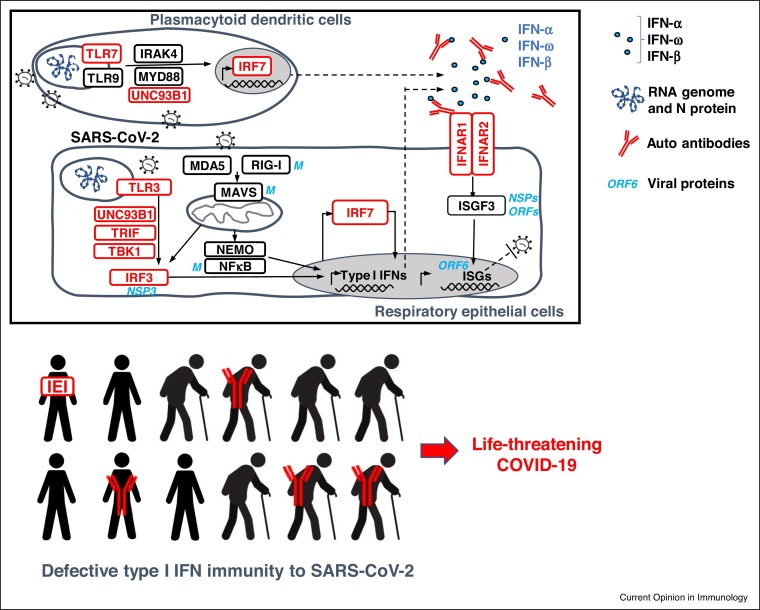
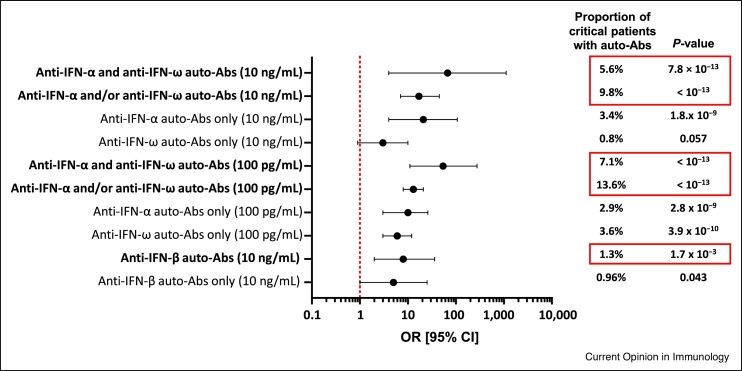
Type I interferons (IFNs) have broad and potent antiviral activity. We review the interplay between type I IFNs and SARS-CoV-2. Human cells infected with SARS-CoV-2 in vitro produce low levels of type I IFNs, and SARS-CoV-2 proteins can inhibit various steps in type I IFN production and response. Exogenous type I IFNs inhibit viral growth in vitro. In various animal species infected in vivo, type I IFN deficiencies underlie higher viral loads and more severe disease than in control animals. The early administration of exogenous type I IFNs improves infection control. In humans, inborn errors of, and auto-antibodies against type I IFNs underlie life-threatening COVID-19 pneumonia. Overall, type I IFNs are essential for host defense against SARS-CoV-2 in individual cells and whole organisms.
I 型干扰素(IFNs)具有广泛而强大的抗病毒活性。我们回顾了 I 型干扰素与 SARS-CoV-2 之间的相互作用。体外感染 SARS-CoV-2 的人细胞产生低水平的 I 型干扰素,SARS-CoV-2 蛋白可以抑制 I 型 IFN 产生和反应的各个步骤。外源性 I 型干扰素可抑制体外病毒生长。在体内感染的各种动物物种中,与对照动物相比,I 型 IFN 缺陷导致更高的病毒载量和更严重的疾病。早期给予外源性 I 型干扰素可改善感染控制。在人类中,I 型干扰素的先天缺陷和自身抗体是导致危及生命的 COVID-19 肺炎的基础。总的来说,I 型干扰素是宿主抵抗 SARS-CoV-2 的个体细胞和整个机体防御所必需的。