Boiteau Jocelyn M, Pingali Prabhu
Tata-Cornell Institute for Agriculture and Nutrition, Cornell University, Ithaca, New York, USA.
Division of Nutritional Sciences, Cornell University, Ithaca, New York, USA.
Am J Clin Nutr. 2022 Jun 7;115(6):1535-1548. doi: 10.1093/ajcn/nqac039.
Reducing food loss and waste (FLW) may narrow gaps between fruit and vegetable production and recommended intake. However, FLW estimates are inconsistent due to varying estimation methods.
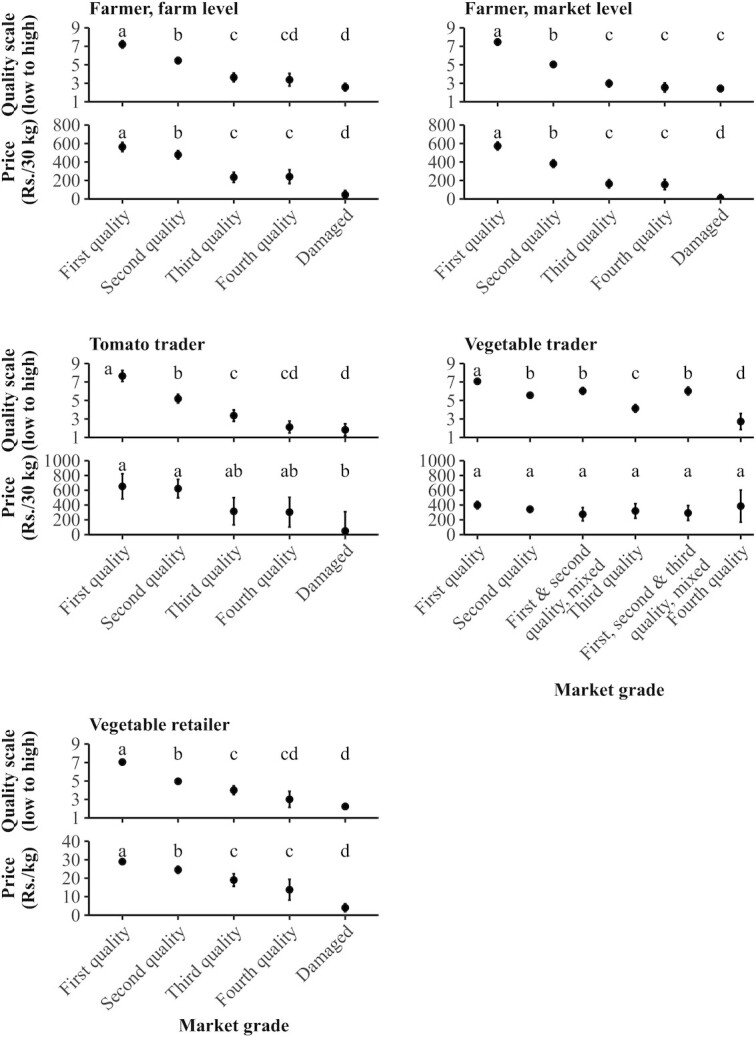
Using multiple estimation approaches, we examined the extent and determinants of FLW along tomato supply chains in South India, from farm to retail. We also explored tomato quality assessments.
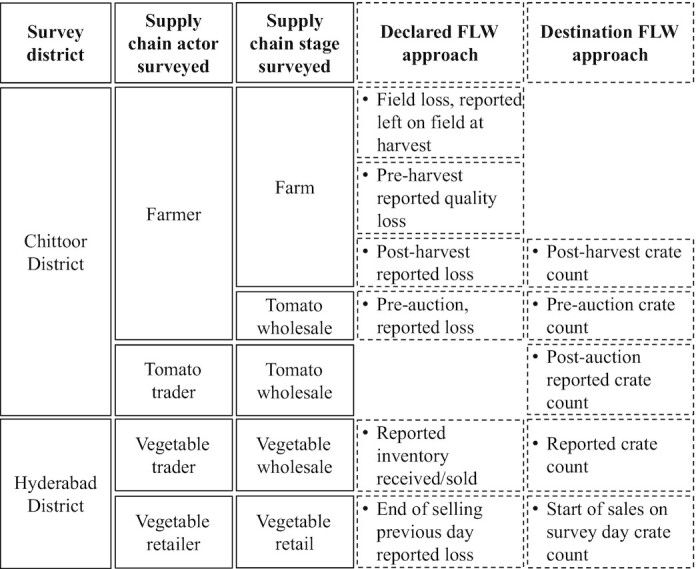
We surveyed 75 farm households and 83 tomato traders in the Chittoor district, Andhra Pradesh, and 52 vegetable traders and 50 vegetable retailers in Hyderabad, Telangana, on harvest and market days. We calculated declared FLW values using participant-reported losses to estimate the preharvest quality FLW and quantitative FLW values at the farmer, vegetable-trader, and vegetable-retailer stages. We calculated the destination FLW based on counted crates diverted to loss destinations, using participant-reported destinations (animal feed, field discard), to estimate the postharvest FLW from farm to retail. We used pile sorting with farmers to explore on-farm quality assessments.
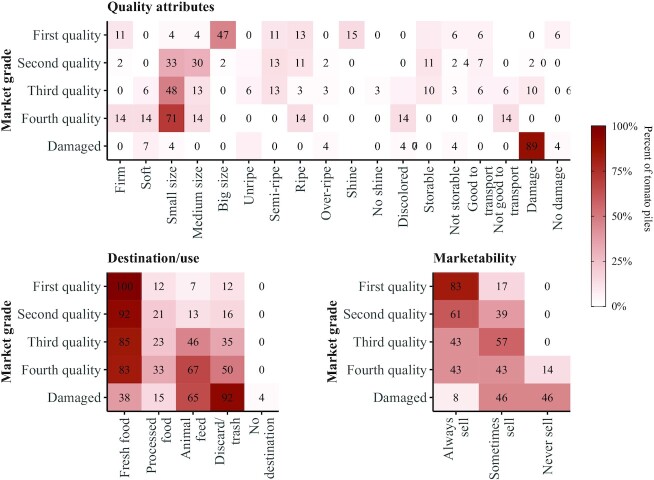
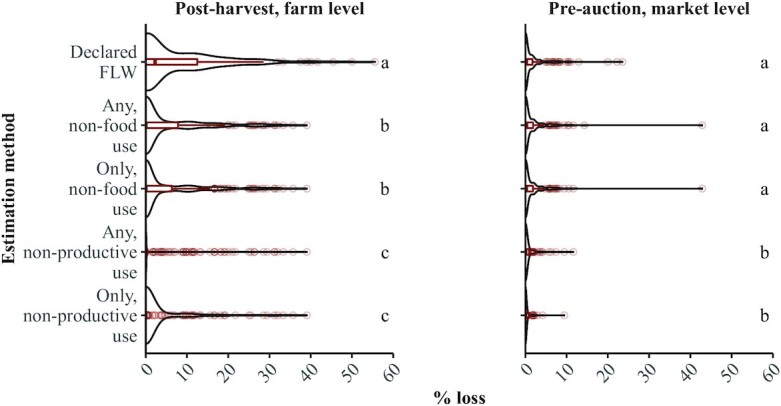
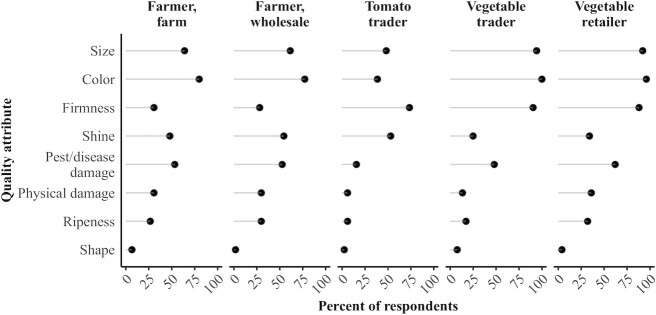
The average preharvest quality FLW was 13.9% of harvested tomatoes. From farm to retail, the quantitative FLW was greatest at the postharvest, farm level. Among all harvests, the median postharvest, farm-level FLW was 0.0% (IQR, 0.0%-7.9%) using the destination FLW approach (tomatoes diverted to nonfood uses) and 2.3% (IQR, 0.0%-12.5%) using the declared FLW approach (P < 0.05). Among harvests with a non-zero postharvest, farm-level FLW, the median FLW was 9.1% (IQR, 2.4%-16.7%) using the destination FLW approach (tomatoes diverted to nonfood uses) and 10.0% (IQR, 2.9%-16.7%) using the declared FLW approach. Harvesting during peak season was a determinant of postharvest, farm-level and preauction, market-level FLW values. Farmers prioritize color/ripeness attributes while harvesting and tomato size while grading.
Single-point estimates may obscure FLW patterns for perishable, indeterminate crops and depend on data collection and estimation methods. Reducing FLW of perishables requires the integration of quantitative and qualitative FLW estimation methods.
减少粮食损失和浪费(FLW)可能会缩小水果和蔬菜产量与推荐摄入量之间的差距。然而,由于估算方法不同,FLW估算结果并不一致。
我们采用多种估算方法,研究了印度南部从农场到零售的番茄供应链中FLW的程度和决定因素。我们还探讨了番茄质量评估。
我们在收获日和市场日对安得拉邦奇图尔区的75户农户和83名番茄贸易商,以及特伦甘纳邦海得拉巴德的52名蔬菜贸易商和50名蔬菜零售商进行了调查。我们使用参与者报告的损失来计算申报的FLW值,以估计收获前质量FLW以及农民、蔬菜贸易商和蔬菜零售商阶段的定量FLW值。我们根据转移到损失目的地的计数板条箱,使用参与者报告的目的地(动物饲料、田间丢弃)来计算目的地FLW,以估计从农场到零售的收获后FLW。我们与农民一起使用堆垛分类法来探索农场质量评估。
收获前质量FLW平均占收获番茄的13.9%。从农场到零售,定量FLW在收获后的农场层面最大。在所有收获中,使用目的地FLW方法(转移到非食品用途的番茄)收获后农场层面FLW的中位数为0.0%(IQR,0.0%-7.9%),使用申报FLW方法为2.3%(IQR,0.0%-12.5%)(P<0.05)。在收获后农场层面FLW非零的收获中,使用目的地FLW方法(转移到非食品用途的番茄)FLW的中位数为9.1%(IQR,2.4%-16.7%),使用申报FLW方法为10.0%(IQR,2.9%-16.7%)。旺季收获是收获后农场层面和拍卖前市场层面FLW值的一个决定因素。农民在收获时优先考虑颜色/成熟度属性,在分级时优先考虑番茄大小。
单点估计可能会掩盖易腐、不确定作物的FLW模式,并且取决于数据收集和估算方法。减少易腐食品的FLW需要整合定量和定性的FLW估算方法。