Che Lin, Wu Jia-Shen, Du Ze-Bang, He Yu-Qiao, Yang Lei, Lin Jin-Xian, Lei Zhao, Chen Xiao-Xuan, Guo Dong-Bei, Li Wen-Gang, Lin Yu-Chun, Lin Zhong-Ning
State Key Laboratory of Molecular Vaccinology and Molecular Diagnostics, School of Public Health, Xiamen University, Xiamen 361102, China.
Department of Hepatobiliary Surgery and Pancreatic & Organ Transplantation Surgery, Xiang'an Hospital of Xiamen University, School of Medicine, Xiamen University, Xiamen 361102, China.
Cancers (Basel). 2022 Feb 6;14(3):821. doi: 10.3390/cancers14030821.
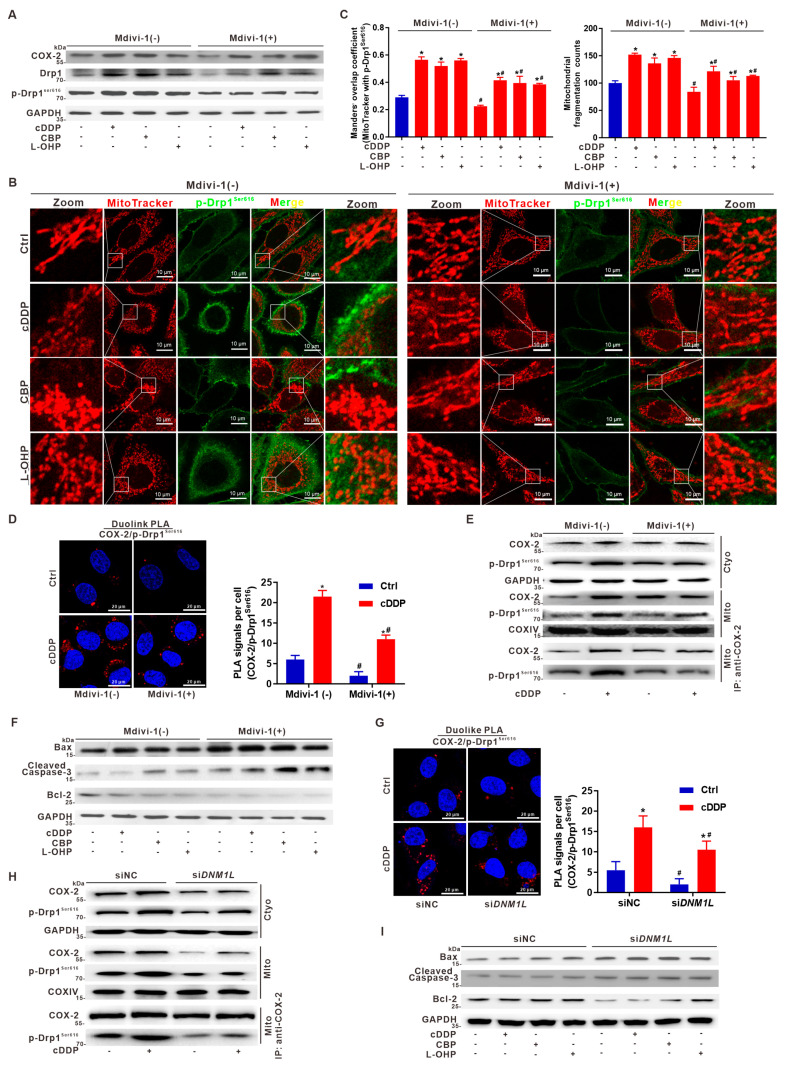
Mitochondria are highly dynamic organelles and undergo constant fission and fusion, which are both essential for the maintenance of cell physiological functions. Dysregulation of dynamin-related protein 1 (Drp1)-dependent mitochondrial dynamics is associated with tumorigenesis and the chemotherapeutic response in hepatocellular carcinoma (HCC). The enzyme cyclooxygenase-2 (COX-2) is overexpressed in most cancer types and correlates with a poor prognosis. However, the roles played by the translocation of mitochondrial COX-2 (mito-COX-2) and the interaction between mito-COX-2 and Drp1 in chemotherapeutic responses remain to be elucidated in the context of HCC. Bioinformatics analysis, paired HCC patient specimens, xenograft nude mice, immunofluorescence, transmission electron microscopy, molecular docking, CRISPR/Cas9 gene editing, proximity ligation assay, cytoplasmic and mitochondrial fractions, mitochondrial immunoprecipitation assay, and flow cytometry analysis were performed to evaluate the underlying mechanism of how mito-COX-2 and p-Drp1 interaction regulates the chemotherapeutic response via mitochondrial dynamics in vitro and in vivo. We found that COX-2 and Drp1 were frequently upregulated and confer a poor prognosis in HCC. We also found that the proportion of mito-COX-2 and p-Drp1 was increased in HCC cell lines. In vitro, we demonstrated that the enhanced mitochondrial translocation of COX-2 promotes its interaction with p-Drp1 via PTEN-induced putative kinase 1 (PINK1)-mediated Drp1 phosphorylation activation. This increase was associated with higher colony formation, cell proliferation, and mitochondrial fission. These findings were confirmed by knocking down COX-2 in HCC cells using CRISPR/Cas9 technology. Furthermore, inhibition of Drp1 using pharmacologic inhibitors (Mdivi-1) or RNA interference (si) decreased mito-COX-2/p-Drp1 interaction-mediated mitochondrial fission, and increased apoptosis in HCC cells treated with platinum drugs. Moreover, inhibiting mito-COX-2 acetylation with the natural phytochemical resveratrol resulted in reducing cell proliferation and mitochondrial fission, occurring through upregulation of mitochondrial deacetylase sirtuin 3 (SIRT3), which, in turn, increased the chemosensitivity of HCC to platinum drugs in vitro and in vivo. Our results suggest that targeting interventions to PINK1-mediated mito-COX-2/p-Drp1-dependent mitochondrial dynamics increases the chemosensitivity of HCC and might help us to understand how to use the SIRT3-modulated mito-COX-2/p-Drp1 signaling axis to develop an effective clinical intervention in hepatocarcinogenesis.
线粒体是高度动态的细胞器,不断进行裂变和融合,这两者对于维持细胞生理功能都至关重要。动力相关蛋白1(Drp1)依赖性线粒体动力学的失调与肝细胞癌(HCC)的肿瘤发生和化疗反应相关。环氧合酶-2(COX-2)在大多数癌症类型中过度表达,且与预后不良相关。然而,线粒体COX-2(mito-COX-2)的易位以及mito-COX-2与Drp1之间的相互作用在HCC化疗反应中所起的作用仍有待阐明。我们进行了生物信息学分析、配对的HCC患者标本、异种移植裸鼠、免疫荧光、透射电子显微镜、分子对接、CRISPR/Cas9基因编辑、邻近连接分析、细胞质和线粒体组分、线粒体免疫沉淀分析以及流式细胞术分析,以评估mito-COX-2与p-Drp1相互作用如何通过线粒体动力学在体外和体内调节化疗反应的潜在机制。我们发现COX-2和Drp1在HCC中经常上调,并预示着不良预后。我们还发现mito-COX-2和p-Drp1的比例在HCC细胞系中增加。在体外,我们证明COX-2增强的线粒体易位通过PTEN诱导的假定激酶1(PINK1)介导的Drp1磷酸化激活促进其与p-Drp1的相互作用。这种增加与更高的集落形成、细胞增殖和线粒体裂变相关。使用CRISPR/Cas9技术在HCC细胞中敲低COX-2证实了这些发现。此外,使用药物抑制剂(Mdivi-1)或RNA干扰(si)抑制Drp1可减少mito-COX-2/p-Drp1相互作用介导的线粒体裂变,并增加用铂类药物处理的HCC细胞的凋亡。此外,用天然植物化学物质白藜芦醇抑制mito-COX-2乙酰化可导致细胞增殖和线粒体裂变减少,这是通过线粒体去乙酰化酶沉默调节蛋白3(SIRT3)的上调实现的,进而在体外和体内增加了HCC对铂类药物的化学敏感性。我们的结果表明,针对PINK1介导的mito-COX-2/p-Drp1依赖性线粒体动力学的靶向干预可增加HCC的化学敏感性,并可能有助于我们理解如何利用SIRT3调节的mito-COX-2/p-Drp1信号轴来开发针对肝癌发生的有效临床干预措施。