National Fitness Survey Center, China Institute of Sport Science, Beijing 100061, China.
Institute of Child and Adolescent Health, School of Public Health, Peking University, Beijing 100191, China.
Int J Environ Res Public Health. 2022 Jan 23;19(3):1262. doi: 10.3390/ijerph19031262.
To investigate the compliance rates of health-related behaviors among Chinese preschool children, and to explore how supportive family environment, parental behavior, sociodemographic and community factors affect children's health-related behavior comprehensively.
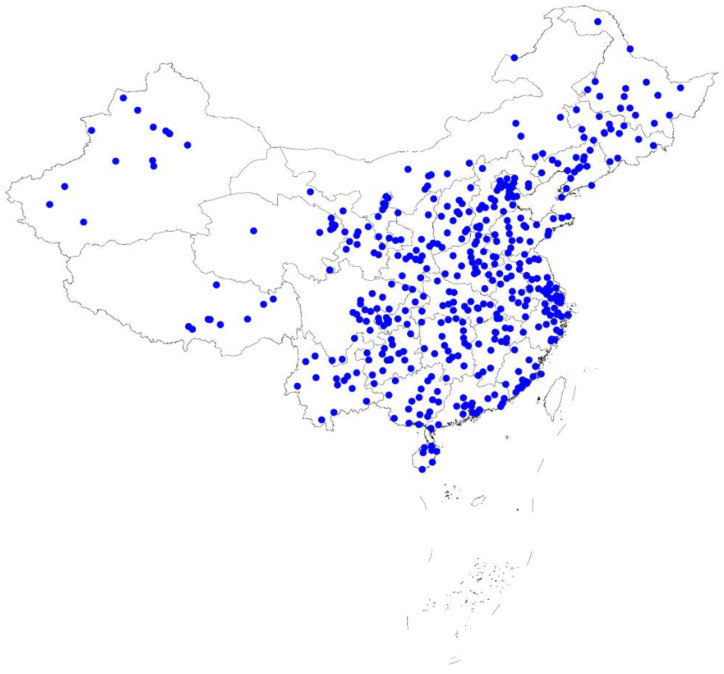
Preschool children aged 3 to 6 years were chosen from 5760 villages (residential) committees from 471 counties (districts) of 31 provinces by use of a stratified random sampling procedure, with 10,967 preschool children aged 3-6 years old included. The survey was conducted from September 2020 to November 2020.
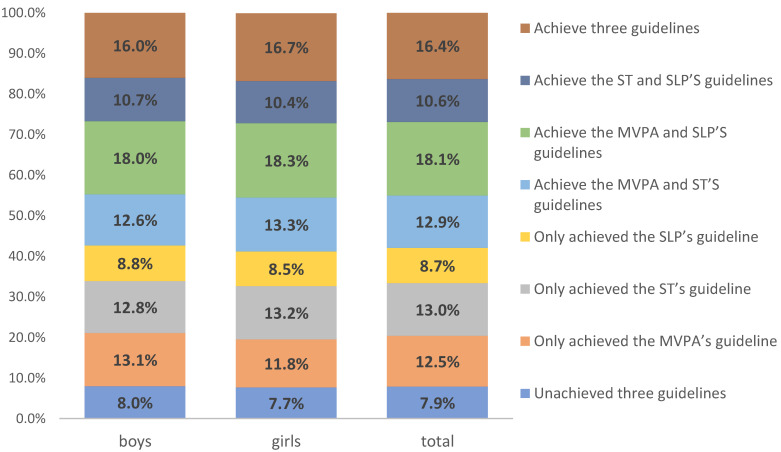
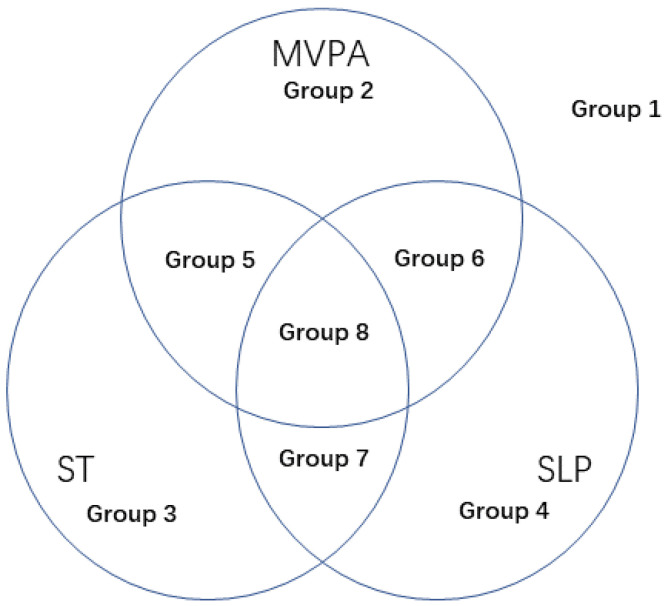
The proportion of Chinese preschool children who met the moderate to vigorous physical activity (MVPA), screen time behavior (ST), and sleep behavior (SLP) guidelines were 62.3%, 52.8%, and 53.8%. Among the supportive family environment factors, parents' time with their children on weekends had the most significant impact on children's MVPA, ST, and SLP, with the odds ratio (OR) values of 2.18 (95%CI:1.97, 2.40), 0.69 (0.63, 0.76), and 1.62 (1.48, 1.79), respectively. Among the parental behavior factors, the mother's exercise frequency had a strong association with the children's MVPA and SLP, with OR values of 1.65 (1.50, 1.83) and 1.24 (1.13, 1.37), respectively; the mother's screen time was inversely associated with the children's ST with an OR value of 0.47 (0.44, 0.51).
Different types of family environments were associated with the different levels of MVPA, ST and SLP among Chinese preschool children. In addition to the influence of parents' education and family income, parents could also improve their children's behaviors by providing a supportive family environment. The more of these factors presented in a family, the more likely it was for children to meet the guidelines. Therefore, for those families whose children's health-related behaviors needed to be improved, the parents should create supportive family environments, such as by playing less on mobile phone and spending more time with children.
调查中国学龄前儿童健康相关行为的依从率,并探讨支持性家庭环境、父母行为、社会人口学和社区因素如何综合影响儿童的健康相关行为。
采用分层随机抽样方法,从全国 31 个省的 471 个县(区)的 5760 个村(居)委会中抽取 3 至 6 岁学龄前儿童,共纳入 10967 名 3-6 岁学龄前儿童。调查于 2020 年 9 月至 11 月进行。
中国学龄前儿童达到中高强度身体活动(MVPA)、屏幕时间行为(ST)和睡眠行为(SLP)指南的比例分别为 62.3%、52.8%和 53.8%。在支持性家庭环境因素中,父母周末与孩子共度的时间对儿童的 MVPA、ST 和 SLP 影响最大,优势比(OR)值分别为 2.18(95%CI:1.97,2.40)、0.69(0.63,0.76)和 1.62(1.48,1.79)。在父母行为因素中,母亲的运动频率与儿童的 MVPA 和 SLP 呈强相关,OR 值分别为 1.65(1.50,1.83)和 1.24(1.13,1.37);母亲的屏幕时间与儿童的 ST 呈负相关,OR 值为 0.47(0.44,0.51)。
不同类型的家庭环境与中国学龄前儿童的 MVPA、ST 和 SLP 水平有关。除了父母教育和家庭收入的影响外,父母还可以通过营造支持性的家庭环境来改善孩子的行为。家庭中存在的这些因素越多,孩子越有可能达到指南要求。因此,对于那些需要改善孩子健康相关行为的家庭,父母应该营造支持性的家庭环境,如少玩手机、多陪孩子玩耍等。