Graduate School of Biomedical and Health Sciences, Hiroshima University, Hiroshima 734-8553, Japan.
Department of Health Science, Nagoya Women's University, Nagoya 467-8610, Japan.
Int J Environ Res Public Health. 2022 Jan 31;19(3):1654. doi: 10.3390/ijerph19031654.
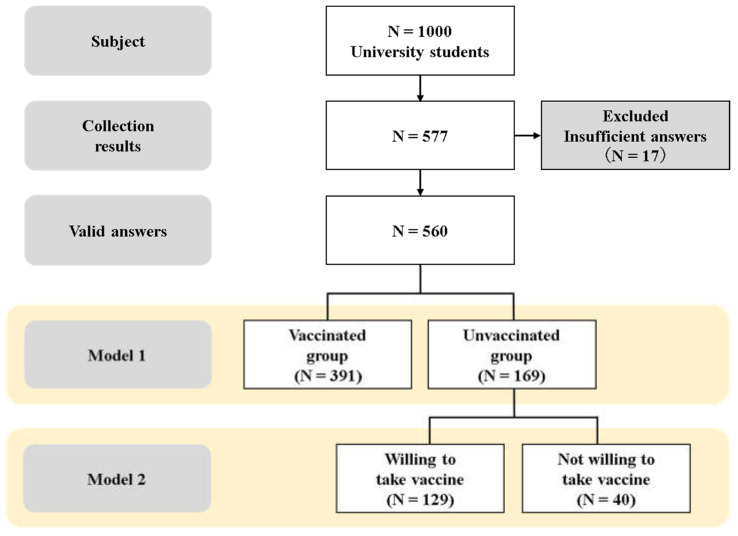
Vaccinations may be one of the solutions to end the COVID-19 pandemic. One's psychological state may be strongly related to one's willingness to be vaccinated. This study investigated the relationship between the psychological state of Japanese university students and their willingness to be vaccinated. A self-report questionnaire on COVID-19, its vaccines (vaccination status, and perceived efficacy and safety), and psychological state (anxiety and depressive mood) was administered online, and 560 valid responses were obtained. The unvaccinated group reported significantly lower perceived vaccine effectiveness and importance than the vaccinated group. However, there were no differences in anxiety and depressive mood symptoms between the two groups. Multivariate logistic regression analysis was performed on the unvaccinated participants to identify the factors associated with their unwillingness to be vaccinated; there was a significant association between anxiety and unwillingness to receive the vaccine ( < 0.05). However, there was no significant association between depressive mood and unwillingness to receive the vaccine. The results suggest that timely psychological support for Japanese university students experiencing high levels of anxiety is important in accelerating vaccination programs.
接种疫苗可能是结束 COVID-19 大流行的解决方案之一。一个人的心理状态可能与他/她接种疫苗的意愿密切相关。本研究调查了日本大学生的心理状态与其接种疫苗意愿之间的关系。通过在线方式发放了一份关于 COVID-19、其疫苗(接种状况、感知效力和安全性)和心理状态(焦虑和抑郁情绪)的自我报告问卷,共获得了 560 份有效回复。未接种组报告的疫苗感知效力和重要性明显低于已接种组。然而,两组的焦虑和抑郁情绪症状没有差异。对未接种参与者进行多变量逻辑回归分析,以确定与他们不愿接种疫苗相关的因素;焦虑与不愿接种疫苗之间存在显著关联(<0.05)。然而,抑郁情绪与不愿接种疫苗之间没有显著关联。研究结果表明,及时为焦虑程度较高的日本大学生提供心理支持,对于加速疫苗接种计划很重要。