Department of Medicine- Division of Critical Care, Western University, London, Ontario, Canada.
Department of Medicine, Sinai Health System, Toronto, Ontario, Canada.
PLoS One. 2022 Feb 15;17(2):e0263438. doi: 10.1371/journal.pone.0263438. eCollection 2022.
We aimed to evaluate the personal, professional, and psychological impact of the COVID-19 pandemic on hospital workers and their perceptions about mitigating strategies.
Cross-sectional web-based survey consisting of (1) a survey of the personal and professional impact of the COVID-19 pandemic and potential mitigation strategies, and (2) two validated psychological instruments (Kessler Psychological Distress Scale [K10] and Impact of Events Scale Revised [IES-R]). Regression analyses were conducted to identify the predictors of workplace stress, psychological distress, and post-traumatic stress.
Hospital workers employed at 4 teaching and 8 non-teaching hospitals in Ontario, Canada during the COVID-19 pandemic.
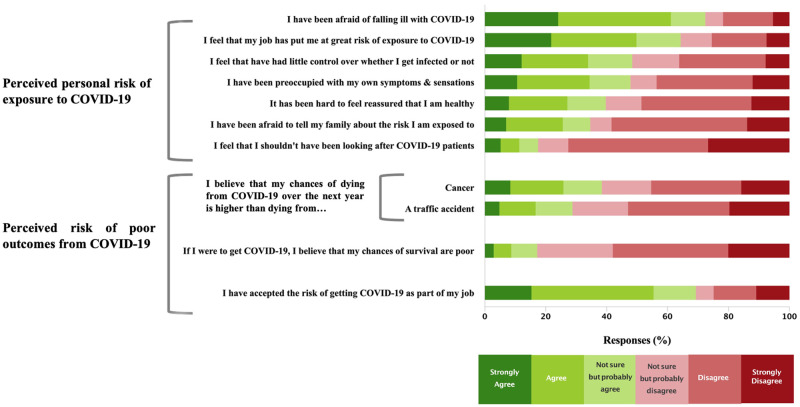
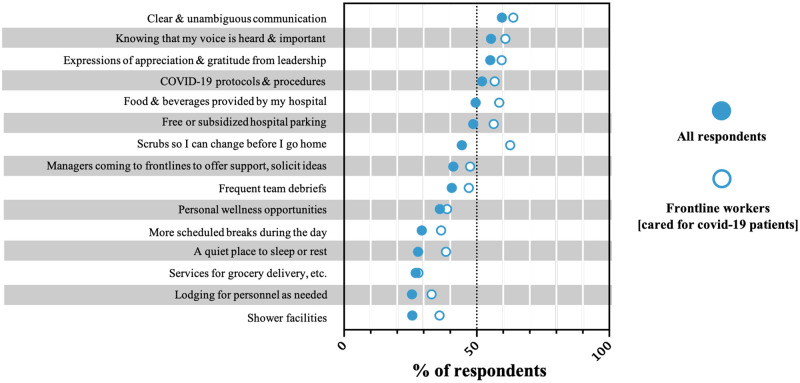
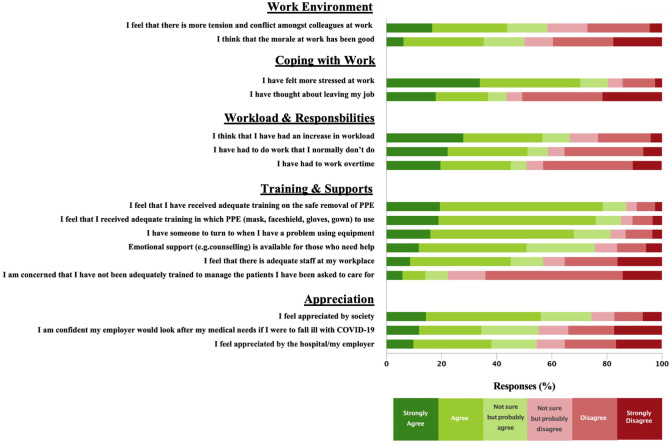
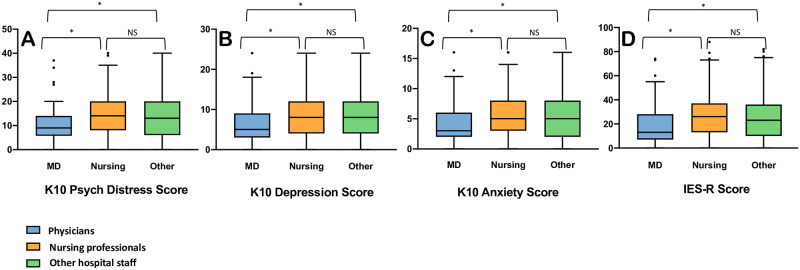
Among 1875 respondents (84% female, 49% frontline workers), 72% feared falling ill, 64% felt their job placed them at great risk of COVID-19 exposure, and 48% felt little control over the risk of infection. Respondents perceived that others avoided them (61%), reported increased workplace stress (80%), workload (66%) and responsibilities (59%), and 44% considered leaving their job. The psychological questionnaires revealed that 25% had at least some psychological distress on the K10, 50% had IES-R scores suggesting clinical concern for post-traumatic stress, and 38% fulfilled criteria for at least one psychological diagnosis. Female gender and feeling at increased risk due to PPE predicted all adverse psychological outcomes. Respondents favoured clear hospital communication (59%), knowing their voice is heard (55%), expressions of appreciation from leadership (55%), having COVID-19 protocols (52%), and food and beverages provided by the hospital (50%).
Hospital work during the COVID-19 pandemic has had important personal, professional, and psychological impacts. Respondents identified opportunities to better address information, training, and support needs.
评估 COVID-19 大流行对医院工作人员的个人、职业和心理影响,以及他们对缓解策略的看法。
横断面网络调查,包括(1)COVID-19 大流行的个人和职业影响及潜在缓解策略调查,以及(2)两个经过验证的心理量表(Kessler 心理困扰量表[K10]和修订后的事件影响量表[IES-R])。回归分析用于确定工作场所压力、心理困扰和创伤后应激的预测因素。
COVID-19 大流行期间,加拿大安大略省的 4 所教学医院和 8 所非教学医院的在职员工。
在 1875 名应答者中(84%为女性,49%为一线工作人员),72%的人担心自己生病,64%的人认为自己的工作使他们面临感染 COVID-19 的巨大风险,48%的人对感染风险几乎没有控制感。应答者认为他人回避他们(61%),报告工作场所压力(80%)、工作量(66%)和责任(59%)增加,44%的人考虑离职。心理问卷显示,K10 得分至少有一些心理困扰的人占 25%,IES-R 得分表明创伤后应激有临床关注的人占 50%,至少有一种心理诊断标准的人占 38%。女性性别和因个人防护装备而感到风险增加预测了所有不良心理结果。应答者赞成医院进行清晰的沟通(59%)、知道自己的声音被听到(55%)、领导层表示赞赏(55%)、有 COVID-19 协议(52%)和医院提供食物和饮料(50%)。
COVID-19 大流行期间的医院工作对个人、职业和心理都有重要影响。应答者确定了更好地满足信息、培训和支持需求的机会。