Department of Geriatric Medicine, Concord Hospital, Sydney, New South Wales, Australia.
Centre for Education and Research on Ageing, Concord Hospital, Sydney, New South Wales, Australia.
J Gerontol A Biol Sci Med Sci. 2022 Nov 21;77(11):2168-2174. doi: 10.1093/gerona/glac039.
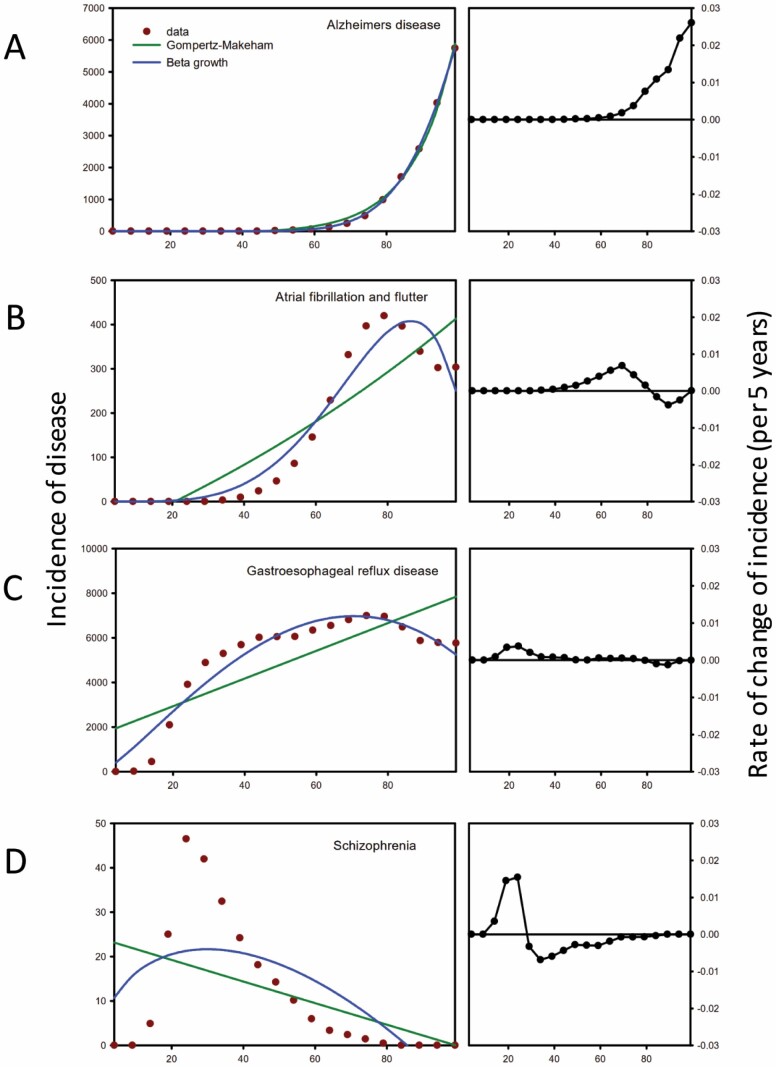
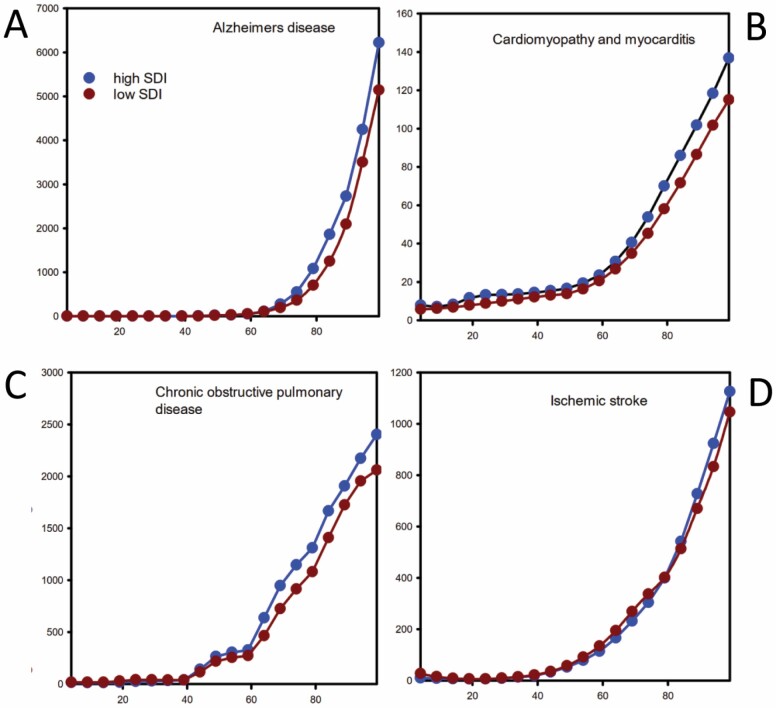
There are no established or standardized definitions of aging-related disease. Data from the Global Burden of Diseases, Injuries, and Risk Factors Study 2019 were used to model the relationship between age and incidence of diseases. Clustering analysis identified 4 groups of noncommunicable diseases: Group A diseases with an exponential increase in incidence with age; Group B diseases with an exponential increase in incidence that usually peaked in late life which then declined or plateaued at the oldest ages; and Groups C and D diseases with an onset in earlier life and where incidence was stable or decreased in old age. From an epidemiological perspective, Group A diseases are "aging-related diseases" because there is an exponential association between age and incidence, and the slope of the incidence curves remains positive throughout old age. These included the major noncommunicable diseases dementia, stroke, and ischemic heart disease. Whether any of the other diseases are aging-related is uncertain because their incidence either does not change or more often decreases in old age. Only biological studies can determine how the aging process contributes to any of these diseases and this may lead to a reclassification of disease on the basis of whether they are directly caused by or are in continuity with the biological changes of aging. In the absence of this mechanistic data, we propose the term "aging-related disease" should be used with precision based on epidemiological evidence.
目前,与衰老相关疾病尚无既定或标准化的定义。本研究使用 2019 年全球疾病、伤害和危险因素研究的数据来模拟年龄与疾病发生率之间的关系。聚类分析确定了 4 组非传染性疾病:A 组疾病的发生率随年龄呈指数增长;B 组疾病的发生率也呈指数增长,但通常在晚年达到峰值,然后在最年长的年龄下降或趋于平稳;C 组和 D 组疾病在生命早期发病,且发病率在老年时稳定或下降。从流行病学角度来看,A 组疾病是“与衰老相关的疾病”,因为年龄与发病率之间存在指数关联,且发病率曲线在整个老年期保持正值。这些疾病包括主要的非传染性疾病痴呆症、中风和缺血性心脏病。其他疾病是否与衰老相关则不确定,因为它们的发病率要么在老年时不变,要么更常见于下降。只有生物学研究才能确定衰老过程如何导致这些疾病中的任何一种,这可能会导致根据这些疾病是否直接由衰老的生物学变化引起或与衰老的生物学变化连续发生来对疾病进行重新分类。在缺乏这些机制数据的情况下,我们建议根据流行病学证据,精确使用“与衰老相关的疾病”这一术语。