
基于神经进化算法的新冠疫情最优非药物干预政策
Optimal non-pharmaceutical intervention policy for Covid-19 epidemic via neuroevolution algorithm.
作者信息
Saeidpour Arash, Rohani Pejman
机构信息
Odum School of Ecology, University of Georgia, Athens, GA 30602, USA.
Center for the Ecology of Infectious Diseases, University of Georgia, Athens, GA 30602, USA.
出版信息
Evol Med Public Health. 2022 Jan 28;10(1):59-70. doi: 10.1093/emph/eoac002. eCollection 2022.
BACKGROUND
National responses to the Covid-19 pandemic varied markedly across countries, from business-as-usual to complete shutdowns. Policies aimed at disrupting the viral transmission cycle and preventing the overwhelming of healthcare systems inevitably exact an economic toll.
METHODOLOGY
We developed an intervention policy model that comprised the relative human, implementation and healthcare costs of non-pharmaceutical epidemic interventions and identified the optimal strategy using a neuroevolution algorithm. The proposed model finds the minimum required reduction in transmission rates to maintain the burden on the healthcare system below the maximum capacity.
RESULTS
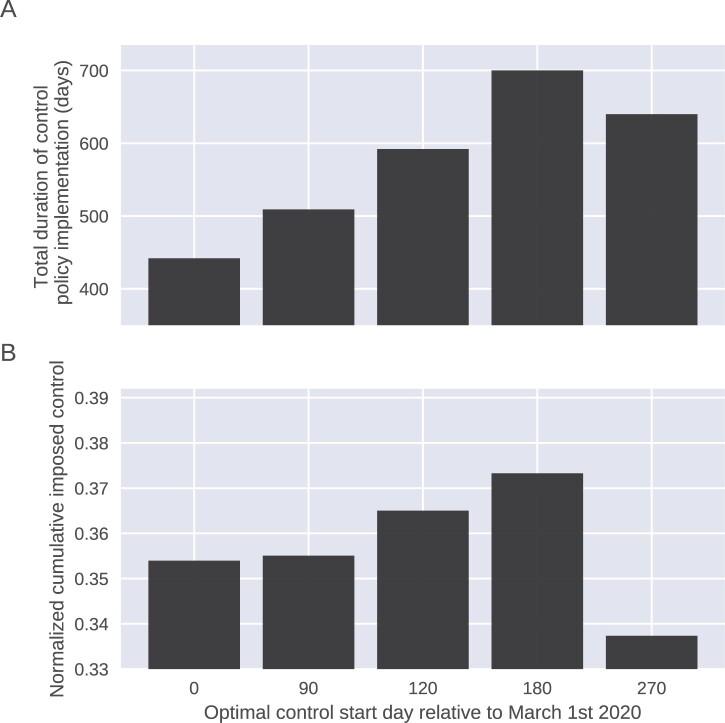
We find that such a policy renders a sharp increase in the control strength during the early stages of the epidemic, followed by a steady increase in the subsequent ten weeks as the epidemic approaches its peak, and finally the control strength is gradually decreased as the population moves towards herd immunity. We have also shown how such a model can provide an efficient adaptive intervention policy at different stages of the epidemic without having access to the entire history of its progression in the population.
CONCLUSIONS AND IMPLICATIONS
This work emphasizes the importance of imposing intervention measures early and provides insights into adaptive intervention policies to minimize the economic impacts of the epidemic without putting an extra burden on the healthcare system.
LAY SUMMARY
We developed an intervention policy model that comprised the relative human, implementation and healthcare costs of non-pharmaceutical epidemic interventions and identified the optimal strategy using a neuroevolution algorithm. Our work emphasizes the importance of imposing intervention measures early and provides insights into adaptive intervention policies to minimize the economic impacts of the epidemic without putting an extra burden on the healthcare system.
背景
各国对新冠疫情的应对措施差异显著,从照常营业到全面封锁。旨在打破病毒传播周期和防止医疗系统不堪重负的政策不可避免地会带来经济损失。
方法
我们开发了一种干预政策模型,该模型包含非药物性防疫干预措施的人力、实施和医疗成本,并使用神经进化算法确定最优策略。所提出的模型能找到维持医疗系统负担在最大容量以下所需的最低传播率降低幅度。
结果
我们发现,这样的政策在疫情早期会使控制力度急剧增加,随后在疫情接近峰值的十周内稳步上升,最后随着人群趋向群体免疫,控制力度逐渐下降。我们还展示了这种模型如何在无法获取疫情在人群中发展的完整历史记录的情况下,在疫情不同阶段提供有效的适应性干预政策。
结论与启示
这项工作强调了尽早实施干预措施的重要性,并为适应性干预政策提供了见解,以在不给医疗系统增加额外负担的情况下,将疫情的经济影响降至最低。
简要概述
我们开发了一种干预政策模型,该模型包含非药物性防疫干预措施的人力、实施和医疗成本,并使用神经进化算法确定最优策略。我们的工作强调了尽早实施干预措施的重要性,并为适应性干预政策提供了见解,以在不给医疗系统增加额外负担的情况下,将疫情的经济影响降至最低。


 Zotero 插件