Shiratori Yuki, Ogawa Takafumi, Ota Miho, Sodeyama Noriko, Sakamoto Tohru, Arai Tetsuaki, Tachikawa Hirokazu
Department of Psychiatry, Faculty of Medicine, University of Tsukuba Japan.
University health center, University of Tsukuba Japan.
J Affect Disord Rep. 2022 Apr;8:100314. doi: 10.1016/j.jadr.2022.100314. Epub 2022 Feb 10.
The coronavirus-19 (COVID-19) pandemic has resulted in substantial mental health problems. In addition to the fear of infection, prevention policies that result in isolation such as lockdowns or, in Japan, "self-restraint," are associated with psychological symptoms. University students are vulnerable to emotional disorders because of the psychological challenges associated with the transition to adulthood. Therefore, we investigated changes in the mental health of university students before and during the COVID-19 pandemic.
We used data from depression screening conducted by the University of Tsukuba, Japan, during student health examinations. Students completed the Patient Health Questionnaire-9 (PHQ-9) and an open-ended question on stress self-coping.
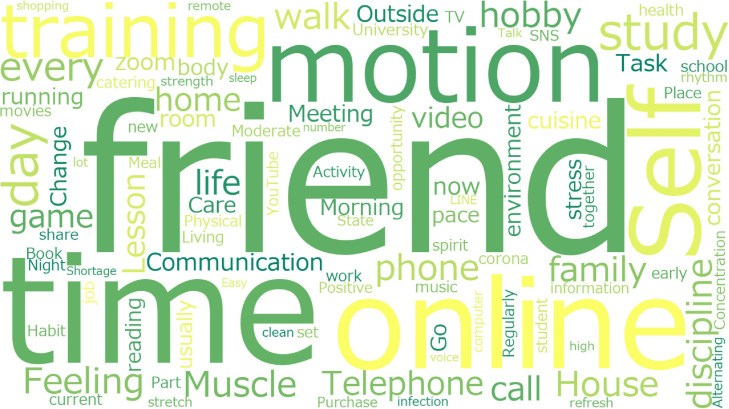
In 2020, 9.6% of students were depressed, approximately twice as many as in previous years. The paired samples Wilcoxon test showed that PHQ-9 scores were significantly higher in 2020 than in 2019; the largest effect size was for sleep difficulties. Analysis of the open-ended responses for stress coping strategies showed that physical activity and online communication were most frequently used.
The 2020 survey was web-based, whereas the surveys in previous years were completed in person. Only approximately one-sixth of participants answered the open-ended question.
The percentage of students with mental health problems has doubled, and more attention to student mental health is needed. However, many students seem to be using appropriate coping measures. Education about best practices and raising awareness about establishing and maintaining sleep-wake rhythms may be useful.
2019冠状病毒病(COVID-19)大流行已导致大量心理健康问题。除了对感染的恐惧之外,诸如封锁措施或在日本的“自我约束”等导致隔离的预防政策也与心理症状有关。大学生由于向成年过渡所带来的心理挑战,容易出现情绪障碍。因此,我们调查了COVID-19大流行之前及期间大学生心理健康的变化情况。
我们使用了日本筑波大学在学生健康检查期间进行的抑郁症筛查数据。学生们完成了患者健康问卷-9(PHQ-9)以及一个关于压力自我应对的开放式问题。
2020年,9.6%的学生患有抑郁症,约为前几年的两倍。配对样本威尔科克森检验显示,2020年的PHQ-9得分显著高于2019年;最大效应量出现在睡眠困难方面。对应对压力策略的开放式回答分析表明,体育活动和在线交流是最常被使用的方式。
2020年的调查是基于网络进行的,而前几年的调查是当面完成的。只有大约六分之一的参与者回答了开放式问题。
有心理健康问题的学生比例增加了一倍,需要更加关注学生心理健康。然而,许多学生似乎正在采用适当的应对措施。开展关于最佳做法的教育并提高对建立和维持睡眠-清醒节律的认识可能会有所帮助。