Luo Li-Mei, Huang Bao-Tian, Chen Chuang-Zhen, Wang Ying, Su Chuang-Huang, Peng Guo-Bo, Zeng Cheng-Bing, Wu Yan-Xuan, Wang Ruo-Heng, Huang Kang, Qiu Zi-Han
Department of Radiation Oncology, Shantou University Medical College, Shantou, China.
Department of Radiation Oncology, Cancer Hospital of Shantou University Medical College, Shantou, China.
Front Oncol. 2022 Jan 31;11:819047. doi: 10.3389/fonc.2021.819047. eCollection 2021.
Stereotactic body radiotherapy (SBRT) is an important treatment modality for lung cancer patients, however, tumor local recurrence rate remains some challenge and there is no reliable prediction tool. This study aims to develop a prediction model of local control for lung cancer patients undergoing SBRT based on radiomics signature combining with clinical and dosimetric parameters.
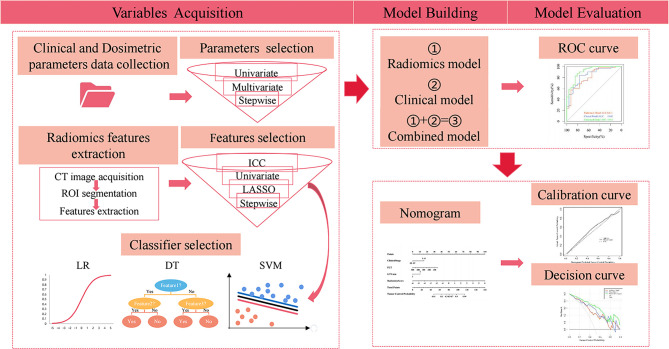
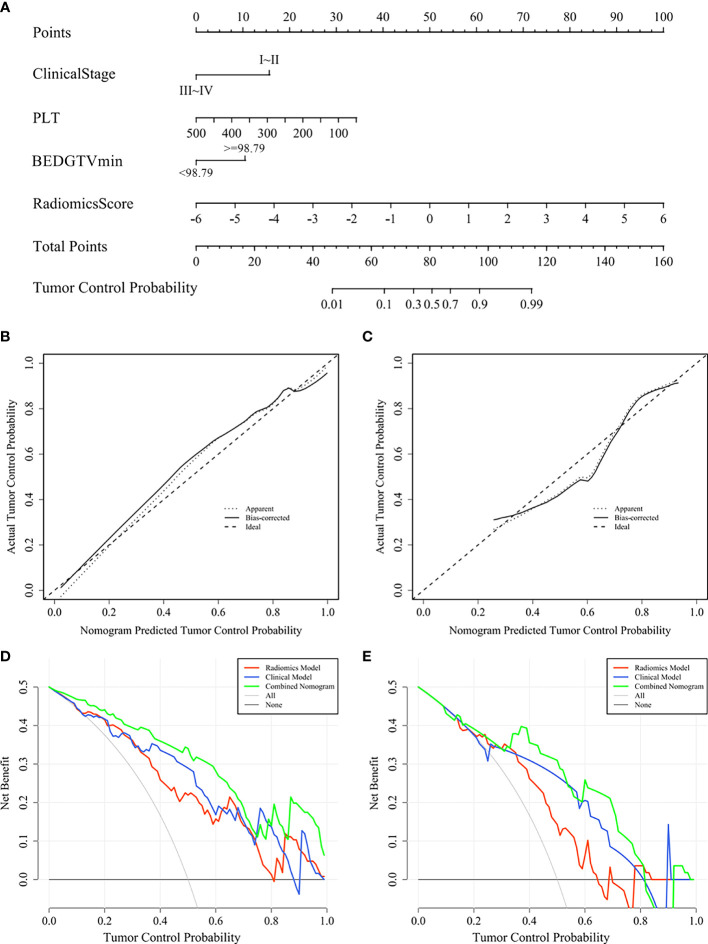
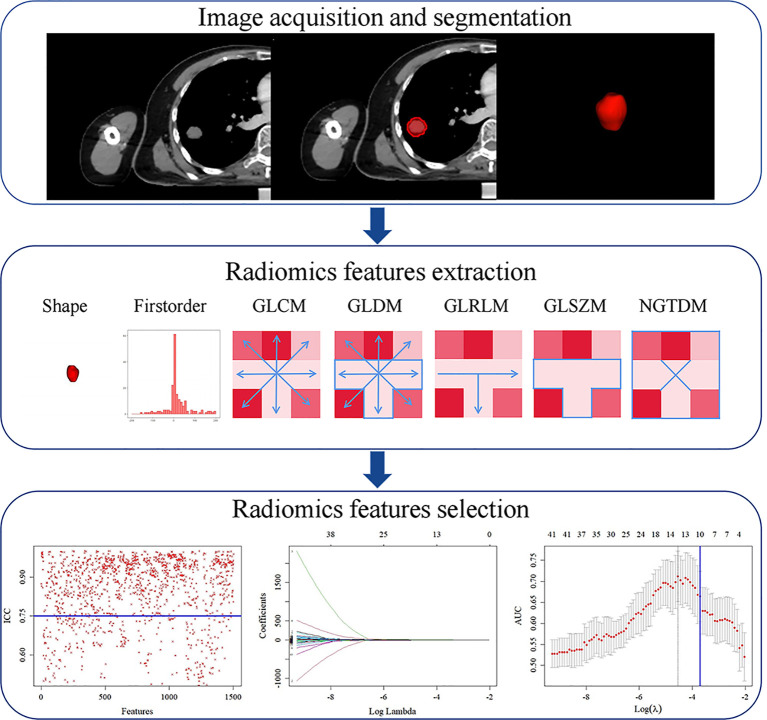
The radiomics model, clinical model and combined model were developed by radiomics features, incorporating clinical and dosimetric parameters and radiomics signatures plus clinical and dosimetric parameters, respectively. Three models were established by logistic regression (LR), decision tree (DT) or support vector machine (SVM). The performance of models was assessed by receiver operating characteristic curve (ROC) and DeLong test. Furthermore, a nomogram was built and was assessed by calibration curve, Hosmer-Lemeshow and decision curve.
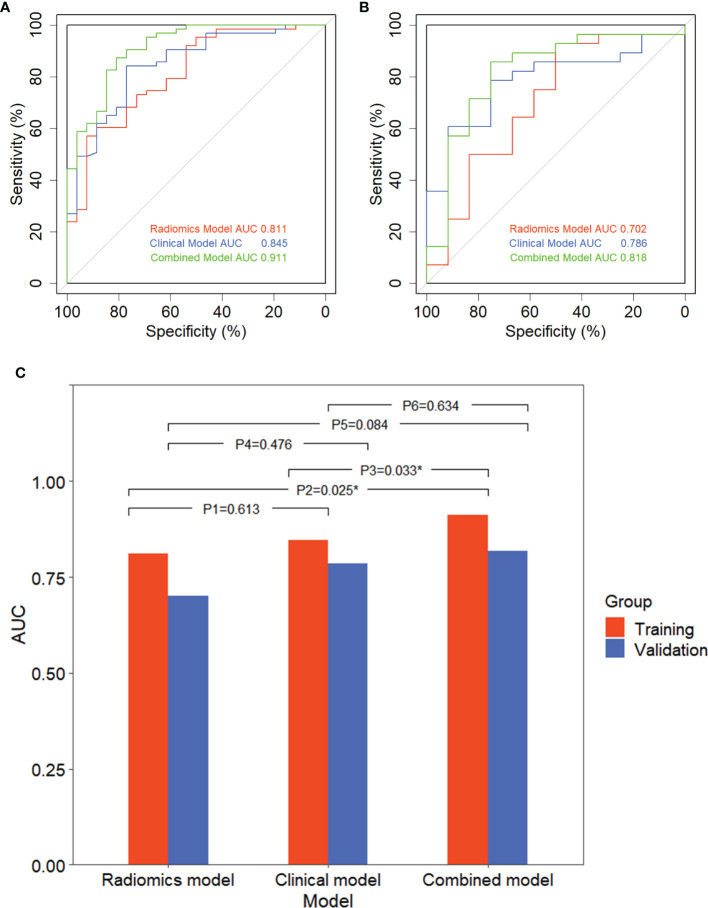
The LR method was selected for model establishment. The radiomics model, clinical model and combined model showed favorite performance and calibration (Area under the ROC curve (AUC) 0.811, 0.845 and 0.911 in the training group, 0.702, 0.786 and 0.818 in the validation group, respectively). The performance of combined model was significantly superior than the other two models. In addition, Calibration curve and Hosmer-Lemeshow (training group: P = 0.898, validation group: P = 0.891) showed good calibration of combined nomogram and decision curve proved its clinical utility.
The combined model based on radiomics features plus clinical and dosimetric parameters can improve the prediction of 1-year local control for lung cancer patients undergoing SBRT.
立体定向体部放射治疗(SBRT)是肺癌患者的一种重要治疗方式,然而,肿瘤局部复发率仍然存在一些挑战,且尚无可靠的预测工具。本研究旨在基于影像组学特征结合临床和剂量学参数,开发一种用于接受SBRT的肺癌患者局部控制的预测模型。
影像组学模型、临床模型和联合模型分别通过影像组学特征、纳入临床和剂量学参数以及影像组学特征加临床和剂量学参数来构建。通过逻辑回归(LR)、决策树(DT)或支持向量机(SVM)建立三种模型。通过受试者操作特征曲线(ROC)和德龙检验评估模型的性能。此外,构建了列线图,并通过校准曲线、Hosmer-Lemeshow检验和决策曲线进行评估。
选择LR方法进行模型建立。影像组学模型、临床模型和联合模型表现出良好的性能和校准(训练组中ROC曲线下面积(AUC)分别为0.811、0.845和0.911,验证组中分别为0.702、0.786和0.818)。联合模型的性能显著优于其他两个模型。此外,校准曲线和Hosmer-Lemeshow检验(训练组:P = 0.898,验证组:P = 0.891)显示联合列线图校准良好,决策曲线证明了其临床实用性。
基于影像组学特征加临床和剂量学参数的联合模型可以提高对接受SBRT的肺癌患者1年局部控制的预测。