Department of Biology and Ecology, Faculty of Science, University of Ostrava, Ostrava, Czech Republic.
Department of Biology, Faculty of Science, Chiang Mai University, Chiang Mai, Thailand.
PLoS Genet. 2022 Feb 17;18(2):e1010036. doi: 10.1371/journal.pgen.1010036. eCollection 2022 Feb.
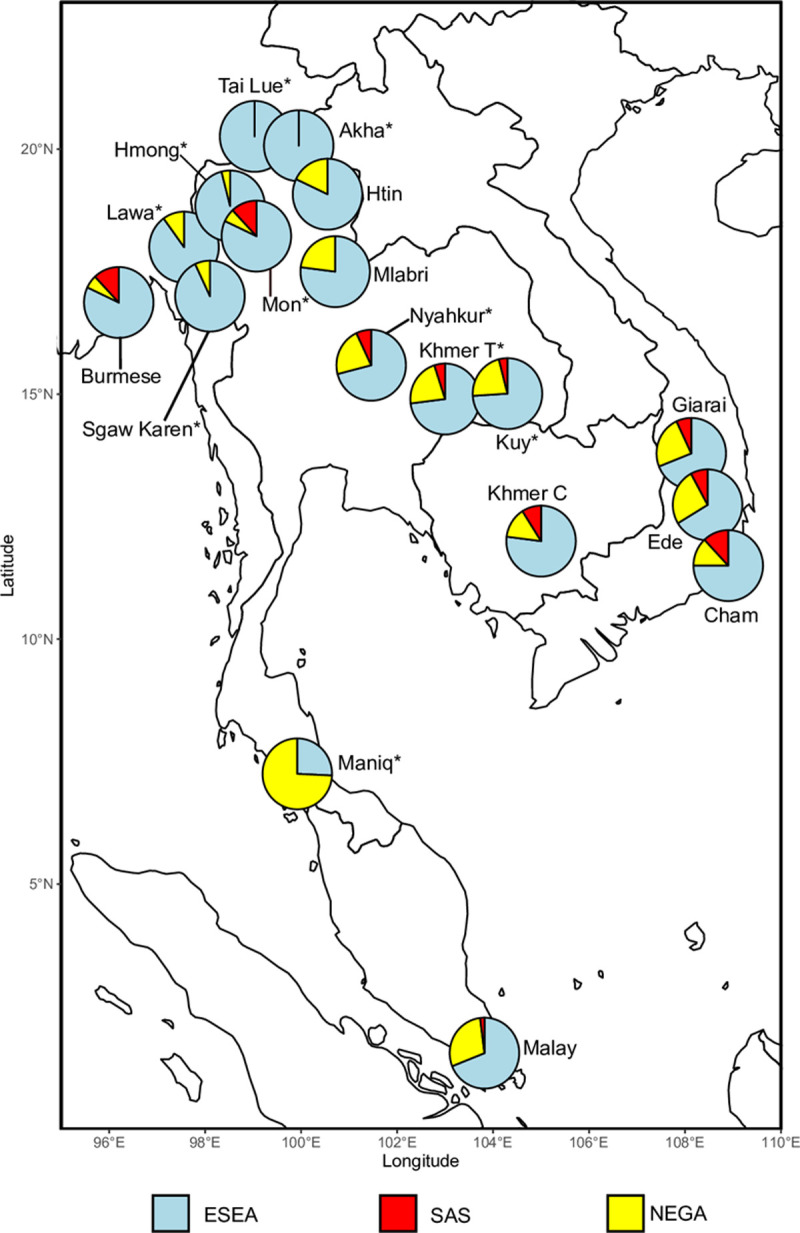
The great ethnolinguistic diversity found today in mainland Southeast Asia (MSEA) reflects multiple migration waves of people in the past. Maritime trading between MSEA and India was established at the latest 300 BCE, and the formation of early states in Southeast Asia during the first millennium CE was strongly influenced by Indian culture, a cultural influence that is still prominent today. Several ancient Indian-influenced states were located in present-day Thailand, and various populations in the country are likely to be descendants of people from those states. To systematically explore Indian genetic heritage in MSEA populations, we generated genome-wide SNP data (using the Affymetrix Human Origins array) for 119 present-day individuals belonging to 10 ethnic groups from Thailand and co-analyzed them with published data using PCA, ADMIXTURE, and methods relying on f-statistics and on autosomal haplotypes. We found low levels of South Asian admixture in various MSEA populations for whom there is evidence of historical connections with the ancient Indian-influenced states but failed to find this genetic component in present-day hunter-gatherer groups and relatively isolated groups from the highlands of Northern Thailand. The results suggest that migration of Indian populations to MSEA may have been responsible for the spread of Indian culture in the region. Our results also support close genetic affinity between Kra-Dai-speaking (also known as Tai-Kadai) and Austronesian-speaking populations, which fits a linguistic hypothesis suggesting cladality of the two language families.
当今东南亚大陆(SEA)的民族语言多样性反映了过去多次的人口迁徙浪潮。SEA 和印度之间的海上贸易最晚在公元前 300 年就已建立,而东南亚早期国家在公元一千年的形成受到了印度文化的强烈影响,这种文化影响至今仍然很突出。几个受印度影响的古代国家位于今天的泰国,该国的各种人口很可能是来自这些国家的人的后裔。为了系统地探索 MSEA 人口中的印度遗传遗产,我们为来自泰国的 10 个民族的 119 个现代个体生成了全基因组 SNP 数据(使用 Affymetrix Human Origins 芯片),并与使用 PCA、ADMIXTURE 和基于 f 统计量和常染色体单倍型的方法进行了已发表数据的共同分析。我们发现,在与古代受印度影响的国家有历史联系的各种 MSEA 人群中,南亚混合程度较低,但在当今的狩猎采集者群体和来自泰国北部高地的相对孤立的群体中,没有发现这种遗传成分。研究结果表明,印度人口向 MSEA 的迁移可能导致了印度文化在该地区的传播。我们的结果还支持了说克伦语(也称为台卡语)和南岛语的人群之间密切的遗传亲和力,这符合两个语系具有亲缘关系的语言假说。