Sisay Woretaw, Andargie Yared, Molla Mulugeta
Department of Pharmacy, College of Health Sciences, Debre Tabor University, Debre Tabor, Ethiopia.
J Exp Pharmacol. 2022 Feb 9;14:59-72. doi: 10.2147/JEP.S343735. eCollection 2022.
Despite modern therapeutic armamentaria, DM remains a 21st-century public health menace. Novel phytomedicines are a rapidly expanding focus of research. The juice of roots has long been used for the treatment of diabetes mellitus in traditional Ethiopian medicine, but its efficacy has not been supported by in vitro or in vivo scientific study. To investigate this, the present work was performed.
In this experimental study, simple random sampling was applied. Healthy male mice were used in normoglycemic and oral glucose-tolerance test (OGTT) models. Streptozotocin (IP, 150 mg/kg)-administered diabetic male mice were utilized. Animals were randomly divided into five groups of six each. Group I received 10 mL/kg distilled water, groups II-IV received 100 (DB100), 200 (DB200), and 400 (DB400) mg/kg crude extract, respectively, and group V received glibenclamide 5 mg/kg. A sham group (group VI) was added that received 10 mL/kg distilled water. All treatments were given orally. FBG, serum-lipid profiles, and body-weight changes were then measured. In vitro α-amylase inhibitory activity was also evaluated.
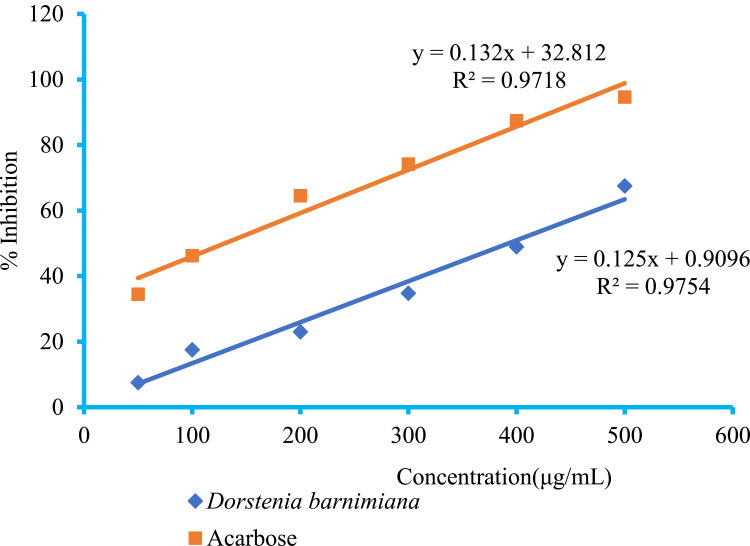
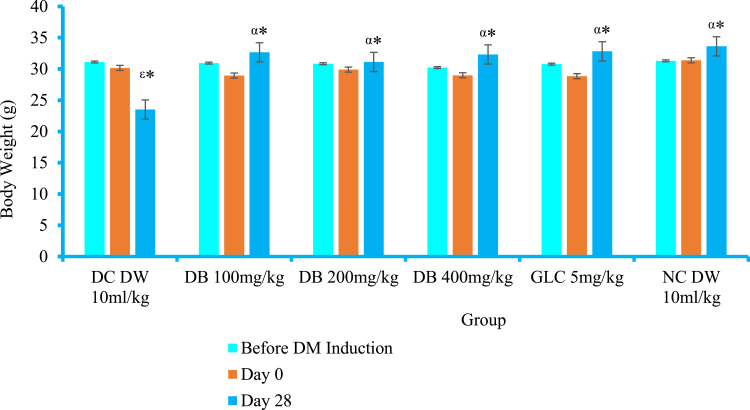
The doses were atoxic up to 2,000 mg/kg. There was α-amylase inhibition activity of 67.52% at 500 μg/mL with an IC of 4.595 μg/mL. The OGTT revealed an antihyperglycemic effect of the crude extract. This was not attributed to a hypoglycemic side effect. In the diabetic mouse model, it shrank FBG levels remarkably. There were also significant reductions in serum TC, TGs, VLDL-C, and LDL-C. Nevertheless, HDL-C and body-weight levels returned.
The present study confirmed the safety and promising in vivo antidiabetic and antidyslipidemic activity of , thus corroborating the traditional claim.
尽管有现代治疗手段,糖尿病仍然是21世纪的公共卫生威胁。新型植物药是一个迅速扩大的研究重点。在传统埃塞俄比亚医学中,根汁长期用于治疗糖尿病,但其疗效尚未得到体外或体内科学研究的支持。为对此进行研究,开展了本项工作。
在本实验研究中,采用简单随机抽样。健康雄性小鼠用于正常血糖和口服葡萄糖耐量试验(OGTT)模型。使用链脲佐菌素(腹腔注射,150 mg/kg)诱导的糖尿病雄性小鼠。动物被随机分为五组,每组六只。第一组接受10 mL/kg蒸馏水,第二至四组分别接受100(DB100)、200(DB200)和400(DB400)mg/kg粗提物,第五组接受5 mg/kg格列本脲。添加了一个假手术组(第六组),接受10 mL/kg蒸馏水。所有处理均经口给予。然后测量空腹血糖(FBG)、血脂谱和体重变化。还评估了体外α-淀粉酶抑制活性。
剂量高达2000 mg/kg时无毒。在500 μg/mL时α-淀粉酶抑制活性为67.52%,半数抑制浓度(IC)为4.595 μg/mL。OGTT显示粗提物具有抗高血糖作用。这并非归因于低血糖副作用。在糖尿病小鼠模型中,它显著降低了FBG水平。血清总胆固醇(TC)、甘油三酯(TGs)、极低密度脂蛋白胆固醇(VLDL-C)和低密度脂蛋白胆固醇(LDL-C)也有显著降低。然而,高密度脂蛋白胆固醇(HDL-C)和体重水平恢复。
本研究证实了[提取物名称未给出]的安全性及其在体内有前景的抗糖尿病和抗血脂异常活性,从而证实了传统说法。