Li Xin, Chen Le-Mei, Kumar Gajendra, Zhang Shan-Jin, Zhong Quan-Hai, Zhang Hong-Yan, Gui Guan, Wu Lv-Le, Fan Hui-Zhen, Sheng Jian-Wen
Department of Gastroenterology, The People's Hospital of Zhangshu City, Jiangxi, China.
Department of Pharmacy, Guangdong Provincial People's Hospital Ganzhou Hospital, Ganzhou Municipal Hospital, Jiangxi, China.
Front Neurosci. 2022 Feb 2;16:820106. doi: 10.3389/fnins.2022.820106. eCollection 2022.
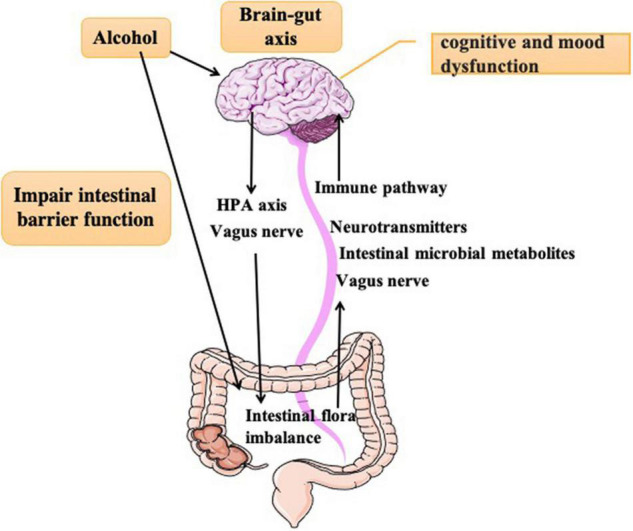
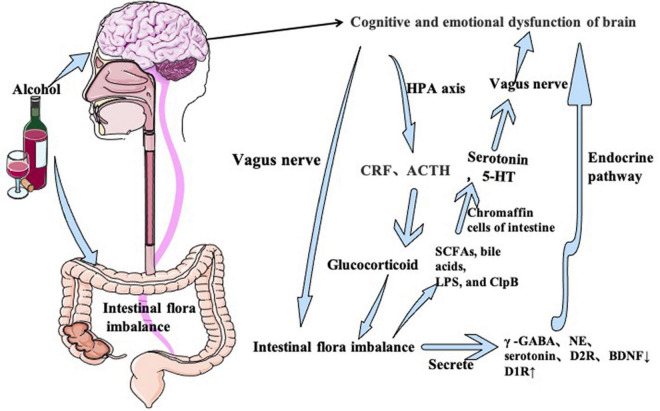
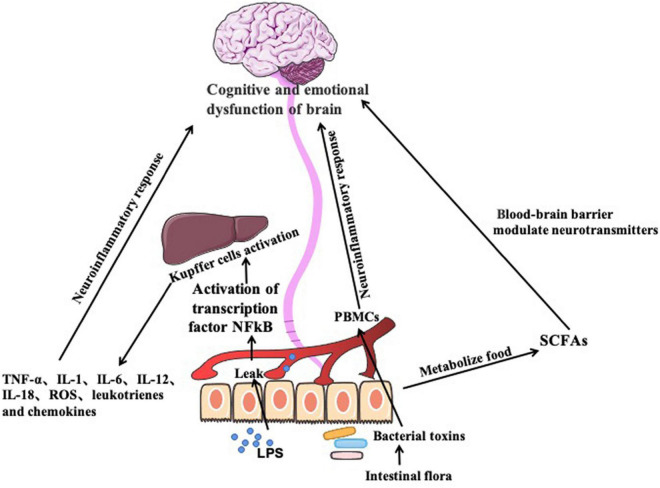
Alcohol use disorders (AUD) is characterized by persistent or intermittent alcohol cravings and compulsive drinking. The functional changes in the central nervous system (CNS) after alcohol consumption are alcohol-associated cognitive impairment and mood disorders, which are major health issues reported in AUDs. Studies have shown that transferring the intestinal microbiota from AUDs patients to germ-free animals causes learning and memory dysfunction, depression and anxiety-like behavior, indicating the vital role of intestinal microbiota in development of neuropsychiatric disorders in AUD. Intestinal flora composition of AUD patients are significantly different from normal people, suggesting that intestinal flora imbalance orchestrate the development of neuropsychiatric disorders in AUD. Studies suggests that gut microbiome links bidirectional signaling network of the enteric nervous system (ENS) to central nervous system (CNS), forming gut-microbe-brain axis (brain-gut axis). In this review, we discussed pathogenesis and possible treatment of AUD-induced cognitive deficits, anxiety, and depression disorders. Further, we described the mechanism of intestinal flora imbalance and dysfunction of hippocampus-amygdala-frontal cortex (gut-limbic circuit system dysfunction). Therefore, we postulate therapeutic interventions of gut-brain axis as novel strategies for treatment of AUD-induced neuropsychiatric disorders.
酒精使用障碍(AUD)的特征是持续或间歇性的酒精渴望和强迫性饮酒。饮酒后中枢神经系统(CNS)的功能变化是与酒精相关的认知障碍和情绪障碍,这是AUD中报告的主要健康问题。研究表明,将AUD患者的肠道微生物群转移到无菌动物身上会导致学习和记忆功能障碍、抑郁和焦虑样行为,表明肠道微生物群在AUD神经精神障碍发展中起着至关重要的作用。AUD患者的肠道菌群组成与正常人有显著差异,这表明肠道菌群失衡在AUD神经精神障碍的发展中起作用。研究表明,肠道微生物群将肠神经系统(ENS)的双向信号网络与中枢神经系统(CNS)联系起来,形成肠-微生物-脑轴(脑-肠轴)。在这篇综述中,我们讨论了AUD引起的认知缺陷、焦虑和抑郁障碍的发病机制及可能的治疗方法。此外,我们描述了肠道菌群失衡和海马-杏仁核-前额叶皮质功能障碍(肠-边缘回路系统功能障碍)的机制。因此,我们提出将肠-脑轴的治疗干预作为治疗AUD引起的神经精神障碍的新策略。