Vidgen Miranda E, Fowles Lindsay F, Istiko Satrio Nindyo, Evans Erin, Cutler Katrina, Sullivan Kate, Bean Jessica, Healy Louise, Hondow Gary, McInerney-Leo Aideen M, Pratt Gregory, Robins Deborah, Best Stephanie, Finlay Keri, Ramarao-Milne Priya, Waddell Nicola
QIMR Berghofer Medical Research Institute, Brisbane, QLD, Australia.
Genetic Health Queensland, Royal Brisbane and Women's Hospital, Brisbane, QLD, Australia.
Front Genet. 2022 Feb 3;12:771892. doi: 10.3389/fgene.2021.771892. eCollection 2021.
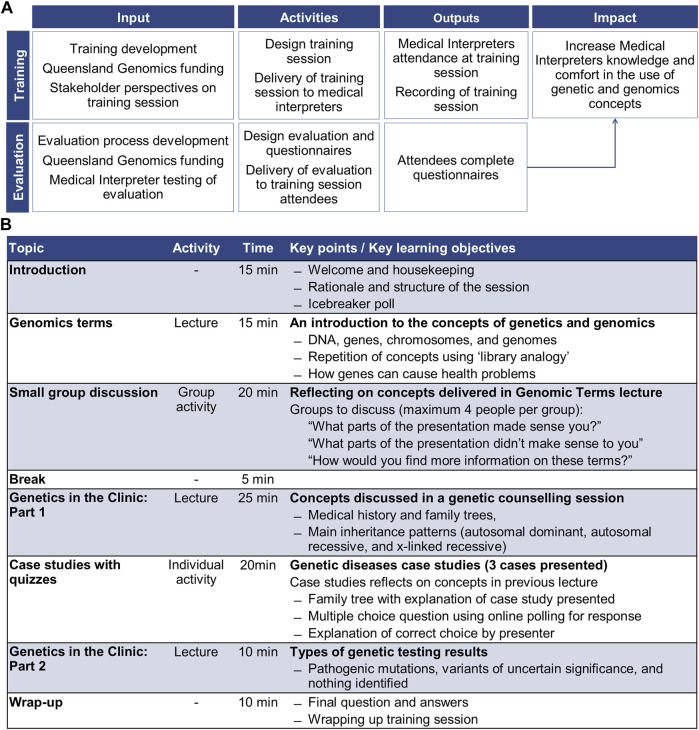
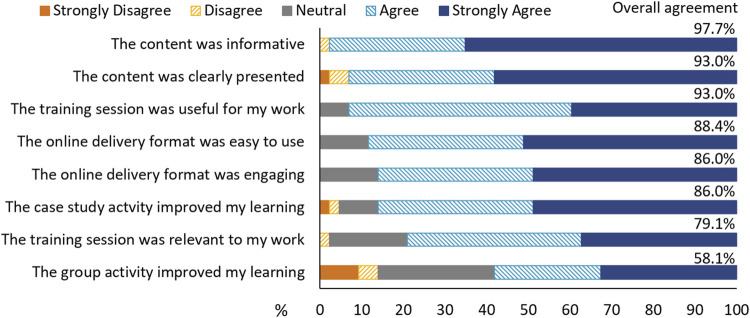
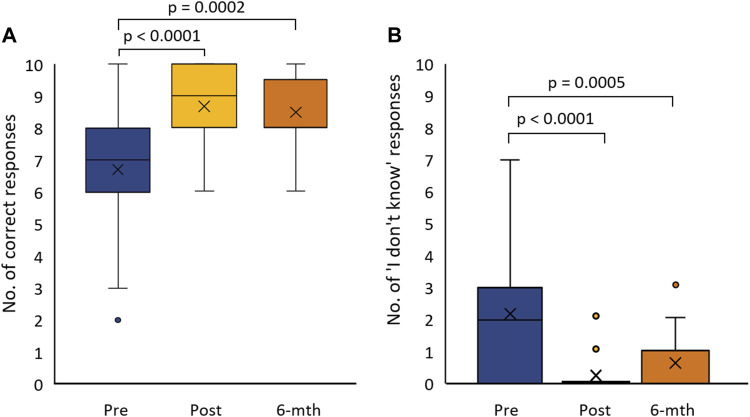
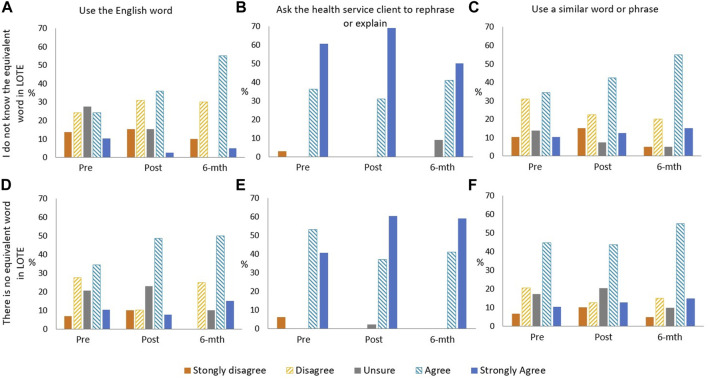
Health Interpreters enable effective communication between health practitioners and patients with limited knowledge of the predominant language. This study developed and evaluated a training session introducing Health Interpreters to genetics. The online training was delivered multiple times as a single 2-h session comprising lectures and activities. Participants completed questionnaires (pre-, post-, and 6-months follow-up) to assess the impact of training on knowledge, attitude, self-efficacy, and self-reported practice behaviour. Questionnaires were analysed using descriptive statistics, Fisher's Exact, or independent -test. In total, 118 interpreters participated in the training sessions. Respondent knowledge improved, with gains maintained at 6-months ( < 0.01). There were no changes in self-efficacy, and attitudes. Training did not change self-reported practice behaviour, but there was notable pre-existing variability in participants' methods of managing unknown genetic words. Most respondents agreed that training was useful (93%) and relevant (79%) to their work. More respondents reported learning more from the case study activity (86%) than the group activity (58%). Health Interpreters found the training acceptable and demonstrated sustained improvement in knowledge of genetic concepts. Increased delivery of this training and associated research is needed to assess findings in a larger cohort and to measure the impact on patients.
健康口译员能够促进医疗从业者与主要语言知识有限的患者之间的有效沟通。本研究开发并评估了一个向健康口译员介绍遗传学的培训课程。该在线培训作为一个包含讲座和活动的2小时单场课程多次进行。参与者完成了问卷(培训前、培训后和6个月随访),以评估培训对知识、态度、自我效能感和自我报告的实践行为的影响。问卷采用描述性统计、Fisher精确检验或独立样本t检验进行分析。共有118名口译员参加了培训课程。受访者的知识有所提高,6个月时仍保持增长(P<0.01)。自我效能感和态度没有变化。培训没有改变自我报告的实践行为,但参与者处理未知遗传学术语的方法在之前就存在显著差异。大多数受访者认为培训对他们的工作有用(93%)且相关(79%)。更多受访者表示从案例研究活动中学到的比小组活动中学到的更多(86%对58%)。健康口译员认为该培训可以接受,并在遗传概念知识方面表现出持续的进步。需要增加此类培训的开展及相关研究,以在更大的队列中评估结果,并衡量对患者的影响。