Department of Child and Adolescent Psychiatry, Psychosomatics and Psychotherapy, University Hospital of Psychiatry and Psychotherapy, Osianderstr. 14-16, 72076, Tübingen, Germany.
PFH - Private University of Applied Sciences, Department of Psychology (Clinical Psychology II), Göttingen, Germany.
Trials. 2022 Feb 21;23(1):164. doi: 10.1186/s13063-022-06062-w.
Obsessive-compulsive disorder (OCD) in children can lead to a huge burden on the concerned patients and their family members. While successful state-of-the art cognitive behavioral interventions exist, there is still a lack of available experts for treatment at home, where most symptoms manifest. Internet-based cognitive behavioral therapy (iCBT) could overcome these restrictions; however, studies about iCBT in children with OCD are rare and mostly target computerized self-help resources and only email contact with the therapist. Therefore, we intended to build up and to evaluate an iCBT approach for children with OCD, replacing successful elements of traditional in-office face-to-face CBT, with face-to-face teleconferences, online materials, and apps.
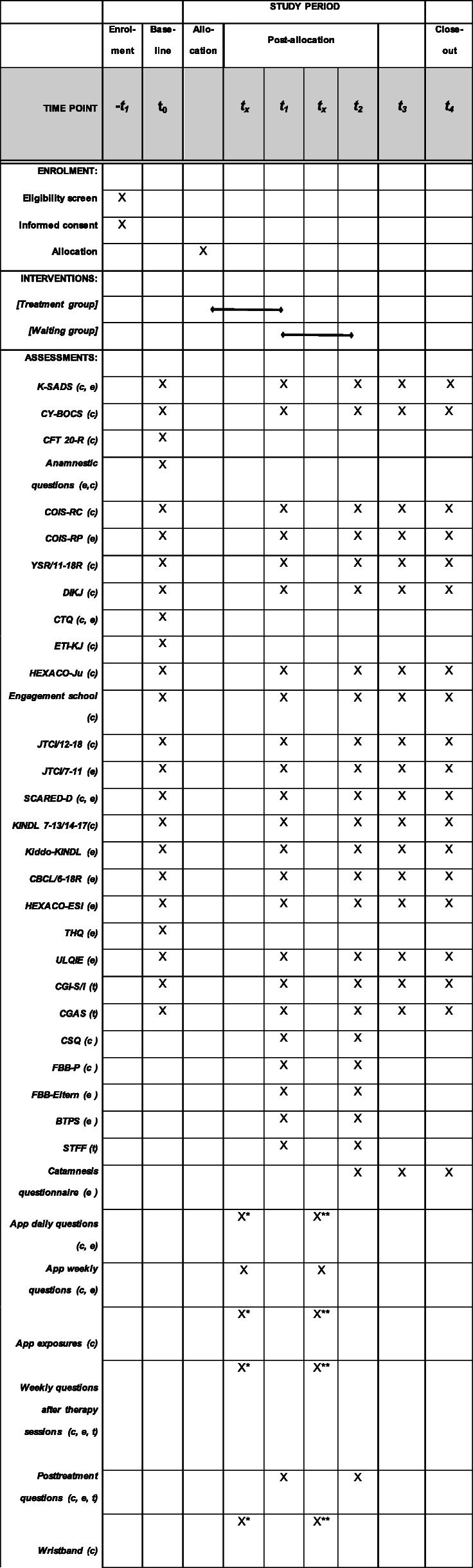
With the help of a pilot feasibility study, we developed the iCBT consisting of 14 teleconference sessions with the child and parents. The sessions are supported by an app assessing daily and weekly symptoms and treatment course completed by children and parents. Additionally, we obtain heart rate and activity scores from the child via wristbands during several days and exposure sessions. Using a waiting list randomized control trial design, we aim to treat and analyze 20 children with OCD immediately after a diagnostic session whereas the control group of another set of 20 OCD patients will be treated after waiting period of 16 weeks. We will recruit 30 patients in each group to take account for potential dropouts. Outcomes for the treatment group are evaluated before randomization (baseline, t0), 16 weeks (end of treatment, t1), 32 weeks (follow-up 1, t2), and 48 weeks after randomization (follow-up 2, t3). For the waiting list group, outcomes are measured before the first randomization (baseline), at 16 weeks (waiting list period), 32 weeks (end of treatment), 48 weeks after the first randomization (follow-up I), and 64 weeks after the first randomization (follow-up II).
Based on our experience of feasibility during the pilot study, we were able to develop the iCBT approach and the current study will investigate treatment effectiveness. Building up an iCBT approach, resembling traditional in-office face-to-face therapy, may ensure the achievement of well-known therapy effect factors, the acceptance in both patients and clinicians, and the wide distribution within the health system.
ClinicalTrials.gov NCT05037344 . Registered May 2019, last release August 13th, 2021.
儿童强迫症(OCD)会给患者及其家属带来巨大负担。虽然现有的认知行为干预技术已经非常先进,但在大多数症状表现的家庭治疗中,仍然缺乏专业治疗师。基于互联网的认知行为疗法(iCBT)可以克服这些限制;然而,针对儿童 OCD 的 iCBT 研究很少,且大多针对计算机化自助资源,仅通过电子邮件与治疗师联系。因此,我们旨在建立并评估一种针对儿童 OCD 的 iCBT 方法,用面对面远程会议、在线材料和应用程序替代传统面对面 CBT 中的成功元素。
在试点可行性研究的帮助下,我们开发了包含 14 次与儿童及其父母进行的远程会议的 iCBT。该课程由一个应用程序支持,该应用程序评估儿童和父母完成的日常和每周症状和治疗过程。此外,我们还通过腕带在几天和暴露疗程中获取儿童的心率和活动分数。我们采用等待名单随机对照试验设计,旨在在诊断会议后立即治疗和分析 20 名 OCD 儿童,而另一组 20 名 OCD 患者的对照组将在 16 周的等待期后进行治疗。我们将在每个组中招募 30 名患者,以考虑潜在的脱落者。治疗组的结果在随机分组前(基线,t0)、16 周(治疗结束,t1)、32 周(随访 1,t2)和随机分组后 48 周(随访 2,t3)进行评估。对于等待名单组,结果在第一次随机分组前(基线)、16 周(等待名单期)、32 周(治疗结束)、第一次随机分组后 48 周(随访 I)和第一次随机分组后 64 周(随访 II)进行测量。
基于试点研究中的可行性经验,我们能够开发出 iCBT 方法,而目前的研究将调查治疗效果。建立类似于传统面对面治疗的 iCBT 方法,可能会确保实现众所周知的治疗效果因素、患者和临床医生的接受程度以及在卫生系统内的广泛分布。
ClinicalTrials.gov NCT05037344。于 2019 年 5 月注册,最后一次发布于 2021 年 8 月 13 日。