Laboratory of Bio-Physio Sensors and Nanobioengineering, School of Biochemical Engineering, Indian Institute of Technology (BHU) Varanasi, Varanasi 221005, Uttar Pradesh, India.
Biosensors (Basel). 2022 Jan 29;12(2):81. doi: 10.3390/bios12020081.
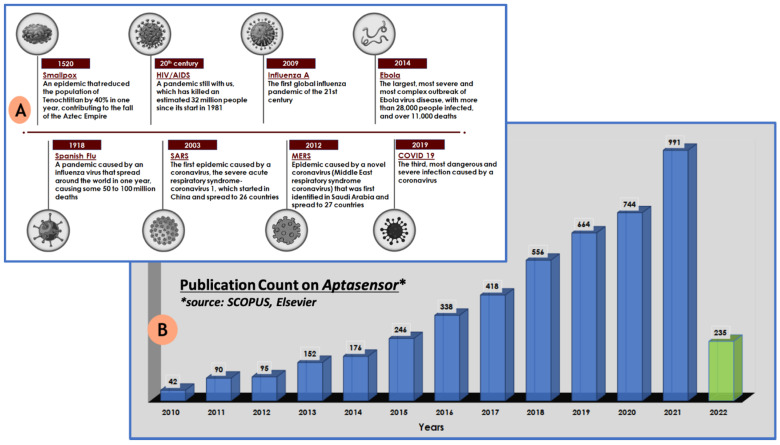
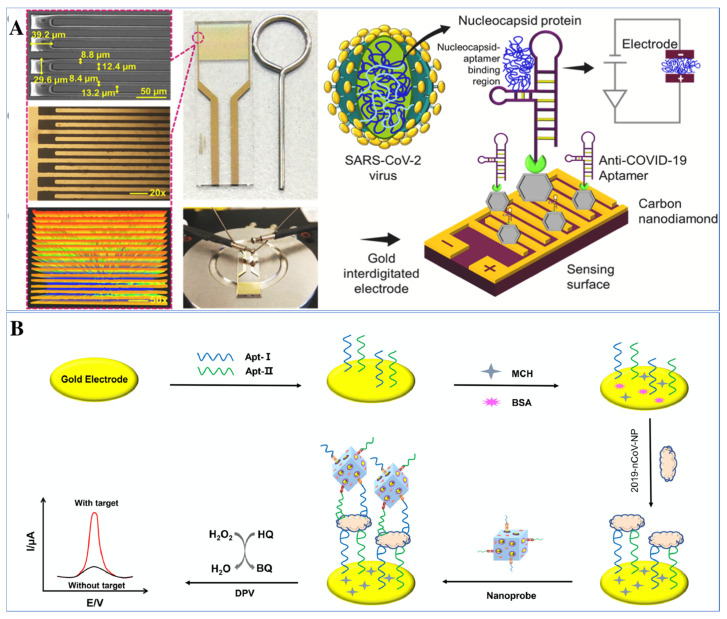
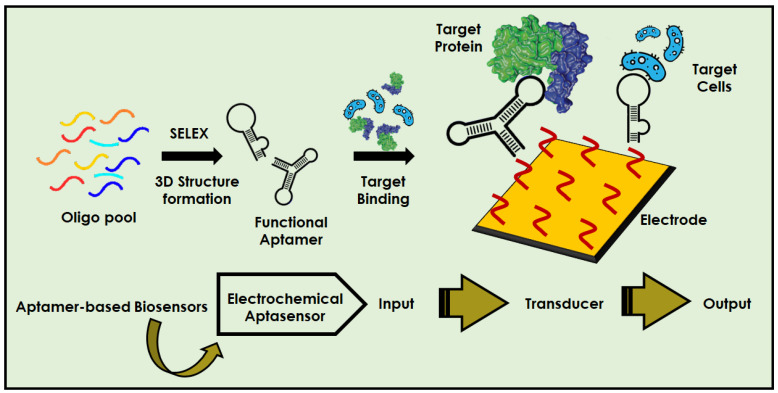
Viral infections are becoming the foremost driver of morbidity, mortality and economic loss all around the world. Treatment for diseases associated to some deadly viruses are challenging tasks, due to lack of infrastructure, finance and availability of rapid, accurate and easy-to-use detection methods or devices. The emergence of biosensors has proven to be a success in the field of diagnosis to overcome the challenges associated with traditional methods. Furthermore, the incorporation of aptamers as bio-recognition elements in the design of biosensors has paved a way towards rapid, cost-effective, and specific detection devices which are insensitive to changes in the environment. In the last decade, aptamers have emerged to be suitable and efficient biorecognition elements for the detection of different kinds of analytes, such as metal ions, small and macro molecules, and even cells. The signal generation in the detection process depends on different parameters; one such parameter is whether the labelled molecule is incorporated or not for monitoring the sensing process. Based on the labelling, biosensors are classified as label or label-free; both have their significant advantages and disadvantages. Here, we have primarily reviewed the advantages for using aptamers in the transduction system of sensing devices. Furthermore, the labelled and label-free opto-electrochemical aptasensors for the detection of various kinds of viruses have been discussed. Moreover, numerous globally developed aptasensors for the sensing of different types of viruses have been illustrated and explained in tabulated form.
病毒感染正在成为全世界发病率、死亡率和经济损失的首要驱动因素。由于缺乏基础设施、资金以及快速、准确和易于使用的检测方法或设备,一些与致命病毒相关疾病的治疗成为了具有挑战性的任务。生物传感器的出现已经证明在诊断领域取得了成功,可以克服传统方法所面临的挑战。此外,将适体作为生物识别元件纳入生物传感器的设计中,为开发快速、经济高效且对环境变化不敏感的特定检测设备铺平了道路。在过去的十年中,适体已成为检测各种分析物(如金属离子、小分子和大分子,甚至细胞)的合适且有效的生物识别元件。检测过程中的信号产生取决于不同的参数;其中一个参数是是否包含标记分子,以监测传感过程。根据标记,生物传感器可分为标记或无标记;两者都有其显著的优点和缺点。在这里,我们主要回顾了在传感设备的转导系统中使用适体的优势。此外,还讨论了用于检测各种病毒的标记和无标记光电化学适体传感器。此外,还以表格形式说明了和解释了许多全球开发的用于检测不同类型病毒的适体传感器。