Instituto de Química de São Carlos, Universidade de São Paulo, São Carlos, SP, 13566-590, Brazil; Instituto Nacional de Ciência e Tecnologia de Bioanalítica-INCTBio, Campinas, SP, 13083-970, Brazil.
Departamento de Química, Universidade Federal de Santa Catarina, Florianópolis, SC, 88040-900, Brazil.
Anal Chim Acta. 2021 May 15;1159:338384. doi: 10.1016/j.aca.2021.338384. Epub 2021 Mar 12.
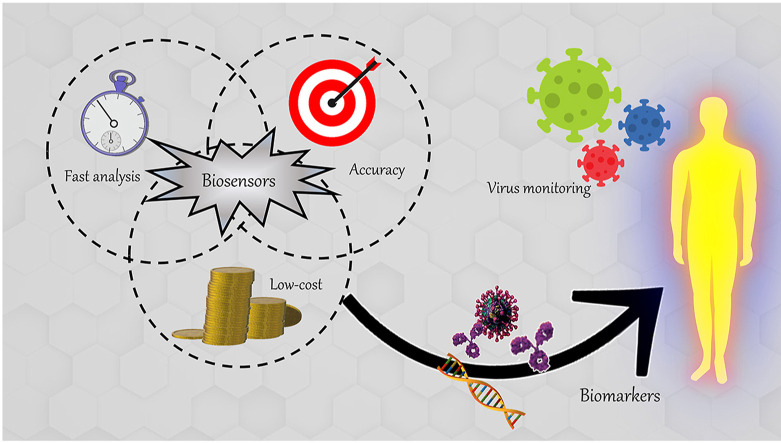
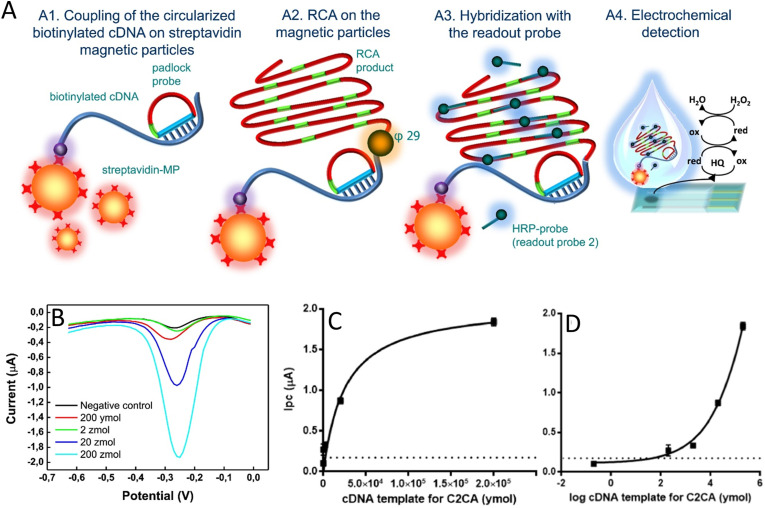
Viruses are the causing agents for many relevant diseases, including influenza, Ebola, HIV/AIDS, and COVID-19. Its rapid replication and high transmissibility can lead to serious consequences not only to the individual but also to collective health, causing deep economic impacts. In this scenario, diagnosis tools are of significant importance, allowing the rapid, precise, and low-cost testing of a substantial number of individuals. Currently, PCR-based techniques are the gold standard for the diagnosis of viral diseases. Although these allow the diagnosis of different illnesses with high precision, they still present significant drawbacks. Their main disadvantages include long periods for obtaining results and the need for specialized professionals and equipment, requiring the tests to be performed in research centers. In this scenario, biosensors have been presented as promising alternatives for the rapid, precise, low-cost, and on-site diagnosis of viral diseases. This critical review article describes the advancements achieved in the last five years regarding electrochemical biosensors for the diagnosis of viral infections. First, genosensors and aptasensors for the detection of virus and the diagnosis of viral diseases are presented in detail regarding probe immobilization approaches, detection methods (label-free and sandwich), and amplification strategies. Following, immunosensors are highlighted, including many different construction strategies such as label-free, sandwich, competitive, and lateral-flow assays. Then, biosensors for the detection of viral-diseases-related biomarkers are presented and discussed, as well as point of care systems and their advantages when compared to traditional techniques. Last, the difficulties of commercializing electrochemical devices are critically discussed in conjunction with future trends such as lab-on-a-chip and flexible sensors.
病毒是许多相关疾病的致病因子,包括流感、埃博拉、艾滋病毒/艾滋病和 COVID-19。它的快速复制和高传染性不仅会对个人,还会对集体健康造成严重后果,导致严重的经济影响。在这种情况下,诊断工具非常重要,可以快速、准确、低成本地检测大量个体。目前,基于 PCR 的技术是病毒病诊断的金标准。虽然这些技术可以高度精确地诊断不同的疾病,但它们仍然存在明显的缺点。它们的主要缺点包括获得结果的时间长,以及需要专业的专业人员和设备,要求在研究中心进行测试。在这种情况下,生物传感器已被提出作为快速、精确、低成本和现场诊断病毒病的有前途的替代方法。本文综述了过去五年中用于诊断病毒感染的电化学生物传感器的最新进展。首先,详细介绍了用于检测病毒和诊断病毒病的基因传感器和适体传感器,包括探针固定方法、检测方法(无标记和夹心)和扩增策略。其次,重点介绍了免疫传感器,包括无标记、夹心、竞争和侧向流动测定等许多不同的构建策略。然后,介绍和讨论了用于检测与病毒病相关生物标志物的生物传感器,以及即时检测系统及其与传统技术相比的优势。最后,与未来趋势(如芯片实验室和柔性传感器)一起,批判性地讨论了电化学器件商业化的困难。