Gomes Fausto Gueths, Andrade André Cronemberger, Wolf Martin, Hochmann Sarah, Krisch Linda, Maeding Nicole, Regl Christof, Poupardin Rodolphe, Ebner-Peking Patricia, Huber Christian G, Meisner-Kober Nicole, Schallmoser Katharina, Strunk Dirk
Cell Therapy Institute, Spinal Cord Injury and Tissue Regeneration Center Salzburg (SCI-TReCS), Paracelsus Medical University (PMU), 5020 Salzburg, Austria.
Department of Transfusion Medicine and SCI-TReCS, Paracelsus Medical University (PMU), 5020 Salzburg, Austria.
Biomedicines. 2022 Jan 23;10(2):238. doi: 10.3390/biomedicines10020238.
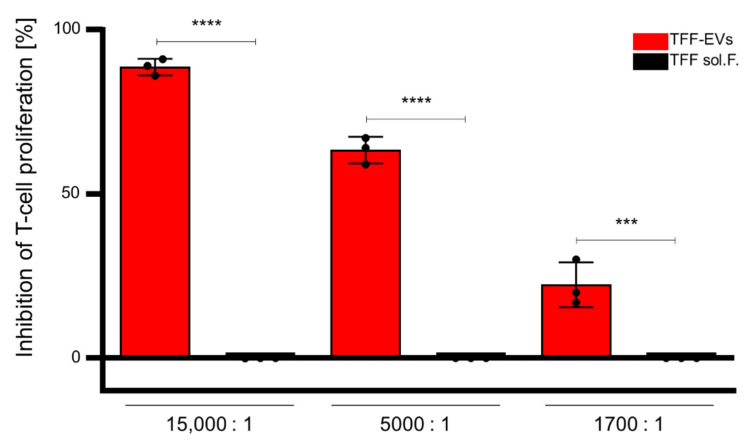
Platelet-rich plasma is a promising regenerative therapeutic with controversial efficacy. We and others have previously demonstrated regenerative functions of human platelet lysate (HPL) as an alternative platelet-derived product. Here we separated extracellular vesicles (EVs) from soluble factors of HPL to understand the mode of action during skin-organoid formation and immune modulation as model systems for tissue regeneration. HPL-EVs were isolated by tangential-flow filtration (TFF) and further purified by size-exclusion chromatography (SEC) separating EVs from (lipo)protein-enriched soluble fractions. We characterized samples by tunable resistive pulse sensing, western blot, tandem mass-tag proteomics and super-resolution microscopy. We evaluated EV function during angiogenesis, wound healing, organoid formation and immune modulation. We characterized EV enrichment by TFF and SEC according to MISEV2018 guidelines. Proteomics showed three major clusters of protein composition separating TSEC-EVs from HPL clustering with TFF soluble fractions and TFF-EVs clustering with TSEC soluble fractions, respectively. HPL-derived TFF-EVs promoted skin-organoid formation and inhibited T-cell proliferation more efficiently than TSEC-EVs or TSEC-soluble fractions. Recombining TSEC-EVs with TSEC soluble fractions re-capitulated TFF-EV effects. Zeta potential and super-resolution imaging further evidenced protein corona formation on TFF-EVs. Corona depletion on SEC-EVs could be artificially reconstituted by TSEC late fraction add-back. In contrast to synthetic nanoparticles, which commonly experience reduced function after corona formation, the corona-bearing EVs displayed improved functionality. We conclude that permissive isolation technology, such as TFF, and better understanding of the mechanism of EV corona function are required to realize the complete potential of platelet-based regenerative therapies.
富血小板血浆是一种有前景的再生疗法,但其疗效存在争议。我们和其他研究团队之前已证明人血小板裂解物(HPL)作为一种替代性血小板衍生产品具有再生功能。在此,我们从HPL的可溶性因子中分离出细胞外囊泡(EVs),以了解其在皮肤类器官形成和免疫调节过程中的作用模式,将其作为组织再生的模型系统。通过切向流过滤(TFF)分离出HPL-EVs,并通过尺寸排阻色谱(SEC)进一步纯化,将EVs与富含(脂)蛋白的可溶性组分分离。我们通过可调电阻脉冲传感、蛋白质印迹、串联质量标签蛋白质组学和超分辨率显微镜对样品进行了表征。我们评估了EVs在血管生成、伤口愈合、类器官形成和免疫调节过程中的功能。我们根据MISEV2018指南对TFF和SEC富集的EVs进行了表征。蛋白质组学显示,蛋白质组成主要有三个簇,分别将TSEC-EVs与HPL聚类,其中TSEC-EVs与TFF可溶性组分聚类,TFF-EVs与TSEC可溶性组分聚类。与TSEC-EVs或TSEC可溶性组分相比,HPL衍生的TFF-EVs更有效地促进皮肤类器官形成并抑制T细胞增殖。将TSEC-EVs与TSEC可溶性组分重新组合可重现TFF-EV的效果。zeta电位和超分辨率成像进一步证明了TFF-EVs上形成了蛋白质冠。通过添加TSEC晚期组分可人工重建SEC-EVs上的冠缺失。与合成纳米颗粒不同,合成纳米颗粒通常在形成冠后功能会降低,而带有冠的EVs显示出更好的功能。我们得出结论,要实现基于血小板的再生疗法的全部潜力,需要采用如TFF这样的允许性分离技术,并更好地理解EV冠功能的机制。