Yue Jianying, Wei Yao, Zhao Mingmin
College of Horticulture and Plant Protection, Inner Mongolia Agricultural University, Hohhot 010018, China.
Biology (Basel). 2022 Feb 9;11(2):271. doi: 10.3390/biology11020271.
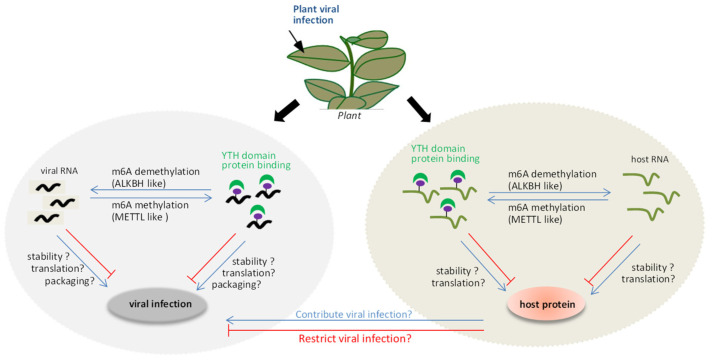
In recent years, m6A RNA methylation has attracted broad interest and is becoming a hot research topic. It has been demonstrated that there is a strong association between m6A and viral infection in the human system. The life cycles of plant RNA viruses are often coordinated with the mechanisms of their RNA modification. Here, we reviewed recent advances in m6A methylation in plant viruses. It appears that m6A methylation plays a dual role during viral infection in plants. On the one hand, m6A methylation acts as an antiviral immune response induced by virus infection, which inhibits viral replication or translation through the methylation of viral genome RNAs. On the other hand, plant viruses could disrupt the m6A methylation through interacting with the key proteins of the m6A pathway to avoid modification. Those plant viruses containing ALKB domain are discussed as well. Based on this mechanism, we propose that new strategies for plant virus control could be designed with competitive antagonists of m6A-associated proteins.
近年来,m6A RNA甲基化引起了广泛关注,正成为一个热门研究课题。已有研究表明,m6A与人体系统中的病毒感染之间存在密切关联。植物RNA病毒的生命周期通常与其RNA修饰机制相互协调。在此,我们综述了植物病毒中m6A甲基化的最新进展。似乎m6A甲基化在植物病毒感染过程中发挥着双重作用。一方面,m6A甲基化作为病毒感染诱导的抗病毒免疫反应,通过病毒基因组RNA的甲基化抑制病毒复制或翻译。另一方面,植物病毒可通过与m6A途径的关键蛋白相互作用来破坏m6A甲基化,从而避免被修饰。我们还讨论了含有ALKB结构域的植物病毒。基于这一机制,我们提出可以设计与m6A相关蛋白的竞争性拮抗剂来制定新的植物病毒控制策略。