Laboratory of Hygiene and Environmental Virology, Department of Biology, University of Pisa, Via S. Zeno 35/39, 56127 Pisa, Italy.
Department of Biomedical Science and Human Oncology, University of Bari Aldo Moro, Piazza G. Cesare 11, 70124 Bari, Italy.
Int J Environ Res Public Health. 2022 Feb 10;19(4):1960. doi: 10.3390/ijerph19041960.
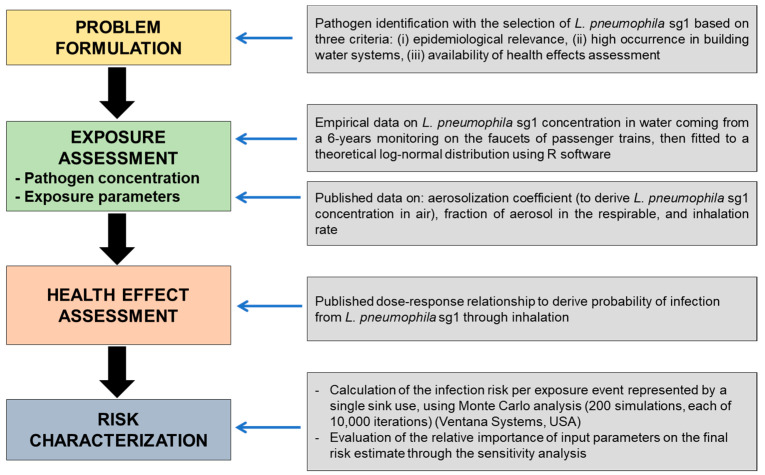
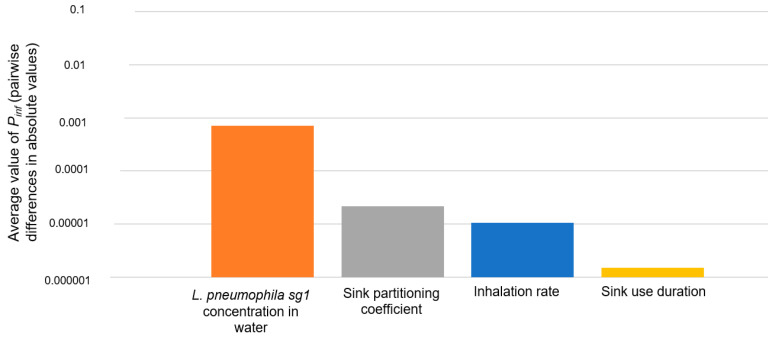
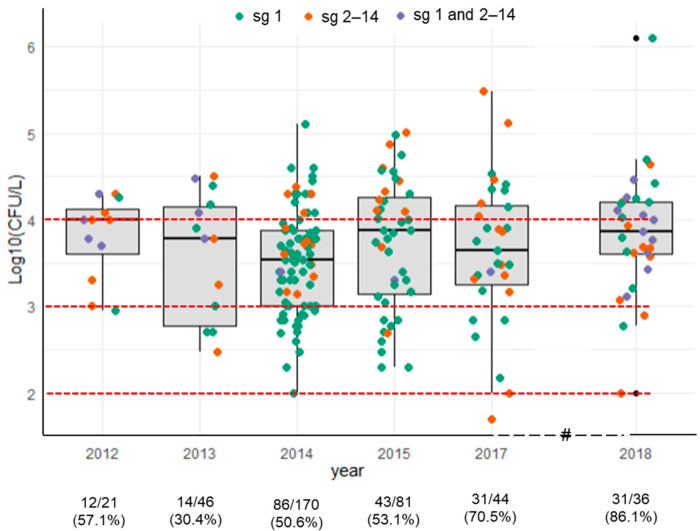
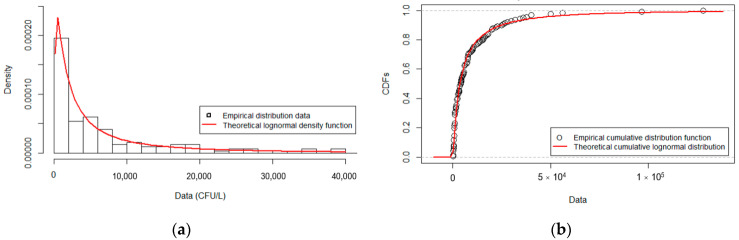
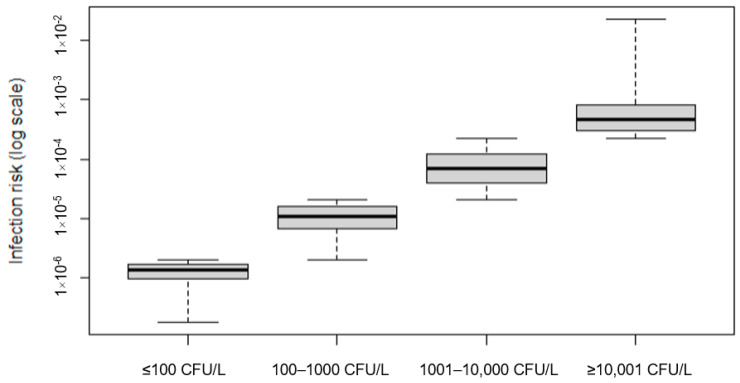
The quantitative microbial risk assessment (QMRA) framework is used for assessing health risk coming from pathogens in the environment. In this paper, we used QMRA to evaluate the infection risk of attributable to sink usage in a toilet cabin on Italian long-distance public transportation (LDT). LDT has water distribution systems with risk points for proliferation, as well as premise plumbing for drinking water, but they are not considered for risk assessment. Monitoring data revealed that approximately 55% of water samples (217/398) were positive for , and the most frequently isolated was sg1 (64%, 139/217); therefore, such data were fitted to the best probability distribution function to be used as a stochastic variable in the QMRA model. Then, a sink-specific aerosolization ratio was applied to calculate the inhaled dose, also considering inhalation rate and exposure time, which were used as stochastic parameters based on literature data. At sg1 concentration ≤100 CFU/L, health risk was approximately 1 infection per 1 million exposures, with an increase of up to 5 infections per 10,000 exposures when the concentrations were ≥10,000 CFU/L. Our QMRA results showed a low infection risk from faucets on LDT; however, it deserves consideration since LDT can be used by people highly susceptible for the development of a severe form of the disease, owing to their immunological status or other predisposing factors. Further investigations could also evaluate -laden aerosols from toilet flushing.
定量微生物风险评估 (QMRA) 框架用于评估环境中病原体带来的健康风险。在本文中,我们使用 QMRA 评估了意大利长途公共交通工具 (LDT) 厕所隔间中水槽使用导致的感染风险。LDT 具有易发生 增殖的风险点,以及用于饮用水的前提管道,但它们未被纳入风险评估范围。监测数据显示,约有 55%的水样(217/398)呈 阳性,最常分离出的是 sg1(64%,139/217);因此,这些数据被拟合到最佳概率分布函数中,作为 QMRA 模型中的随机变量。然后,应用特定于水槽的气溶胶化比来计算吸入剂量,同时考虑吸入率和暴露时间,这些参数基于文献数据被用作随机参数。当 sg1 浓度≤100CFU/L 时,每 100 万次暴露的健康风险约为 1 次感染,而当浓度≥10000CFU/L 时,每次暴露感染风险增加高达 5 次。我们的 QMRA 结果显示,LDT 上的水龙头导致 感染的风险较低;然而,由于其免疫状态或其他易患因素,LDT 可能被易患严重疾病的人群使用,因此值得考虑。进一步的调查还可以评估来自厕所冲水的带 气溶胶。