Hossain Ahmed, Nasrullah Sarker Mohammad, Tasnim Zarrin, Hasan Md Kamrul, Hasan Md Maruf
Department of Public Health, North South University, Dhaka, Bangladesh.
Global Health Institute, North South University, Dhaka, Bangladesh.
EClinicalMedicine. 2021 Mar;33:100770. doi: 10.1016/j.eclinm.2021.100770. Epub 2021 Mar 8.
Knowing the seroprevalence of SARS-CoV-2 IgG antibodies across geographic regions before vaccine administration is one key piece of knowledge to achieve herd immunity. While people of all ages, occupations, and communities are at risk of getting infected with SARS-CoV-2, the health care workers (HCWs) are possibly at the highest risk. Most seroprevalence surveys with HCWs conducted worldwide have been limited to Europe, North America, and East Asia. We aimed to understand how the seroprevalence of SARS-CoV-2 IgG antibodies varied across these geographic regions among HCWs based on the available evidences.
By searching through PubMed, ScienceDirect, and Google Scholar databases, eligible studies published from January 1, 2020 to January 15, 2021 were included for the systematic review and meta-analysis. The random-effects model was used to estimate the pooled proportion of IgG seropositive HCWs. Publication bias was assessed by funnel plot and confirmed by Egger's test. Heterogeneity was quantified using I statistics. We performed sensitivity analyses based on sample size, diagnostic method and publication status. The study protocol was registered with PROSPERO (CRD42020219086).
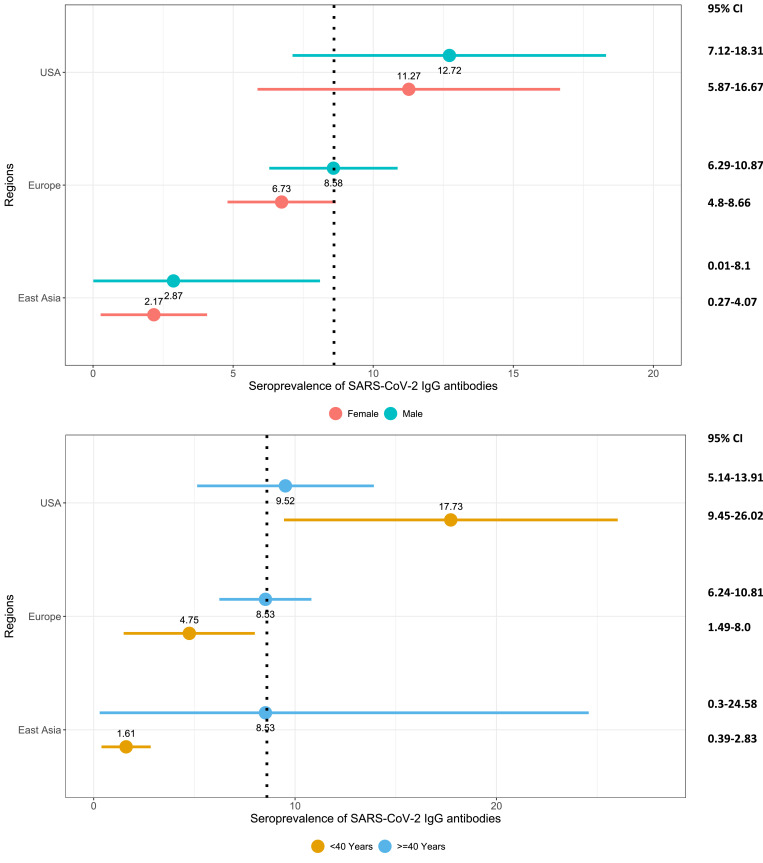
A total of 53 peer-reviewed articles were selected, including 173,353 HCWs (32.7% male) from the United States, ten European, and three East Asian countries. The overall seropositive prevalence rate of IgG antibodies was 8.6% in these regions (95% CI= 7.2-9.9%). Pooled seroprevalence of IgG antibodies was higher in studies conducted in the USA (12.4%, 95% CI= 7.8-17%) than in Europe (7.7%, 95% CI=6.3-9.2%) and East Asia (4.8%, 95% CI=2.9-6.7%). The subgroup study also estimated that male HCWs had 9.4% (95% CI= 7.2-11.6%) IgG seroconversion, and female HCWs had 7.8% (95% CI=5.9-9.7%). The study exhibits a high prevalence of IgG antibodies among HCWs under 40 years in the USA, conversely, it was high in older HCWs (≥40 years of age) in Europe and East Asia. In the months February-April 2020, the estimated pooled seroprevalence was 5.7% (4.0-7.4%) that increased to 8·2% (6.2-10%) in April-May and further to 9.9% (6.9-12.9%) in the May-September time-period.
In the view of all evidence to date, a significant variation in the prevalence of SARS-CoV-2 antibodies in HCWs is observed in regions of Europe, the United States, and East Asia. The patterns of IgG antibodies by time, age, and gender suggest noticeable regional differences in transmission of the virus. Based on the insights driven from the analysis, priority is required for effective vaccination for older HCWs from Europe and East Asia. A considerable high seroprevalence of IgG among HCWs from the USA suggests a high rate of past infection that indicates the need to take adequate measures to prevent hospital spread. Moreover, the seroprevalence trend was not substantially changed after May 2020, suggesting a slow progression of long-term SARS-CoV-2 immunity. Routine testing of HCWs for SARS-CoV-2 should be considered even after the rollout of vaccination to identify the areas of increased transmission.
None.

在疫苗接种之前了解不同地理区域严重急性呼吸综合征冠状病毒2(SARS-CoV-2)IgG抗体的血清流行率是实现群体免疫的关键信息之一。虽然所有年龄、职业和社区的人都有感染SARS-CoV-2的风险,但医护人员(HCWs)可能风险最高。全球范围内针对医护人员开展的大多数血清流行率调查都局限于欧洲、北美和东亚。我们旨在根据现有证据了解不同地理区域的医护人员中SARS-CoV-2 IgG抗体的血清流行率如何变化。
通过检索PubMed、ScienceDirect和谷歌学术数据库,纳入2020年1月1日至2021年1月15日发表的符合条件的研究进行系统评价和荟萃分析。采用随机效应模型估计IgG血清阳性医护人员的合并比例。通过漏斗图评估发表偏倚,并通过Egger检验进行确认。使用I统计量对异质性进行量化。我们基于样本量、诊断方法和发表状态进行了敏感性分析。该研究方案已在国际前瞻性系统评价注册库(PROSPERO,注册号:CRD42020219086)注册。
共筛选出53篇经同行评审的文章,包括来自美国、10个欧洲国家和3个东亚国家的173,353名医护人员(32.7%为男性)。这些地区IgG抗体的总体血清阳性率为8.6%(95%置信区间=7.2-9.9%)。在美国开展的研究中,IgG抗体的合并血清流行率(12.4%,95%置信区间=7.8-17%)高于欧洲(7.7%,95%置信区间=6.3-9.2%)和东亚(4.8%,95%置信区间=2.9-6.7%)。亚组研究还估计,男性医护人员的IgG血清转化率为9.4%(95%置信区间=7.2-11.6%),女性医护人员为7.8%(95%置信区间=5.9-9.7%)。该研究显示,美国40岁以下医护人员中IgG抗体流行率较高,相反,欧洲和东亚40岁及以上的年长医护人员中IgG抗体流行率较高。在2020年2月至4月期间,估计的合并血清流行率为5.7%(4.0-7.4%),4月至5月升至8.2%(6.2-10%),在5月至9月期间进一步升至9.9%(6.9-12.9%)。
根据迄今为止的所有证据,在欧洲、美国和东亚地区观察到医护人员中SARS-CoV-2抗体流行率存在显著差异。IgG抗体随时间、年龄和性别的变化模式表明病毒传播存在明显的区域差异。基于分析得出的见解,欧洲和东亚的年长医护人员需要优先进行有效的疫苗接种。美国医护人员中IgG抗体的血清流行率相当高,表明过去感染率很高,这表明需要采取适当措施防止医院内传播。此外,2020年5月之后血清流行率趋势没有实质性变化,表明长期的SARS-CoV-2免疫力进展缓慢。即使在疫苗接种推出后,也应考虑对医护人员进行SARS-CoV-2的常规检测,以确定传播增加的区域。
无。