University Institute of Physical Therapy, Faculty of Allied Health Sciences, University of Lahore, Lahore 42000, Pakistan.
Riphah College of Rehabilitation and Allied Health Sciences, Riphah International University, Faisalabad 38000, Pakistan.
Int J Environ Res Public Health. 2022 Feb 18;19(4):2346. doi: 10.3390/ijerph19042346.
The most common assessment tool used in clinical settings to detect changes in balance performance is the Berg Balance Scale (BBS). Thus, the purpose of this study was to translate the BBS into Urdu and investigate the psychometric properties (acceptability, internal consistency reliability, interrater reliability, construct validity) for individuals with Parkinson's disease (PD).
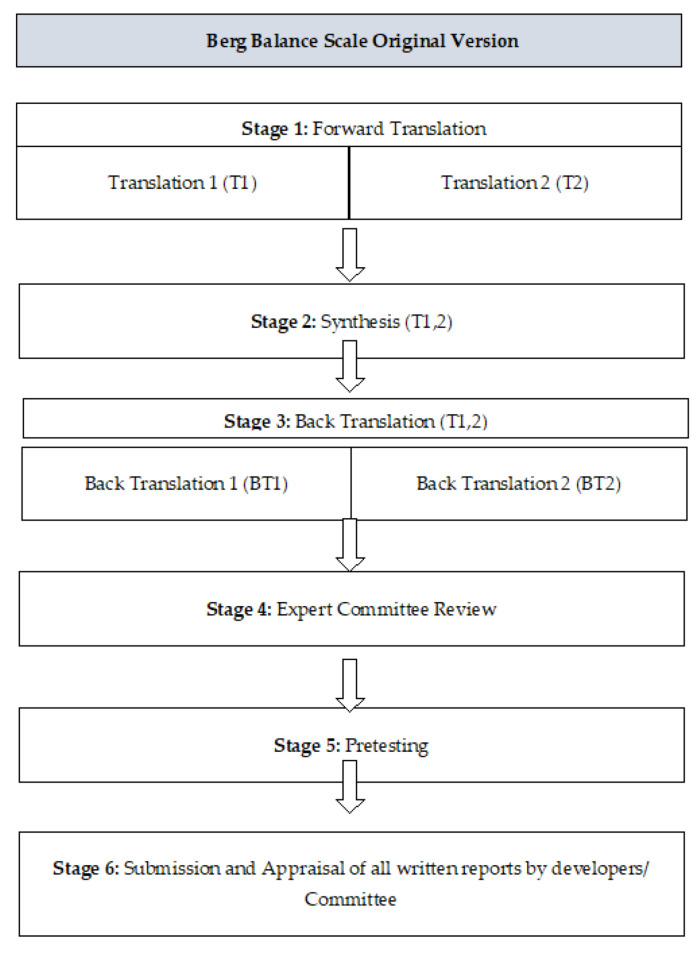
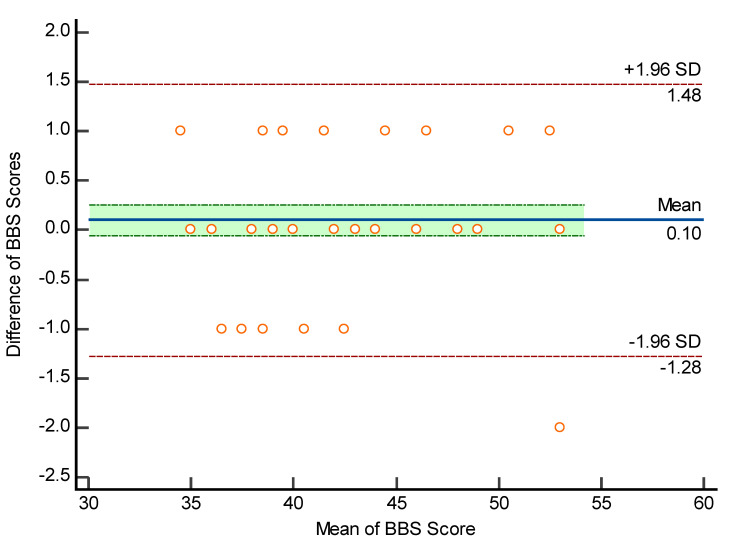
Eighty patients of either gender with idiopathic Parkinson's disease, stages I-III on the modified Hoehn-Yahr (H&Y) scale, with intact cognition according to the Mini Mental Score Examination (MMSE) score (greater than or equal to 24) and independent of transfers, were included in this study. The BBS was translated according to international guidelines based on forward and backward translation processes. The test-retest reliability as well as intra- and inter-observer reliability was assessed by calculating the intra-class correlation coefficient (ICC). The internal consistency of the entire BBS score was assessed by calculating Cronbach's α. The convergent validity was assessed by correlating the scale with the Unified Parkinson Disease Rating Scale (UPDRS) parts II and III and the Activity-specific Balance Confidence Scale (ABCS). The construct validity was assessed using a factor analysis.
The mean age of the subjects was 62.35 ± 5.74 in years (range: 60-87 years). The ICC for intra- and inter-observer reliability was 0.95 ( < 0.0001) and 0.99 ( < 0.001), respectively. Cronbach's α was calculated as 0.81, which showed acceptable internal consistency of the Urdu version of the BBS. The test-retest reliability (ICC) of the Urdu version of the BBS was determined as 0.97 for the total score, and ranged from 0.66-0.95 for individual items. In terms of validity, the Urdu version of the BBS was correlated with the ABCS (in the positive direction) and UPDRS-II and III (in the negative direction) (r = 0.53, < 0.001; r = -0.68, < 0.001, r = -0.78, < 0.0001), respectively.
The Urdu version of the BBS is a reliable and valid scale to be used in balance assessment of population diagnosed with PD with excellent psychometric properties.
临床中最常用于检测平衡表现变化的评估工具是 Berg 平衡量表(BBS)。因此,本研究的目的是将 BBS 翻译成乌尔都语,并研究其在帕金森病(PD)患者中的心理测量学特性(可接受性、内部一致性信度、评分者间信度、结构效度)。
本研究纳入了 80 名男女患者,均为特发性帕金森病,改良 Hoehn-Yahr(H&Y)量表 I-III 期,根据 Mini Mental 评分检查(MMSE)评分(≥24 分)认知完整,且独立于转移,无需辅助。根据正向和反向翻译过程,按照国际指南对 BBS 进行翻译。通过计算组内相关系数(ICC)评估重测信度以及评分者内和评分者间信度。通过计算 Cronbach's α 评估整个 BBS 评分的内部一致性。通过与统一帕金森病评定量表(UPDRS)第二部分和第三部分以及活动特异性平衡信心量表(ABCS)进行相关性评估,评估其聚合效度。通过因子分析评估其结构效度。
受试者的平均年龄为 62.35±5.74 岁(范围:60-87 岁)。评分者内和评分者间信度的 ICC 分别为 0.95(<0.0001)和 0.99(<0.001)。Cronbach's α 计算值为 0.81,表明乌尔都语版本 BBS 具有可接受的内部一致性。乌尔都语版本 BBS 的重测信度(ICC)总分为 0.97,各个条目分别为 0.66-0.95。就有效性而言,乌尔都语版本 BBS 与 ABCS(呈正相关)和 UPDRS-II 和 III(呈负相关)呈正相关(r=0.53,<0.001;r=-0.68,<0.001,r=-0.78,<0.0001)。
乌尔都语版本的 BBS 是一种可靠且有效的量表,可用于诊断为 PD 的人群的平衡评估,具有极好的心理测量学特性。