Pell Gaby S, Harmelech Tal, Zibman Sam, Roth Yiftach, Tendler Aron, Zangen Abraham
BrainsWay Ltd., Jerusalem 9777518, Israel.
Department of Life Sciences, Ben-Gurion University of the Negev, Be'er-Sheva 8410501, Israel.
J Clin Med. 2022 Feb 15;11(4):1015. doi: 10.3390/jcm11041015.
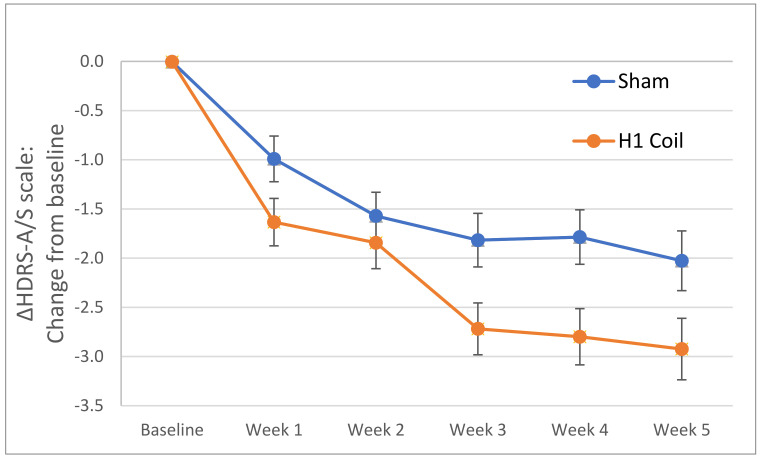
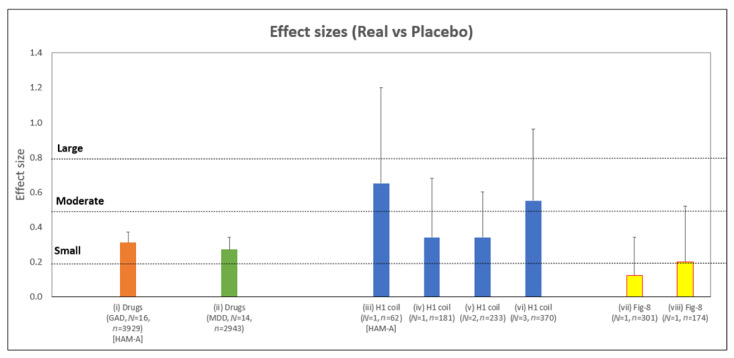
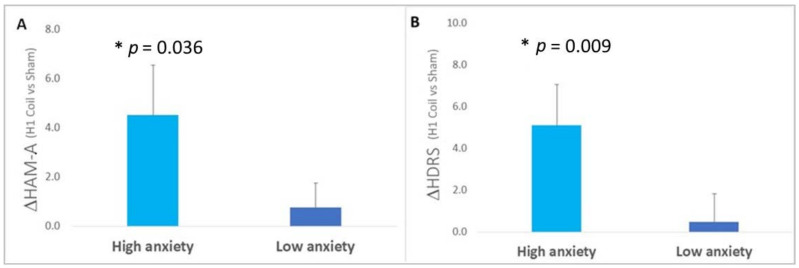
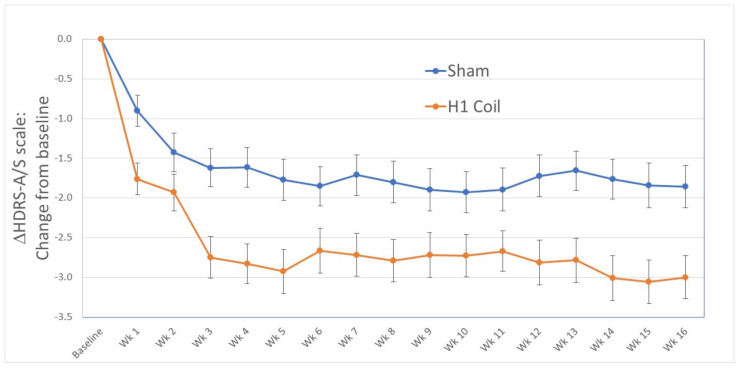
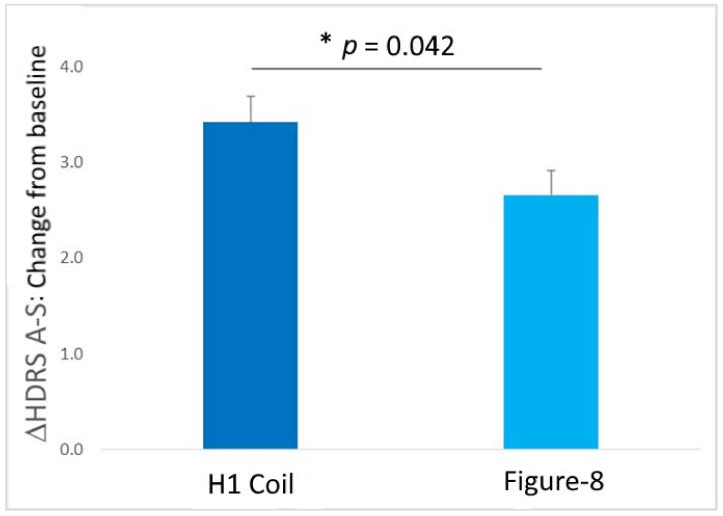
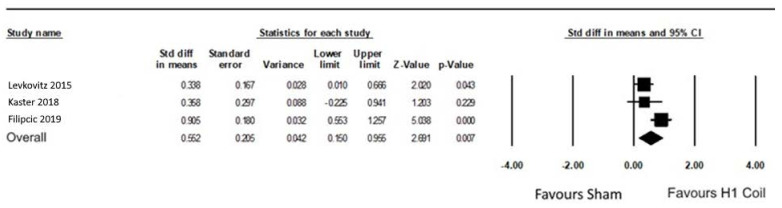
(1) Background: While the therapeutic efficacy of Transcranial Magnetic Stimulation (TMS) for major depressive disorder (MDD) is well established, less is known about the technique's efficacy for treating comorbid anxiety. (2) Methods: Data were retrospectively analyzed from randomized controlled trials (RCTs) that used Deep TMS with the H1 Coil for MDD treatment. The primary endpoint was the difference relative to sham treatment following 4 weeks of stimulation. The effect size was compared to literature values for superficial TMS and medication treatments. (3) Results: In the pivotal RCT, active Deep TMS compared with sham treatment showed significantly larger improvements in anxiety score (effect size = 0.34, = 0.03 (FDR)) which were sustained until 16 weeks (effect size = 0.35, = 0.04). The pooled effect size between all the RCTs was 0.55, which compares favorably to alternative treatments. A direct comparison to Figure-8 Coil treatment indicated that treatment with the H1 Coil was significantly more effective ( = 0.042). In contrast to previously reported studies using superficial TMS and medication for which anxiety has been shown to be a negative predictor of effectiveness, higher baseline anxiety was found to be predictive of successful outcome for the H1-Coil treatment. (4) Conclusions: Deep TMS is effective in treating comorbid anxiety in MDD and, unlike alternative treatments, the outcome does not appear to be adversely affected by high baseline anxiety levels.
(1) 背景:虽然经颅磁刺激(TMS)治疗重度抑郁症(MDD)的疗效已得到充分证实,但对于该技术治疗共病焦虑症的疗效了解较少。(2) 方法:对使用H1线圈进行深度TMS治疗MDD的随机对照试验(RCT)数据进行回顾性分析。主要终点是刺激4周后相对于假治疗的差异。将效应量与浅表TMS和药物治疗的文献值进行比较。(3) 结果:在关键的RCT中,与假治疗相比,主动深度TMS在焦虑评分方面显示出显著更大的改善(效应量 = 0.34,P = 0.03(FDR)),这种改善一直持续到16周(效应量 = 0.35,P = 0.04)。所有RCT之间的合并效应量为0.55,与其他治疗方法相比具有优势。与8字形线圈治疗的直接比较表明,使用H1线圈治疗显著更有效(P = 0.042)。与先前报道的使用浅表TMS和药物治疗的研究不同,在那些研究中焦虑被证明是疗效的负预测因子,而在本研究中发现较高的基线焦虑是H1线圈治疗成功结果的预测因子。(4) 结论:深度TMS对治疗MDD共病焦虑有效,并且与其他治疗方法不同,高基线焦虑水平似乎不会对治疗结果产生不利影响。