Sarma Devojit Kumar, Kumar Manoj, Dhurve Jigyasa, Pal Namrata, Sharma Poonam, James Meenu Mariya, Das Deepanker, Mishra Sweta, Shubham Swasti, Kumawat Manoj, Verma Vinod, Tiwari Rajnarayan R, Nagpal Ravinder, Marotta Francesco
ICMR-National Institute for Research in Environmental Health, Bhopal Bypass Road, Bhouri, Bhopal 462030, Madhya Pradesh, India.
Stem Cell Research Centre, Department of Hematology, Sanjay Gandhi Post-Graduate Institute of Medical Sciences, Lucknow 226014, Uttar Pradesh, India.
Microorganisms. 2022 Feb 1;10(2):332. doi: 10.3390/microorganisms10020332.
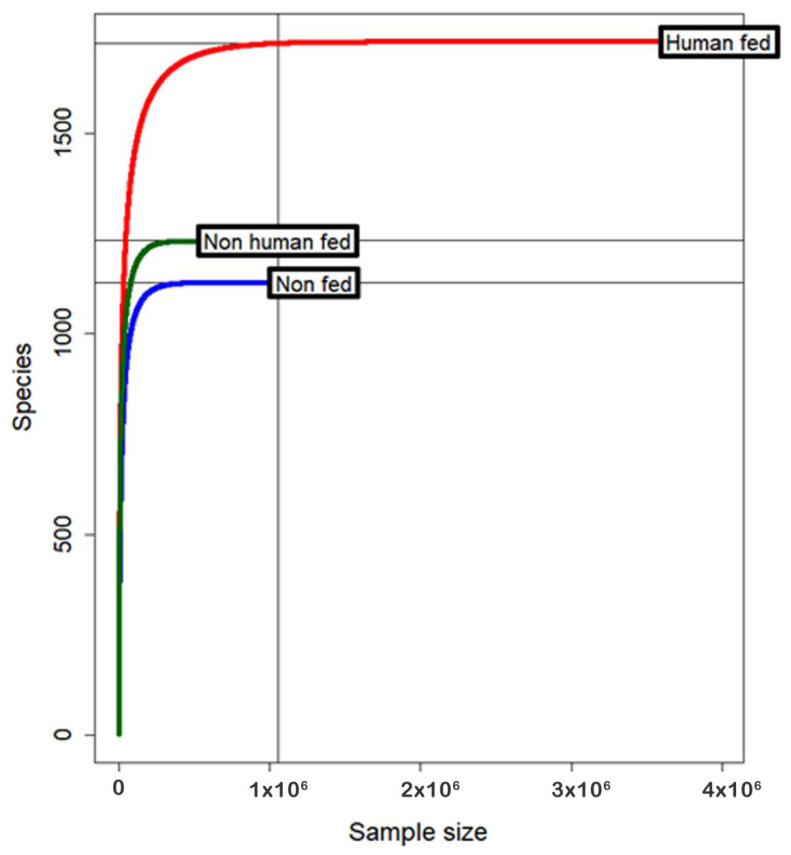
Blood feeding is an important behavior of , a dominant arboviral disease vector, as it can establish and transmit viruses to humans. Bacteria associated with the mosquito gut can modulate the biological characteristics and behavior of disease vectors. In this study, we characterized the gut microbiota composition of human-blood-fed (HF), non-human-blood-fed (NHF) and non-fed (NF) field-collected mosquitoes, using a 16S metagenomic approach, to assess any association of bacterial taxa with the blood-feeding behavior of A significant difference in the microbiota composition between the HF and NF mosquito group was observed. A significant association was observed in the relative abundance of families and in the HF group in contrast to NF and NHF mosquitoes, respectively. At the class level, two classes ( and ) were found to be in higher abundance in the HF mosquitoes compared to a single class of bacteria () in the NF mosquitoes. These results show that human-blood feeding may change the gut microbiota in wild populations. More research is needed to determine how changes in the midgut bacterial communities in response to human-blood-feeding affect the vectorial capacity of
吸食血液是主要虫媒病毒病传播媒介[蚊子学名]的一种重要行为,因为它能够感染并将病毒传播给人类。与蚊子肠道相关的细菌能够调节疾病传播媒介的生物学特性和行为。在本研究中,我们采用16S宏基因组学方法,对野外采集的吸食人血(HF)、非吸食人血(NHF)和未进食(NF)的[蚊子学名]肠道微生物群组成进行了表征,以评估细菌分类群与[蚊子学名]吸食血液行为之间的任何关联。观察到HF和NF蚊子组之间的微生物群组成存在显著差异。与NF和NHF蚊子相比,分别在HF组中观察到[两个科名]科的相对丰度存在显著关联。在纲水平上,发现HF蚊子中有两个纲([两个纲名])的丰度高于NF蚊子中的单一细菌纲([一个纲名])。这些结果表明,吸食人血可能会改变野生[蚊子学名]种群的肠道微生物群。需要更多的研究来确定中肠细菌群落因吸食人血而发生的变化如何影响[蚊子学名]的传播能力。