van den Brandhof Jeroen G, Wösten Han A B
Microbiology, Department of Biology, Utrecht University, Padualaan 8, 3584 CH, Utrecht, The Netherlands.
Fungal Biol Biotechnol. 2022 Feb 24;9(1):3. doi: 10.1186/s40694-022-00134-x.
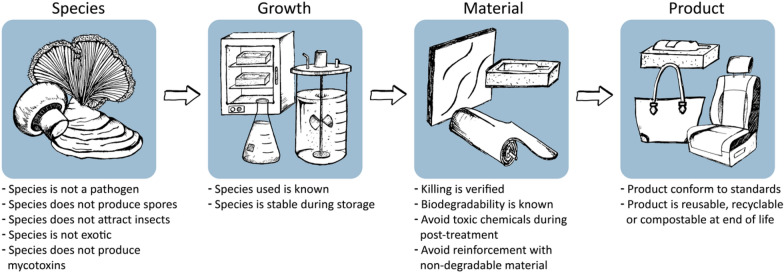
Sustainable fungal materials have a high potential to replace non-sustainable materials such as those used for packaging or as an alternative for leather and textile. The properties of fungal materials depend on the type of fungus and substrate, the growth conditions and post-treatment of the material. So far, fungal materials are mainly made with species from the phylum Basidiomycota, selected for the mechanical and physical properties they provide. However, for mycelium materials to be implemented in society on a large scale, selection of fungal species should also be based on a risk assessment of the potential to be pathogenic, form mycotoxins, attract insects, or become an invasive species. Moreover, production processes should be standardized to ensure reproducibility and safety of the product.
可持续真菌材料极有可能替代不可持续材料,如用于包装的材料,或作为皮革和纺织品的替代品。真菌材料的特性取决于真菌和底物的类型、材料的生长条件及后处理。到目前为止,真菌材料主要由担子菌门的物种制成,这些物种因其所提供的机械和物理特性而被选用。然而,要使菌丝体材料在社会中大规模应用,真菌物种的选择还应基于对其致病、形成霉菌毒素、吸引昆虫或成为入侵物种可能性的风险评估。此外,生产过程应标准化,以确保产品的可重复性和安全性。