Taylor Arlana G, Ignaszewski Andrew I, Bredin Shannon S D, Hill John S, Shellington Erin M, Warburton Darren E R
Cardiovascular Physiology and Rehabilitation Laboratory, University of British Columbia, Vancouver, BC, Canada.
Healthy Heart Program, St. Paul's Hospital, Vancouver, BC, Canada.
Front Cardiovasc Med. 2022 Feb 8;8:752531. doi: 10.3389/fcvm.2021.752531. eCollection 2021.
Inflammatory activation has been associated with the severity and progression of chronic heart failure (CHF). Although cardiac rehabilitation is an important therapy, acute bouts of exercise may lead to increases in pro-inflammatory cytokines with exercise intensity mediating these changes.
To evaluate the acute inflammatory response in patients living with CHF during a randomized trial following Steady State (SS) or High Intensity Interval (HIIT) training.
Patients living with CHF ( = 14) were stratified (for body mass and aerobic power) and randomized into SS and HIIT cycle exercise. The HIIT exercise training involved 2 min work:recovery phases at 90:40% heart rate reserve. The SS exercise training involved continuous exercise at 65% of heart rate reserve (matched total work). Acute inflammatory markers were evaluated (via ELISA) at baseline, immediately following the bout, and at 6, 24, and 48 h post-exercise.
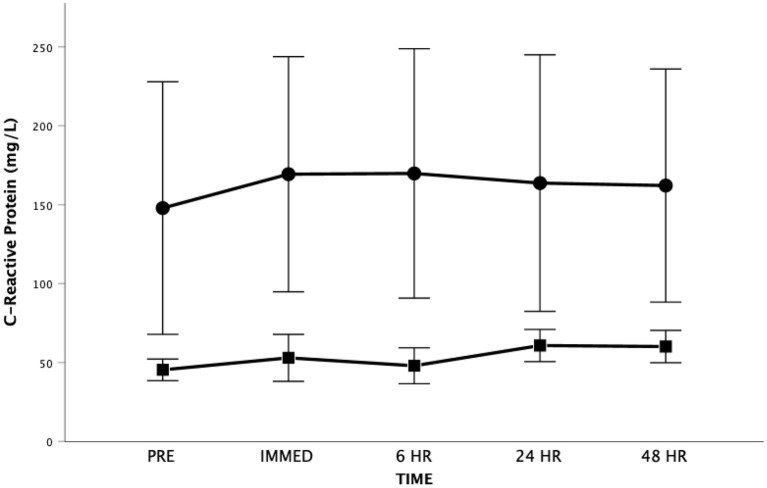
There was limited differences in the changes in inflammatory biomarkers across time between the HIIT and SS groups. Both groups experienced a significant ( < 0.05) change in Interleukin-6 immediately post-exercise.
A single bout of HIIT or SS does not result in excessive inflammatory activation in CHF patients. Acute HIIT and SS result in similar changes in inflammatory markers. These findings have important implications for exercise training and rehabilitation programs in persons living with CHF.
炎症激活与慢性心力衰竭(CHF)的严重程度和进展相关。尽管心脏康复是一项重要治疗方法,但急性运动发作可能会导致促炎细胞因子随着运动强度介导这些变化而增加。
在一项随机试验中,评估稳定状态(SS)或高强度间歇训练(HIIT)后CHF患者的急性炎症反应。
将CHF患者(n = 14)按体重和有氧能力分层,并随机分为SS组和HIIT组进行自行车运动。HIIT运动训练包括以心率储备的90:40%进行2分钟的工作:恢复阶段。SS运动训练包括以心率储备的65%进行持续运动(总工作量匹配)。在基线、运动后即刻、运动后6、24和48小时通过酶联免疫吸附测定法(ELISA)评估急性炎症标志物。
HIIT组和SS组之间炎症生物标志物随时间的变化差异有限。两组在运动后即刻白细胞介素-6均有显著(P < 0.05)变化。
单次HIIT或SS不会导致CHF患者过度的炎症激活。急性HIIT和SS导致炎症标志物的相似变化。这些发现对CHF患者的运动训练和康复计划具有重要意义。