Chan Tatjana, Grisch-Chan Hiu Man, Schmierer Philipp, Subotic Ulrike, Rimann Nicole, Scherer Tanja, Hetzel Udo, Bozza Matthias, Harbottle Richard, Williams James A, Steblaj Barbara, Ringer Simone K, Häberle Johannes, Sidler Xaver, Thöny Beat
Department of Farm Animals, Division of Swine Medicine of the Vetsuisse Faculty University of Zurich, Zurich, Switzerland.
Division of Metabolism and Children's Research Center, University Children's Hospital Zurich, Zurich, Switzerland.
Mol Ther Methods Clin Dev. 2022 Jan 19;24:268-279. doi: 10.1016/j.omtm.2022.01.006. eCollection 2022 Mar 10.
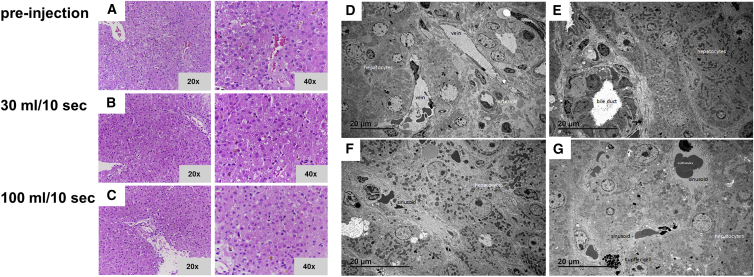
Hepatic gene therapy by delivering non-integrating therapeutic vectors in newborns remains challenging due to the risk of dilution and loss of efficacy in the growing liver. Previously we reported on hepatocyte transfection in piglets by intraportal injection of naked DNA vectors. Here, we established delivery of naked DNA vectors to target periportal hepatocytes in weaned pigs by hydrodynamic retrograde intrabiliary injection (HRII). The surgical procedure involved laparotomy and transient isolation of the liver. For vector delivery, a catheter was placed within the common bile duct by enterotomy. Under optimal conditions, no histological abnormalities were observed in liver tissue upon pressurized injections. The transfection of hepatocytes in all tested liver samples was observed with vectors expressing luciferase from a liver-specific promoter. However, vector copy number and luciferase expression were low compared to hydrodynamic intraportal injection. A 10-fold higher number of vector genomes and luciferase expression was observed in pigs using a non-integrating naked DNA vector with the potential for replication. In summary, the HRII application was less efficient (i.e., lower luciferase activity and vector copy numbers) than the intraportal delivery method but was significantly less distressful for the piglets and has the potential for injection (or re-injection) of vector DNA by endoscopic retrograde cholangiopancreatography.
由于在生长中的肝脏中存在稀释风险和疗效丧失的问题,通过向新生儿递送非整合治疗载体进行肝脏基因治疗仍然具有挑战性。此前我们报道了通过门静脉内注射裸DNA载体对仔猪进行肝细胞转染。在此,我们通过流体动力逆行胆管内注射(HRII)建立了向断奶仔猪的门静脉周围肝细胞递送裸DNA载体的方法。手术过程包括剖腹术和肝脏的短暂分离。为了递送载体,通过肠切开术将导管置于胆总管内。在最佳条件下,加压注射后肝脏组织未观察到组织学异常。在所有测试的肝脏样本中,观察到来自肝脏特异性启动子的表达荧光素酶的载体对肝细胞进行了转染。然而,与流体动力门静脉内注射相比,载体拷贝数和荧光素酶表达较低。在使用具有复制潜力的非整合裸DNA载体的猪中,观察到载体基因组数量和荧光素酶表达高出10倍。总之,HRII应用的效率低于门静脉内递送方法(即荧光素酶活性和载体拷贝数较低),但对仔猪的痛苦明显较小,并且有可能通过内镜逆行胰胆管造影术注射(或重新注射)载体DNA。