
用于肺癌患者脑转移检测的18F-FDG-PET/CT的BSREM技术
BSREM for Brain Metastasis Detection with 18F-FDG-PET/CT in Lung Cancer Patients.
作者信息
Liberini Virginia, Pizzuto Daniele A, Messerli Michael, Orita Erika, Grünig Hannes, Maurer Alexander, Mader Cäcilia, Husmann Lars, Deandreis Désirée, Kotasidis Fotis, Trinckauf Josey, Curioni Alessandra, Opitz Isabelle, Winklhofer Sebastian, Huellner Martin W
机构信息
Department of Nuclear Medicine, University Hospital Zürich, University of Zürich, Zürich, Switzerland.
Department of Medical Science, Unit of Nuclear Medicine, University of Turin, Turin, Italy.
出版信息
J Digit Imaging. 2022 Jun;35(3):581-593. doi: 10.1007/s10278-021-00570-y. Epub 2022 Feb 25.
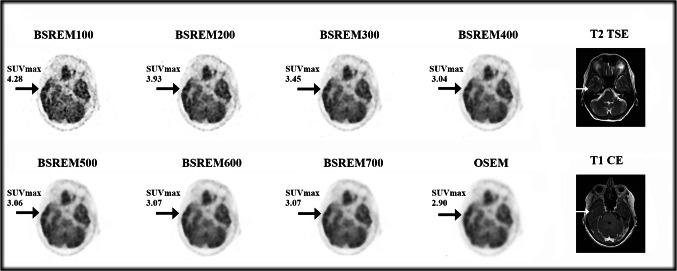
The aim of the study was to analyze the use of block sequential regularized expectation maximization (BSREM) with different β-values for the detection of brain metastases in digital fluorine-18 labeled 2-deoxy-2-fluoro-D-glucose (18F-FDG) PET/CT in lung cancer patients. We retrospectively analyzed staging/restaging 18F-FDG PET/CT scans of 40 consecutive lung cancer patients with new brain metastases, confirmed by MRI. PET images were reconstructed using BSREM (β-values of 100, 200, 300, 400, 500, 600, 700) and OSEM. Two independent blinded readers (R1 and R2) evaluated each reconstruction using a 4-point scale for general image quality, noise, and lesion detectability. SUVmax of metastases, brain background, target-to-background ratio (TBR), and contrast recovery (CR) ratio were recorded for each reconstruction. Among all reconstruction techniques, differences in qualitative parameters were analyzed using non-parametric Friedman test, while differences in quantitative parameters were compared using analysis of variances for repeated measures. Cohen's kappa (k) was used to measure inter-reader agreement. The overall detectability of brain metastases was highest for BSREM200 (R1: 2.83 ± 1.17; R2: 2.68 ± 1.32) and BSREM300 (R1: 2.78 ± 1.23; R2: 2.68 ± 1.36), followed by BSREM100, which had lower accuracy owing to noise. The highest median TBR was found for BSREM100 (R1: 2.19 ± 1.05; R2: 2.42 ± 1.08), followed by BSREM200 and BSREM300. Image quality ratings were significantly different among reconstructions (p < 0.001). The median quality score was higher for BSREM100-300, and both noise and metastases' SUVmax decreased with increasing β-value. Inter-reader agreement was particularly high for the detectability of photopenic metastases and blurring (all k > 0.65). BSREM200 and BSREM300 yielded the best results for the detection of brain metastases, surpassing both BSREM400 and OSEM, typically used in clinical practice.
本研究的目的是分析在肺癌患者的数字化氟-18标记的2-脱氧-2-氟-D-葡萄糖(18F-FDG)PET/CT中,使用不同β值的块序贯正则期望最大化(BSREM)方法检测脑转移瘤的情况。我们回顾性分析了40例经MRI证实有新发性脑转移瘤的连续肺癌患者的分期/再分期18F-FDG PET/CT扫描。PET图像采用BSREM(β值为100、200、300、400、500、600、700)和有序子集期望最大化(OSEM)进行重建。两名独立的盲法阅片者(R1和R2)使用4分制对每种重建图像的总体图像质量、噪声和病变可检测性进行评估。记录每种重建图像的转移瘤最大标准摄取值(SUVmax)、脑背景、靶本比(TBR)和对比恢复(CR)率。在所有重建技术中,定性参数的差异采用非参数Friedman检验进行分析,定量参数的差异采用重复测量方差分析进行比较。采用Cohen's kappa(k)来衡量阅片者间的一致性。对于脑转移瘤的总体可检测性,BSREM200(R1:2.83±1.17;R2:2.68±1.32)和BSREM300(R1:2.78±1.23;R2:2.68±1.36)最高,其次是BSREM100,其因噪声导致准确性较低。发现BSREM100的中位TBR最高(R1:2.19±1.05;R2:2.42±1.08),其次是BSREM200和BSREM300。不同重建图像的质量评分存在显著差异(p<0.001)。BSREM100 - 300的中位质量评分较高,且噪声和转移瘤的SUVmax均随β值增加而降低。对于放射性缺损转移瘤的可检测性和模糊度,阅片者间的一致性特别高(所有k>0.65)。BSREM200和BSREM300在检测脑转移瘤方面产生了最佳结果,超过了临床实践中通常使用的BSREM400和OSEM。


 Zotero 插件