Department of Microbiology Immunology and Tropical Medicine, The George Washington University, 2300 I Street NW, Washington, DC 20037, USA.
Int J Mol Sci. 2022 Feb 19;23(4):2321. doi: 10.3390/ijms23042321.
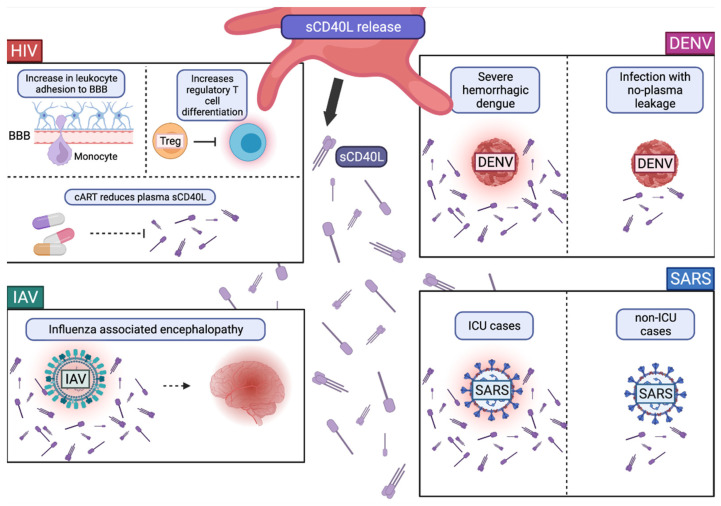
Platelets, which are small anuclear cell fragments, play important roles in thrombosis and hemostasis, but also actively release factors that can both suppress and induce viral infections. Platelet-released factors include sCD40L, microvesicles (MVs), and alpha granules that have the capacity to exert either pro-inflammatory or anti-inflammatory effects depending on the virus. These factors are prime targets for use in extracellular vesicle (EV)-based therapy due to their ability to reduce viral infections and exert anti-inflammatory effects. While there are some studies regarding platelet microvesicle-based (PMV-based) therapy, there is still much to learn about PMVs before such therapy can be used. This review provides the background necessary to understand the roles of platelet-released factors, how these factors might be useful in PMV-based therapy, and a critical discussion of current knowledge of platelets and their role in viral diseases.
血小板是一种无核的细胞碎片,在血栓形成和止血中发挥着重要作用,但也会积极释放抑制和诱导病毒感染的因子。血小板释放的因子包括 sCD40L、微泡(MVs)和α颗粒,这些因子具有发挥促炎或抗炎作用的能力,具体取决于病毒。由于这些因子能够减少病毒感染并发挥抗炎作用,因此它们是基于细胞外囊泡(EV)治疗的主要目标。虽然有一些关于血小板微泡(PMV)治疗的研究,但在这种治疗方法被应用之前,还有很多关于 PMV 的知识需要学习。这篇综述提供了理解血小板释放因子的作用、这些因子在 PMV 治疗中的潜在应用以及对血小板及其在病毒疾病中作用的当前知识的批判性讨论所必需的背景。