Department of Pathology, Memorial Sloan Kettering Cancer Center, New York, New York, USA.
Brain Pathol. 2022 Jul;32(4):e13060. doi: 10.1111/bpa.13060. Epub 2022 Feb 25.
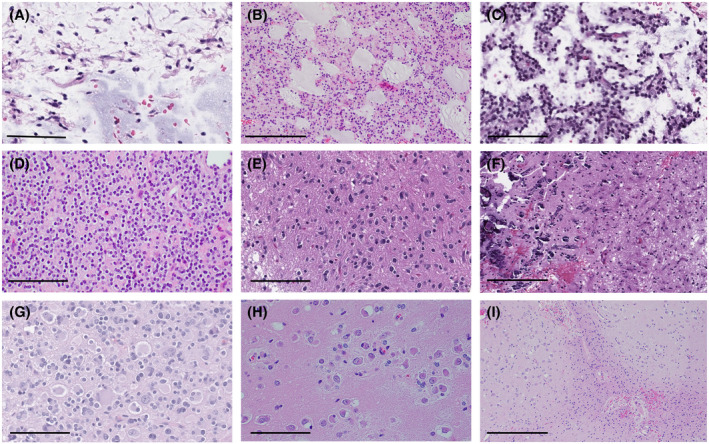
The 2021 5th edition of the WHO Classification of Tumors of the Central Nervous System reflects the discovery of genetic alterations underlying many central nervous system (CNS) neoplasms. Insights gained from technologic advances and novel applications in molecular diagnostics, including next-generation sequencing and DNA methylation-based profiling, coupled with the recognition of clinicopathologic correlates, have prompted substantial changes to CNS tumor classification; this is particularly true for pediatric low-grade gliomas and glioneuronal tumors (pLGG/GNTs). The 2021 WHO now classifies gliomas, glioneuronal tumors and neuronal tumors into 6 families, three of which encompass pLGG/LGNTs: "Pediatric type diffuse low-grade gliomas," "circumscribed astrocytic gliomas," and "glioneuronal and neuronal tumors." Among these are six newly recognized tumor types: "diffuse astrocytoma, MYB or MYBL1-altered"; "polymorphous low grade neuroepithelial tumor of the young (PLNTY)"; "diffuse low-grade glioma-MAPK altered"; "Diffuse glioneuronal tumor with oligodendroglioma-like features and nuclear clusters (DGONC)"; "myxoid glioneuronal tumor (MGT)"; and "multinodular and vacuolating neuronal tumor (MVNT)." We review these newly recognized entities in the context of general changes to the WHO schema, discuss implications of the new classification for treatment of pLGG/LGNT, and consider strategies for molecular testing and interpretation.
2021 年版世界卫生组织(WHO)中枢神经系统肿瘤分类反映了许多中枢神经系统(CNS)肿瘤的遗传改变的发现。技术进步和分子诊断的新应用带来的见解,包括下一代测序和基于 DNA 甲基化的分析,加上临床病理相关性的认识,促使 CNS 肿瘤分类发生了重大变化;对于儿科低级别胶质瘤和神经胶质神经元肿瘤(pLGG/GNTs)尤其如此。2021 年版 WHO 现在将神经胶质瘤、神经胶质神经元肿瘤和神经元肿瘤分为 6 个家族,其中 3 个家族包含 pLGG/LGNTs:“小儿弥漫性低级神经胶质瘤”、“局限性星形细胞瘤”和“神经胶质神经元肿瘤”。其中包括 6 种新认定的肿瘤类型:“弥漫性星形细胞瘤,MYB 或 MYBL1 改变”、“年轻多形性低级别神经上皮肿瘤(PLNTY)”、“弥漫性低级胶质瘤-MAPK 改变”、“弥漫性神经胶质神经元肿瘤伴少突胶质细胞瘤样特征和核簇(DGONC)”、“黏液性神经胶质神经元肿瘤(MGT)”和“多结节性和空泡性神经元肿瘤(MVNT)”。我们在 WHO 方案的总体变化背景下审查这些新认定的实体,讨论新分类对 pLGG/LGNT 治疗的影响,并考虑分子检测和解释的策略。