Department of Artificial Intelligence and Machine Learning, MVJ College of Engineering, Bangalore, Karnataka, India.
Department of Information Science and Engineering, M. S. Ramaiah Institute of Technology, Bangalore, Karnataka, India.
J Healthc Eng. 2022 Feb 16;2022:1601354. doi: 10.1155/2022/1601354. eCollection 2022.
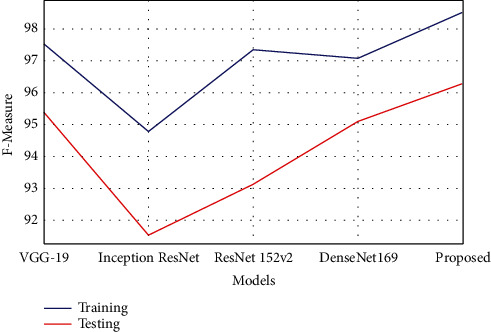
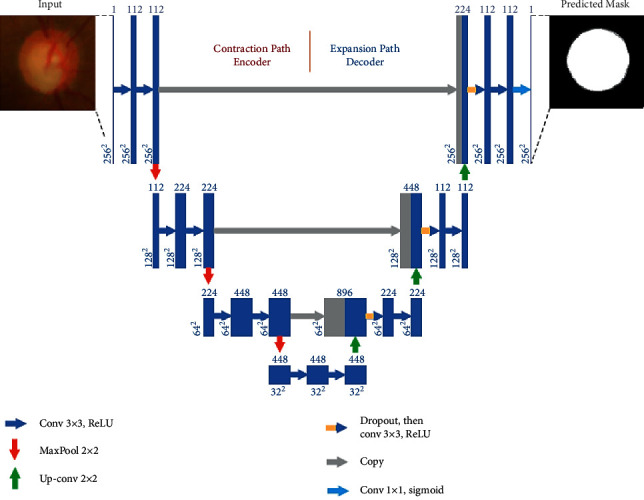
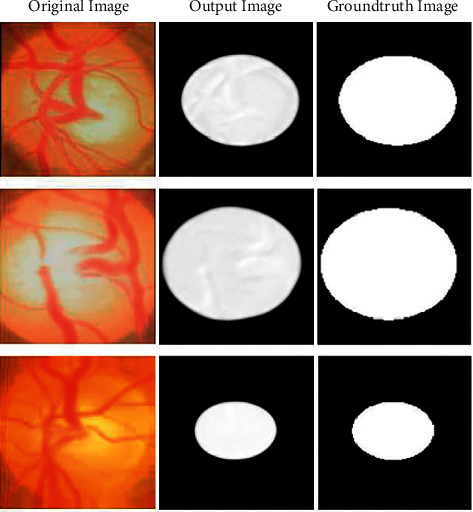
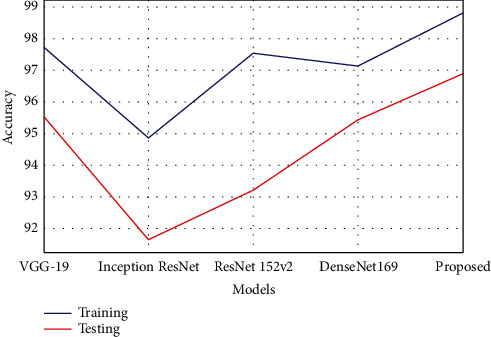
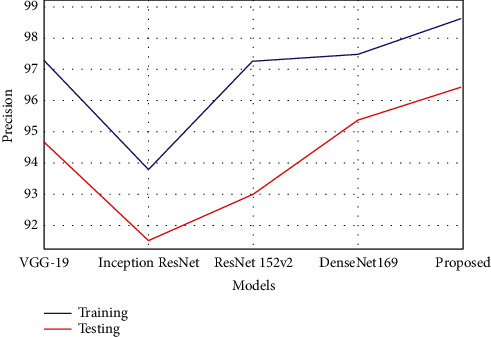
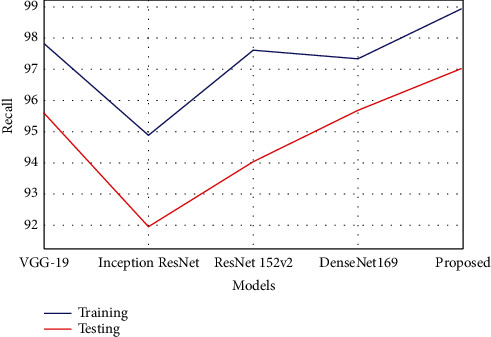
Glaucoma is the second most common cause for blindness around the world and the third most common in Europe and the USA. Around 78 million people are presently living with glaucoma (2020). It is expected that 111.8 million people will have glaucoma by the year 2040. 90% of glaucoma is undetected in developing nations. It is essential to develop a glaucoma detection system for early diagnosis. In this research, early prediction of glaucoma using deep learning technique is proposed. In this proposed deep learning model, the ORIGA dataset is used for the evaluation of glaucoma images. The U-Net architecture based on deep learning algorithm is implemented for optic cup segmentation and a pretrained transfer learning model; DenseNet-201 is used for feature extraction along with deep convolution neural network (DCNN). The DCNN approach is used for the classification, where the final results will be representing whether the glaucoma infected or not. The primary objective of this research is to detect the glaucoma using the retinal fundus images, which can be useful to determine if the patient was affected by glaucoma or not. The result of this model can be positive or negative based on the outcome detected as infected by glaucoma or not. The model is evaluated using parameters such as accuracy, precision, recall, specificity, and F-measure. Also, a comparative analysis is conducted for the validation of the model proposed. The output is compared to other current deep learning models used for CNN classification, such as VGG-19, Inception ResNet, ResNet 152v2, and DenseNet-169. The proposed model achieved 98.82% accuracy in training and 96.90% in testing. Overall, the performance of the proposed model is better in all the analysis.
青光眼是全球第二大致盲原因,也是欧洲和美国第三大致盲原因。目前全球约有 7800 万人患有青光眼(2020 年)。预计到 2040 年,将有 1.118 亿人患有青光眼。在发展中国家,90%的青光眼未被发现。因此,开发青光眼检测系统进行早期诊断至关重要。本研究提出了一种使用深度学习技术早期预测青光眼的方法。在这个提出的深度学习模型中,ORIGA 数据集用于评估青光眼图像。基于深度学习算法的 U-Net 架构用于视杯分割和预训练的迁移学习模型;DenseNet-201 用于特征提取以及深度卷积神经网络(DCNN)。DCNN 方法用于分类,最终结果将表示青光眼是否感染。本研究的主要目的是使用视网膜眼底图像检测青光眼,这有助于确定患者是否患有青光眼。该模型的结果可以是阳性或阴性,具体取决于检测到的感染青光眼的结果。该模型使用准确性、精度、召回率、特异性和 F 度量等参数进行评估。此外,还对所提出的模型进行了验证的比较分析。将输出与用于 CNN 分类的其他当前深度学习模型(如 VGG-19、Inception ResNet、ResNet 152v2 和 DenseNet-169)进行比较。所提出的模型在训练中达到了 98.82%的准确率,在测试中达到了 96.90%的准确率。总体而言,所提出的模型在所有分析中的性能都更好。