Aldhahi Waleed, Sull Sanghoon
School of Electrical Engineering, Korea University, 145 Anam-ro, Seongbuk-gu, Seoul 02841, Republic of Korea.
Diagnostics (Basel). 2023 Jan 26;13(3):441. doi: 10.3390/diagnostics13030441.
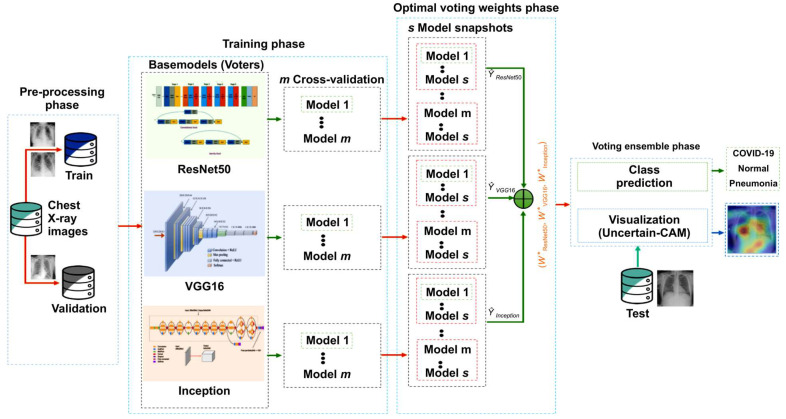
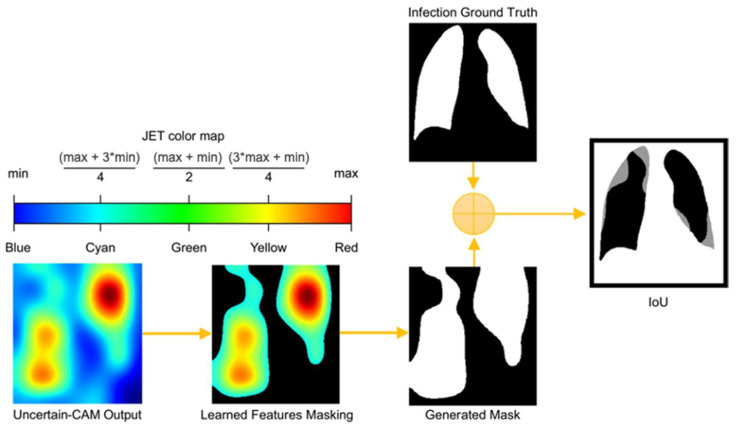
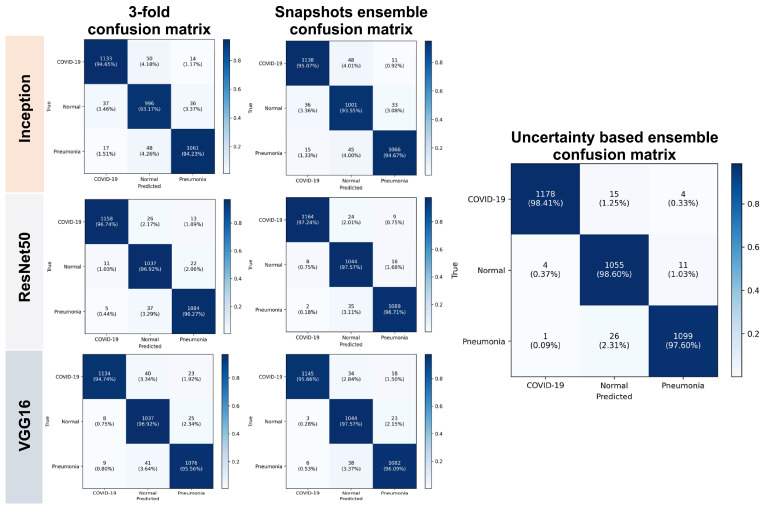
The ongoing coronavirus disease 2019 (COVID-19) pandemic has had a significant impact on patients and healthcare systems across the world. Distinguishing non-COVID-19 patients from COVID-19 patients at the lowest possible cost and in the earliest stages of the disease is a major issue. Additionally, the implementation of explainable deep learning decisions is another issue, especially in critical fields such as medicine. The study presents a method to train deep learning models and apply an uncertainty-based ensemble voting policy to achieve 99% accuracy in classifying COVID-19 chest X-rays from normal and pneumonia-related infections. We further present a training scheme that integrates the cyclic cosine annealing approach with cross-validation and uncertainty quantification that is measured using prediction interval coverage probability (PICP) as final ensemble voting weights. We also propose the Uncertain-CAM technique, which improves deep learning explainability and provides a more reliable COVID-19 classification system. We introduce a new image processing technique to measure the explainability based on ground-truth, and we compared it with the widely adopted Grad-CAM method.
持续的2019冠状病毒病(COVID-19)大流行对全球患者和医疗系统产生了重大影响。以尽可能低的成本并在疾病的最早阶段将非COVID-19患者与COVID-19患者区分开来是一个主要问题。此外,可解释的深度学习决策的实施是另一个问题,尤其是在医学等关键领域。该研究提出了一种训练深度学习模型的方法,并应用基于不确定性的集成投票策略,在将COVID-19胸部X光片与正常和肺炎相关感染进行分类时达到99%的准确率。我们进一步提出了一种训练方案,该方案将循环余弦退火方法与交叉验证和不确定性量化相结合,使用预测区间覆盖概率(PICP)作为最终集成投票权重来衡量不确定性量化。我们还提出了Uncertain-CAM技术,该技术提高了深度学习的可解释性,并提供了一个更可靠的COVID-19分类系统。我们引入了一种基于真实情况测量可解释性的新图像处理技术,并将其与广泛采用的Grad-CAM方法进行了比较。