Bognár Zsófia, Supala Eszter, Yarman Aysu, Zhang Xiaorong, Bier Frank F, Scheller Frieder W, Gyurcsányi Róbert E
BME "Lendület" Chemical Nanosensors Research Group, Department of Inorganic and Analytical Chemistry, Budapest University of Technology and Economics Szt. Gellért tér 4 1111 Budapest Hungary
Institute of Biochemistry and Biology, University of Potsdam Karl-Liebknecht-Str. 24-25 14476 Potsdam OT Golm Germany.
Chem Sci. 2021 Nov 23;13(5):1263-1269. doi: 10.1039/d1sc04502d. eCollection 2022 Feb 2.
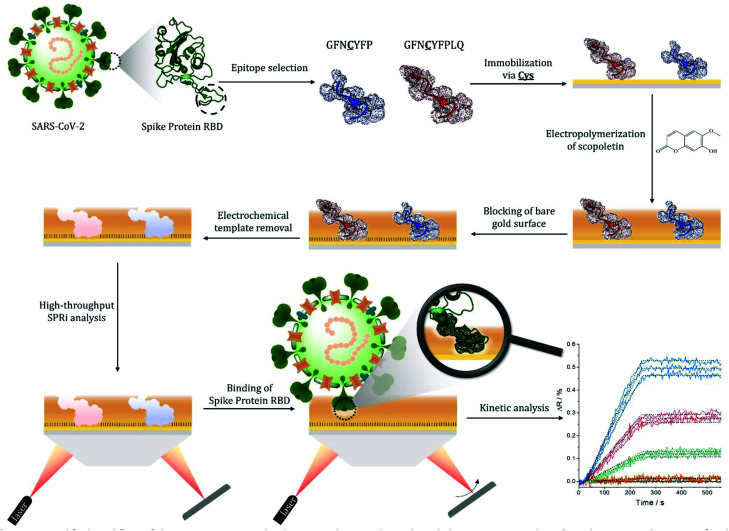
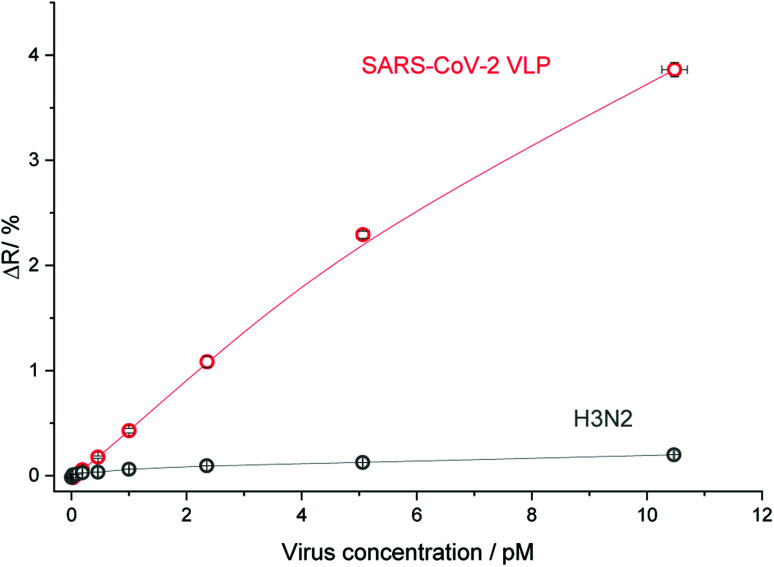
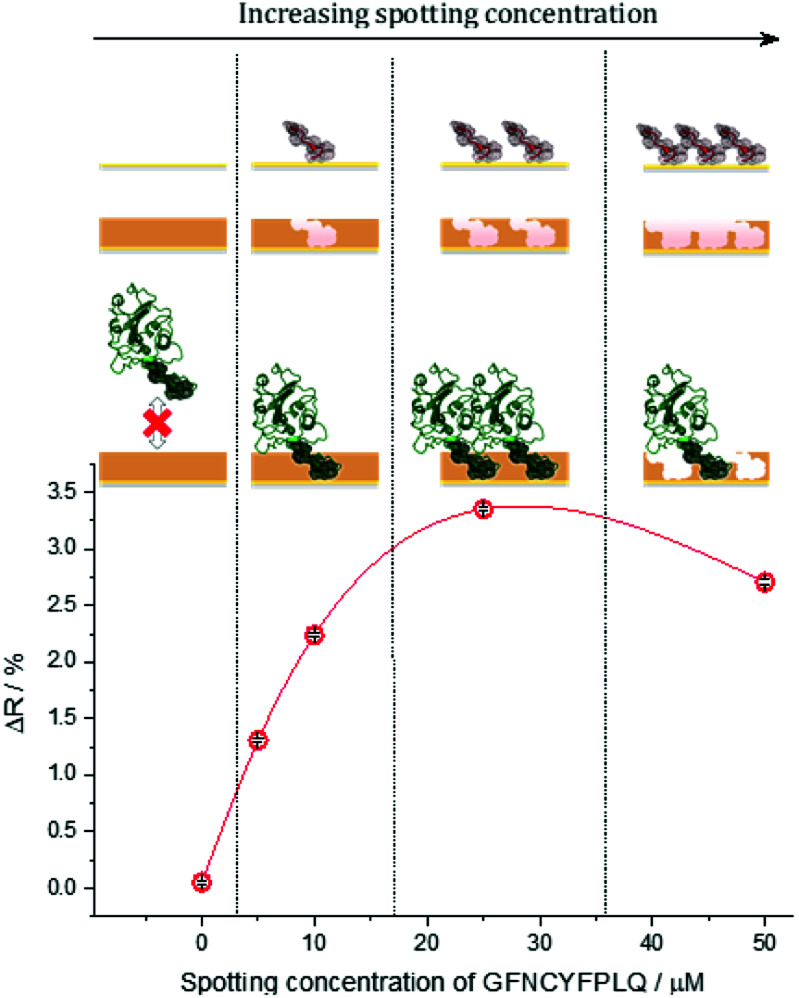
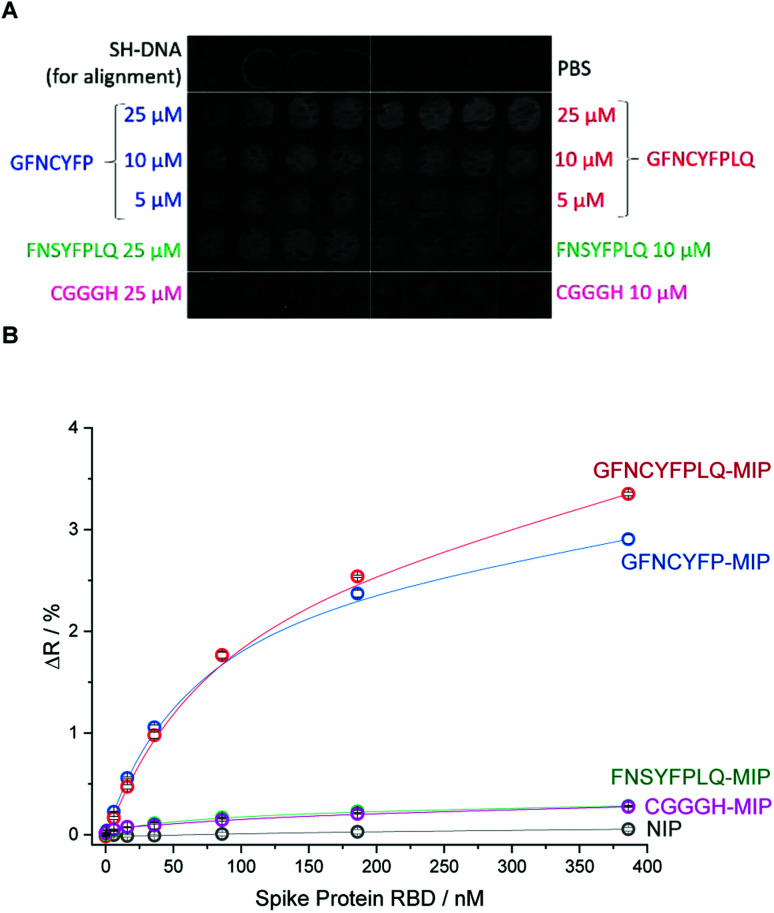
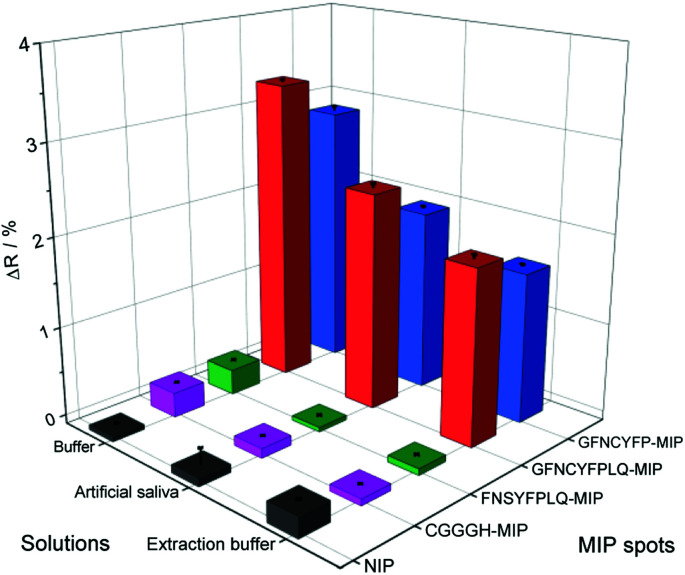
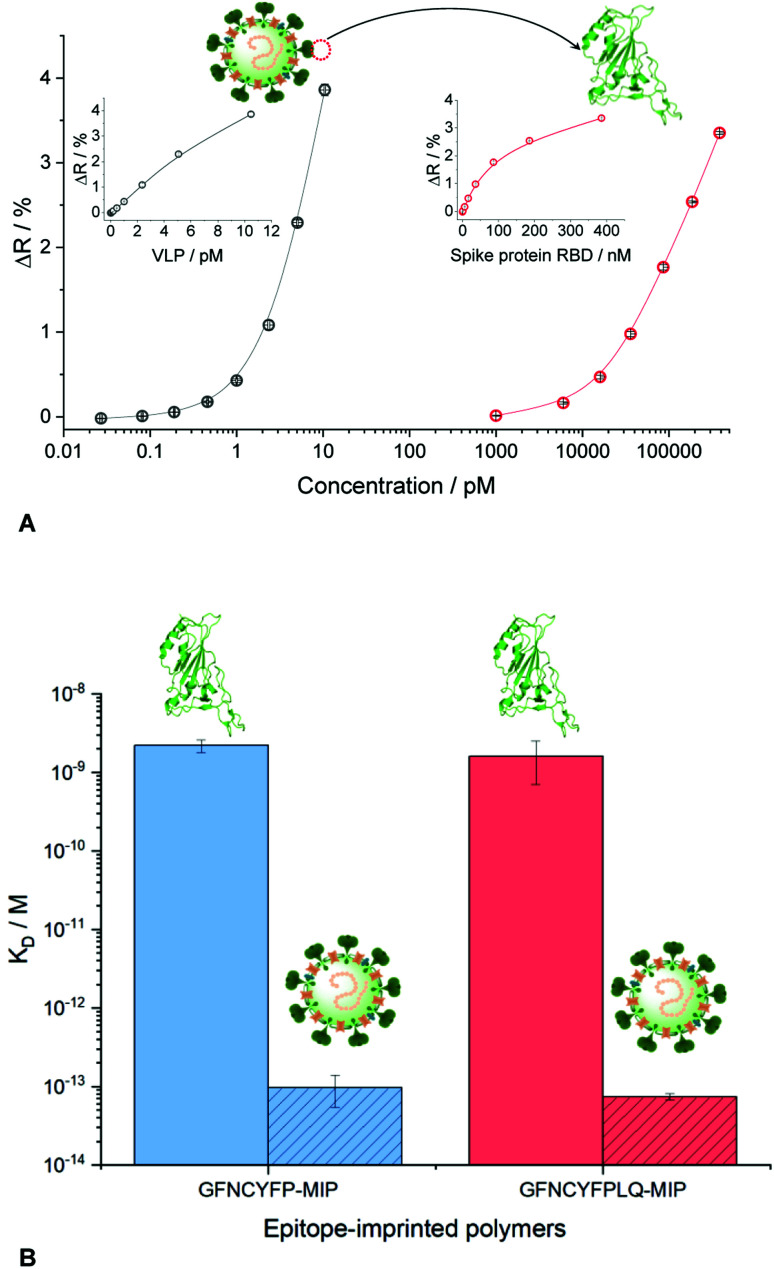
We introduce a practically generic approach for the generation of epitope-imprinted polymer-based microarrays for protein recognition on surface plasmon resonance imaging (SPRi) chips. The SPRi platform allows the subsequent rapid screening of target binding kinetics in a multiplexed and label-free manner. The versatility of such microarrays, both as synthetic and screening platform, is demonstrated through developing highly affine molecularly imprinted polymers (MIPs) for the recognition of the receptor binding domain (RBD) of SARS-CoV-2 spike protein. A characteristic nonapeptide GFNCYFPLQ from the RBD and other control peptides were microspotted onto gold SPRi chips followed by the electrosynthesis of a polyscopoletin nanofilm to generate in one step MIP arrays. A single chip screening of essential synthesis parameters, including the surface density of the template peptide and its sequence led to MIPs with dissociation constants ( ) in the lower nanomolar range for RBD, which exceeds the affinity of RBD for its natural target, angiotensin-convertase 2 enzyme. Remarkably, the same MIPs bound SARS-CoV-2 virus like particles with even higher affinity along with excellent discrimination of influenza A (H3N2) virus. While MIPs prepared with a truncated heptapeptide template GFNCYFP showed only a slightly decreased affinity for RBD, a single mismatch in the amino acid sequence of the template, the substitution of the central cysteine with a serine, fully suppressed the RBD binding.
我们介绍了一种实用的通用方法,用于在表面等离子体共振成像(SPRi)芯片上生成用于蛋白质识别的表位印记聚合物基微阵列。SPRi平台允许随后以多重和无标记的方式快速筛选目标结合动力学。通过开发用于识别SARS-CoV-2刺突蛋白受体结合域(RBD)的高亲和力分子印迹聚合物(MIP),证明了这种微阵列作为合成和筛选平台的多功能性。将来自RBD的特征性九肽GFNCYFPLQ和其他对照肽微点样到金SPRi芯片上,然后电合成聚东莨菪亭纳米膜,一步生成MIP阵列。对包括模板肽的表面密度及其序列在内的关键合成参数进行单芯片筛选,得到了对RBD的解离常数( )处于低纳摩尔范围的MIP,其亲和力超过了RBD对其天然靶标血管紧张素转换酶2的亲和力。值得注意的是,相同的MIP以更高的亲和力结合SARS-CoV-2病毒样颗粒,同时对甲型流感(H3N2)病毒具有出色的区分能力。虽然用截短的七肽模板GFNCYFP制备的MIP对RBD的亲和力仅略有下降,但模板氨基酸序列中的单个错配,即中心半胱氨酸被丝氨酸取代,完全抑制了RBD的结合。