Xie Xiaojing, Xu Junjie, Lin Jing, Jiang Jia, Huang Yunfan, Lu Jun, Kang Yuhao, Hu Yage, Cai Jiangyu, Wang Fujun, Zhu Tonghe, Zhao Jinzhong, Wang Lu
Key Laboratory of Textile Science & Technology of Ministry of Education, College of Textiles, Donghua University, Shanghai, 201620, China.
Department of Sports Medicine, Department of Orthopedics, Shanghai Jiao Tong University Affiliated Sixth People's Hospital, Shanghai, 200233, China.
Bioact Mater. 2021 Nov 12;13:82-95. doi: 10.1016/j.bioactmat.2021.11.001. eCollection 2022 Jul.
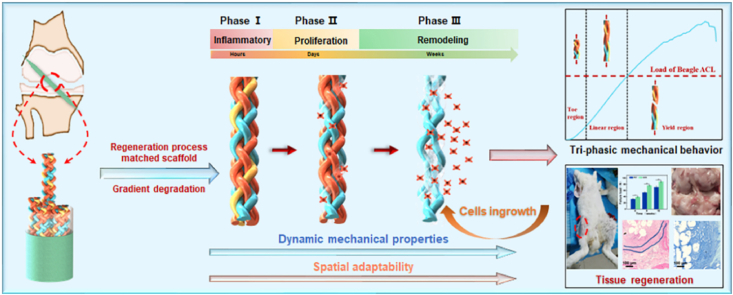
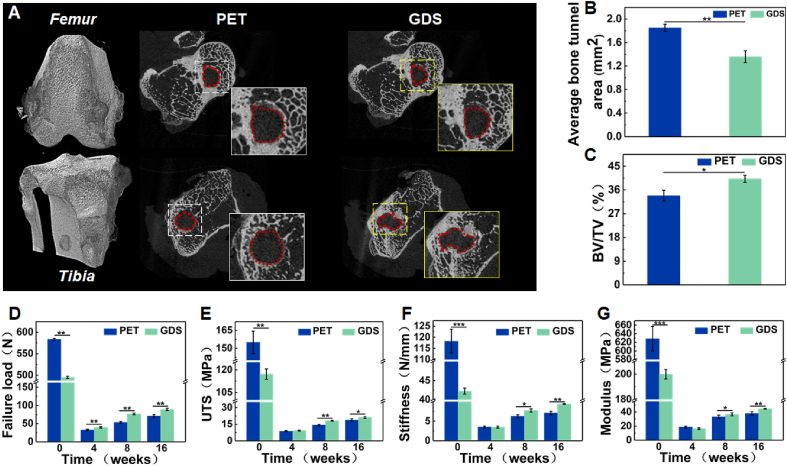
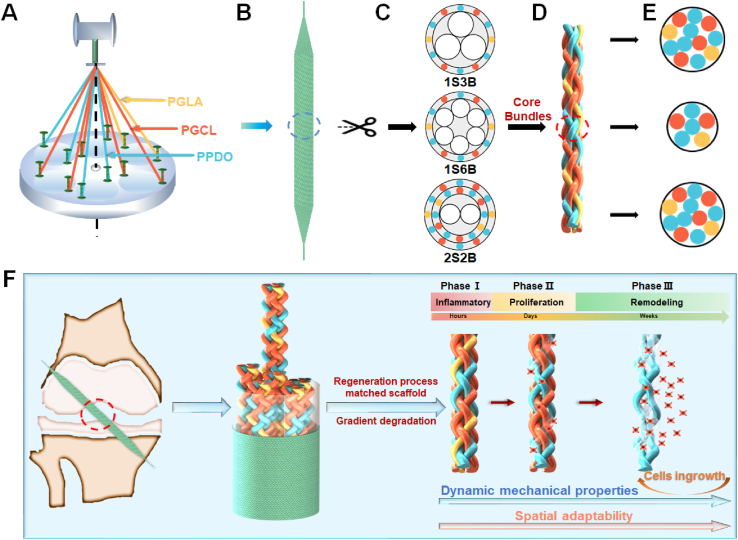
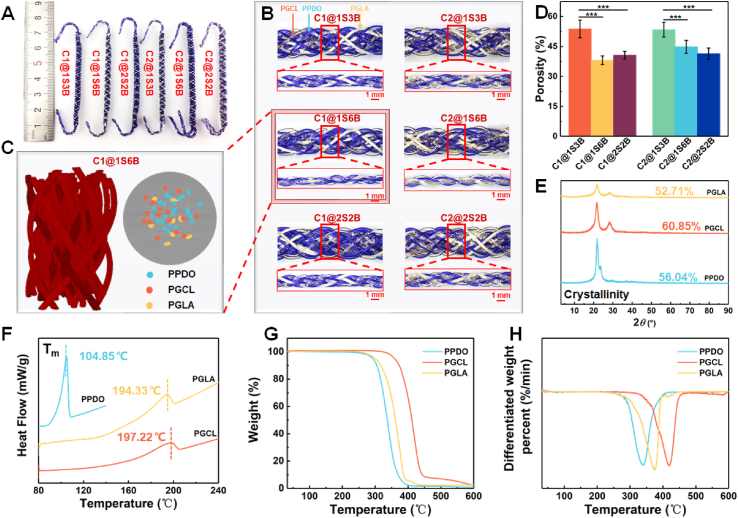
Ligament regeneration is a complicated process that requires dynamic mechanical properties and allowable space to regulate collagen remodeling. Poor strength and limited space of currently available grafts hinder tissue regeneration, yielding a disappointing success rate in ligament reconstruction. Matching the scaffold retreat rate with the mechanical and spatial properties of the regeneration process remains challenging. Herein, a scaffold matching the regeneration process was designed via regulating the trajectories of fibers with different degradation rates to provide dynamic mechanical properties and spatial adaptability for collagen infiltration. This core-shell structured scaffold exhibited biomimetic fiber orientation, having tri-phasic mechanical behavior and excellent strength. Besides, by the sequential material degradation, the available space of the scaffold increased from day 6 and remained stable on day 24, consistent with the proliferation and deposition phase of the native ligament regeneration process. Furthermore, mature collagen infiltration and increased bone integration confirmed the promotion of tissue regeneration by the adaptive space, maintaining an excellent failure load of 67.65% of the native ligament at 16 weeks. This study proved the synergistic effects of dynamic strength and adaptive space. The scaffold matching the regeneration process is expected to open new approaches in ligament reconstruction.
韧带再生是一个复杂的过程,需要动态力学性能和合适的空间来调节胶原蛋白重塑。目前可用移植物的强度不足和空间有限阻碍了组织再生,导致韧带重建的成功率不尽人意。使支架降解速率与再生过程的力学和空间特性相匹配仍然具有挑战性。在此,通过调节具有不同降解速率的纤维轨迹,设计了一种与再生过程相匹配的支架,为胶原蛋白浸润提供动态力学性能和空间适应性。这种核壳结构的支架呈现出仿生纤维取向,具有三相力学行为和优异的强度。此外,通过材料的顺序降解,支架的可用空间从第6天开始增加,并在第24天保持稳定,这与天然韧带再生过程的增殖和沉积阶段一致。此外,成熟的胶原蛋白浸润和骨整合增加证实了适应性空间对组织再生的促进作用,在16周时保持了相当于天然韧带67.65%的优异破坏载荷。本研究证明了动态强度和适应性空间的协同作用。与再生过程相匹配的支架有望为韧带重建开辟新途径。