Department of Population Health Sciences, Duke University Medical Center, and Department of Mathematics, Duke University, Durham, North Carolina (M.D.R.).
Center for Early Detection Advanced Research, Knight Cancer Institute, Oregon Health Sciences University, Portland, Oregon (J.L.).
Ann Intern Med. 2022 Apr;175(4):471-478. doi: 10.7326/M21-3577. Epub 2022 Mar 1.
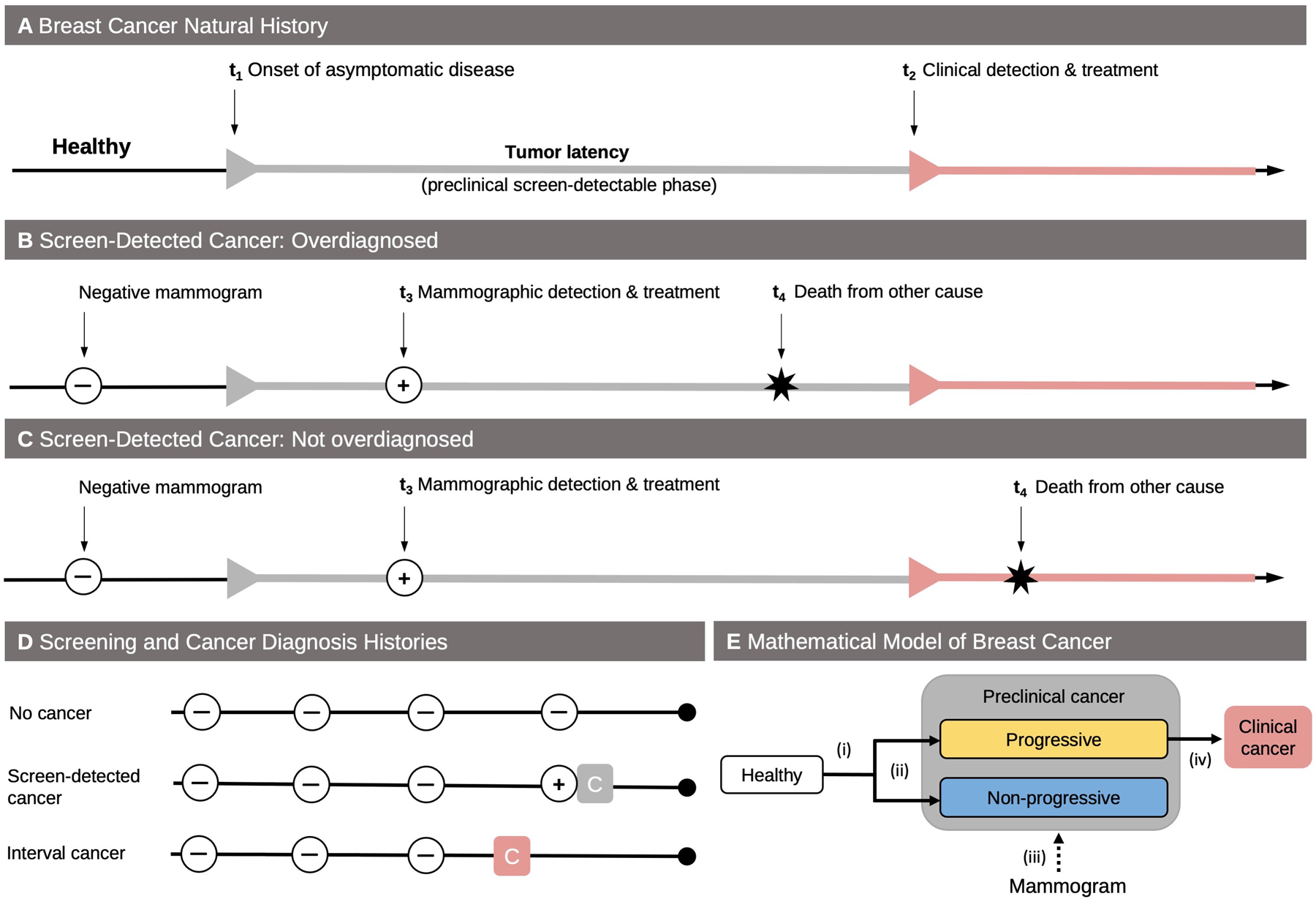
Mammography screening can lead to overdiagnosis-that is, screen-detected breast cancer that would not have caused symptoms or signs in the remaining lifetime. There is no consensus about the frequency of breast cancer overdiagnosis.
To estimate the rate of breast cancer overdiagnosis in contemporary mammography practice accounting for the detection of nonprogressive cancer.
Bayesian inference of the natural history of breast cancer using individual screening and diagnosis records, allowing for nonprogressive preclinical cancer. Combination of fitted natural history model with life-table data to predict the rate of overdiagnosis among screen-detected cancer under biennial screening.
Breast Cancer Surveillance Consortium (BCSC) facilities.
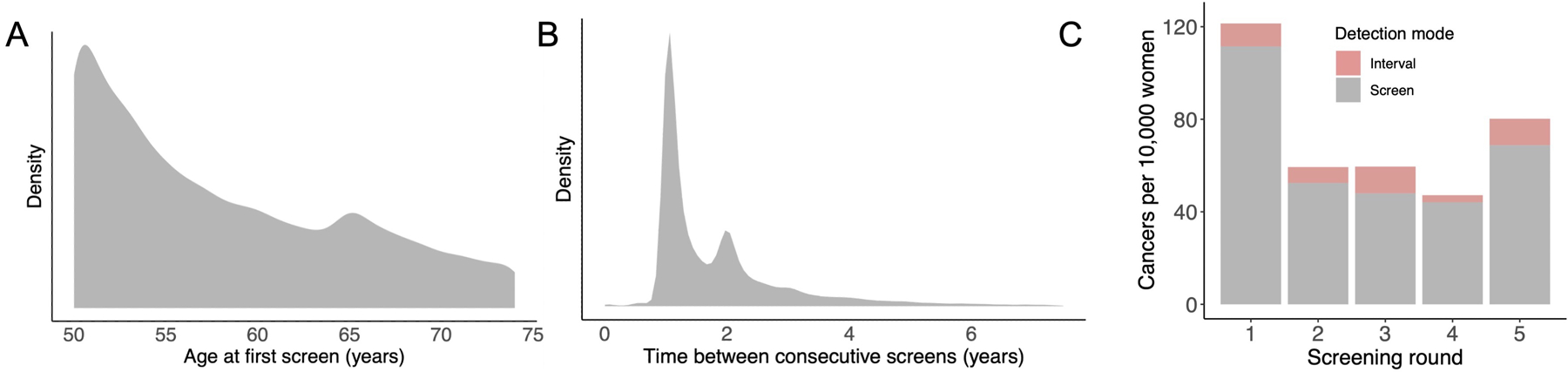
Women aged 50 to 74 years at first mammography screen between 2000 and 2018.
Screening mammograms and screen-detected or interval breast cancer.
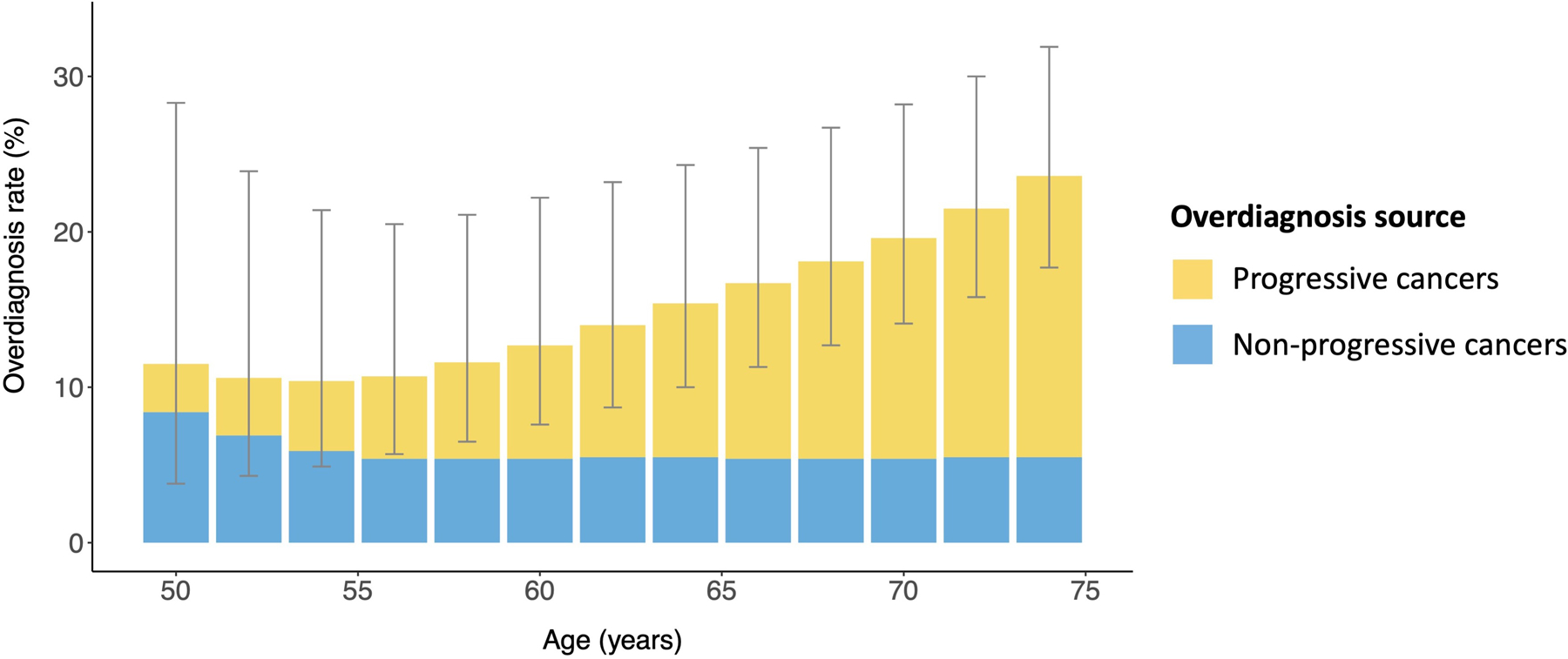
The cohort included 35 986 women, 82 677 mammograms, and 718 breast cancer diagnoses. Among all preclinical cancer cases, 4.5% (95% uncertainty interval [UI], 0.1% to 14.8%) were estimated to be nonprogressive. In a program of biennial screening from age 50 to 74 years, 15.4% (UI, 9.4% to 26.5%) of screen-detected cancer cases were estimated to be overdiagnosed, with 6.1% (UI, 0.2% to 20.1%) due to detecting indolent preclinical cancer and 9.3% (UI, 5.5% to 13.5%) due to detecting progressive preclinical cancer in women who would have died of an unrelated cause before clinical diagnosis.
Exclusion of women with first mammography screen outside BCSC.
On the basis of an authoritative U.S. population data set, the analysis projected that among biennially screened women aged 50 to 74 years, about 1 in 7 cases of screen-detected cancer is overdiagnosed. This information clarifies the risk for breast cancer overdiagnosis in contemporary screening practice and should facilitate shared and informed decision making about mammography screening.
National Cancer Institute.
乳腺 X 线筛查可导致过度诊断,即筛查发现的乳腺癌在剩余的生命周期内不会引起症状或体征。关于乳腺癌过度诊断的频率尚未达成共识。
利用个体筛查和诊断记录,基于非进展性癌的检测,估计当代乳腺 X 线筛查实践中的乳腺癌过度诊断率。
使用个体筛查和诊断记录进行贝叶斯推断乳腺癌的自然史,允许存在非进展性临床前癌症。将拟合的自然史模型与寿命表数据相结合,预测在每两年进行一次筛查的情况下,筛查发现的癌症中的过度诊断率。
乳腺癌监测联盟(BCSC)设施。
2000 年至 2018 年期间首次进行乳腺 X 线筛查时年龄在 50 岁至 74 岁的女性。
筛查用乳腺 X 线片和筛查发现或间期乳腺癌。
该队列纳入了 35986 名女性,82677 次乳腺 X 线片和 718 例乳腺癌诊断。所有临床前癌症病例中,估计有 4.5%(95%置信区间[UI],0.1%至 14.8%)为非进展性。在 50 岁至 74 岁期间每两年进行一次筛查的方案中,估计 15.4%(UI,9.4%至 26.5%)的筛查发现的癌症病例为过度诊断,其中 6.1%(UI,0.2%至 20.1%)归因于检测到惰性临床前癌症,9.3%(UI,5.5%至 13.5%)归因于检测到在临床诊断前会因其他原因死亡的女性中的进展性临床前癌症。
排除了在 BCSC 之外首次进行乳腺 X 线筛查的女性。
基于美国权威人群数据集的分析结果预测,在每两年进行一次筛查的 50 岁至 74 岁女性中,约有 1/7 的筛查发现的癌症病例为过度诊断。这些信息阐明了当代筛查实践中乳腺癌过度诊断的风险,应有助于关于乳腺 X 线筛查的共同知情决策。
美国国立癌症研究所。