Florentino Jhiedon L, Arao Rosa Mia L, Garfin Anna Marie Celina, Gaviola Donna Mae G, Tan Carlos R, Yadav Rajendra Prasad, Hiatt Tom, Morishita Fukushi, Siroka Andrew, Yamanaka Takuya, Nishikiori Nobuyuki
Health Policy Development Program (HPDP)-UPecon Foundation, Inc., Quezon City, Philippines.
National TB Control Programme, Department of Health, Manila, Philippines.
PLoS One. 2022 Feb 28;17(2):e0264689. doi: 10.1371/journal.pone.0264689. eCollection 2022.
Tuberculosis (TB) is a disease associated with poverty. Moreover, a significant proportion of TB patients face a substantial financial burden before and during TB care. One of the top targets in the End TB strategy was to achieve zero catastrophic costs due to TB by 2020. To assess patient costs related to TB care and the proportion of TB-affected households that faced catastrophic costs, the Philippines National TB Programme (NTP) conducted a national TB patient cost survey in 2016-2017.
A cross-sectional survey of 1,912 TB patients taking treatment in health facilities engaged with the NTP. The sample consists of 786 drug-sensitive TB (DS-TB) patients in urban facilities, 806 DS-TB patients in rural facilities, and 320 drug-resistant TB (DR-TB) patients. Catastrophic cost due to TB is defined as total costs, consisting of direct medical and non-medical costs and indirect costs net of social assistance, exceeding 20% of annual household income.
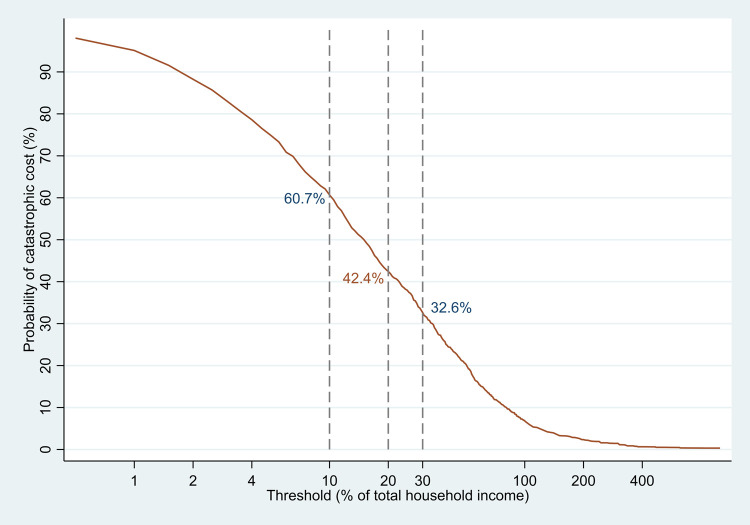
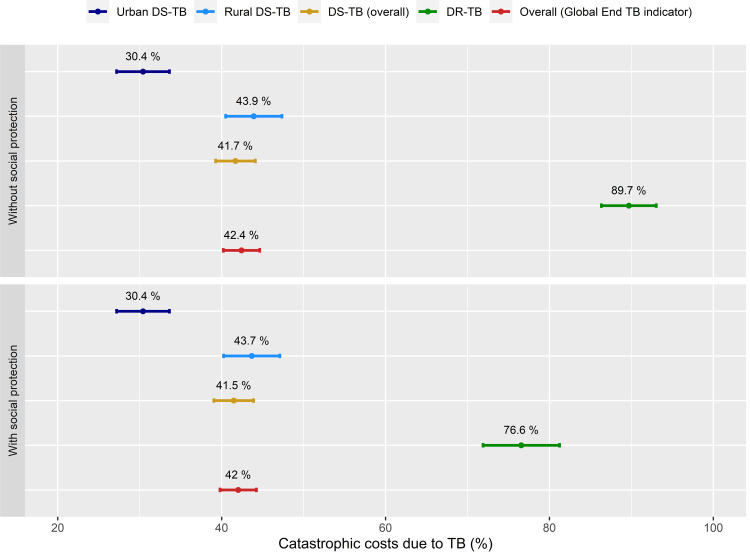
The overall mean total cost including pre- and post-diagnostic costs was US$601. The mean total cost was five times higher among DR-TB patients than DS-TB patients. Direct non-medical costs and income loss accounted for 42.7% and 40.4% of the total cost of TB, respectively. More than 40% of households had to rely on dissaving, taking loans, or selling their assets to cope with the costs. Overall, 42.4% (95% confidence interval (95% CI): 40.2-44.6) of TB-affected households faced catastrophic costs due to TB, and it was significantly higher among DR-TB patients (89.7%, 95%CI: 86.3-93.0). A TB enabler package, which 70% of DR-TB patients received, reduced catastrophic costs by 13.1 percentage points (89.7% to 76.6%) among DR-TB patients, but only by 0.4 percentage points (42.4% to 42.0%), overall.
TB patients in the Philippines face a substantial financial burden due to TB despite free TB services provided by the National TB Programme. The TB enabler package mitigated catastrophic costs to some extent, but only for DR-TB patients. Enhancing the current social and welfare support through multisectoral collaboration is urgently required to achieve zero catastrophic costs due to TB.
结核病是一种与贫困相关的疾病。此外,很大一部分结核病患者在结核病治疗前和治疗期间面临着沉重的经济负担。《终止结核病战略》的首要目标之一是到2020年实现因结核病导致的灾难性费用为零。为了评估与结核病治疗相关的患者费用以及受结核病影响家庭面临灾难性费用的比例,菲律宾国家结核病规划(NTP)在2016 - 2017年开展了一项全国结核病患者费用调查。
对1912名在与NTP合作的医疗机构接受治疗的结核病患者进行横断面调查。样本包括786名城市医疗机构中的药物敏感结核病(DS - TB)患者、806名农村医疗机构中的DS - TB患者以及320名耐多药结核病(DR - TB)患者。因结核病导致的灾难性费用定义为总费用,包括直接医疗和非医疗费用以及扣除社会救助后的间接费用,超过家庭年收入的20%。
包括诊断前后费用在内的总体平均总费用为601美元。DR - TB患者的平均总费用比DS - TB患者高出五倍。直接非医疗费用和收入损失分别占结核病总费用的42.7%和40.4%。超过40%的家庭不得不依靠动用储蓄、借贷或出售资产来应对费用。总体而言,42.4%(95%置信区间(95%CI):40.2 - 44.6)的受结核病影响家庭因结核病面临灾难性费用,在DR - TB患者中这一比例显著更高(89.7%,95%CI:86.3 - 93.0)。70%的DR - TB患者接受了结核病促进包,这使DR - TB患者中的灾难性费用降低了13.1个百分点(从89.7%降至76.6%),但总体上仅降低了0.4个百分点(从42.4%降至42.0%)。
尽管国家结核病规划提供了免费的结核病服务,但菲律宾的结核病患者因结核病仍面临沉重的经济负担。结核病促进包在一定程度上减轻了灾难性费用,但仅针对DR - TB患者。迫切需要通过多部门合作加强当前的社会和福利支持,以实现因结核病导致的灾难性费用为零。