Department of Cardiac Surgery, National Cerebral and Cardiovascular Center, Osaka, Japan.
Department of Cardiovascular Surgery, Kumamoto University Graduate School of Medical Sciences, Kumamoto, Japan.
Gen Thorac Cardiovasc Surg. 2022 Aug;70(8):685-693. doi: 10.1007/s11748-022-01773-y. Epub 2022 Feb 28.
Because the presence of immunocompetent cells in the myocardium is associated with the pathological stage and/or myocardial viability, we explored relationships between functional recovery after left ventricular assist device implantation and the distribution of immunocompetent cells in non-ischaemic dilated cardiomyopathy patients.
We reviewed 50 consecutive dilated cardiomyopathy patients implanted with HeartMate II at our institute between April 2013 and December 2018 who were treated with optimal medical therapy during left ventricular assist device support. Patients were stratified by improvement of the left ventricular ejection fraction at 6 months after implantation: ≥ 10% increase (Gr ≥ 10%), 5-10% (Gr 5-10%), and ≤ 5% (Gr ≤ 5%). T cells and macrophages were evaluated in the apical myocardium after left ventricular assist device implantation.
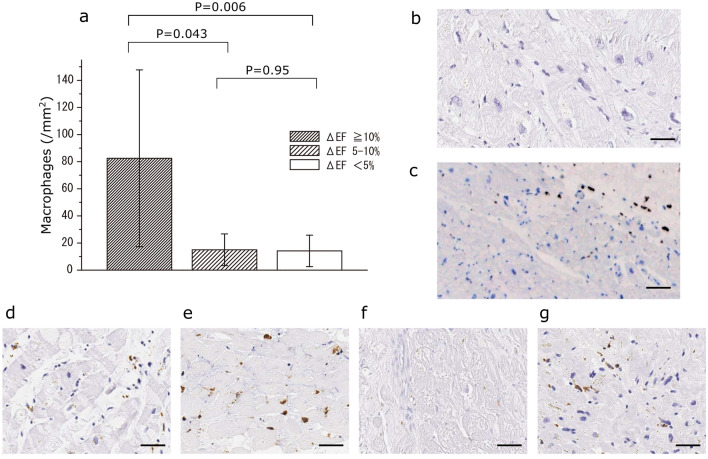
During left ventricular assist device support, 12 patients underwent heart transplantation and 2 patients died. Four patients with Gr ≤ 5% were readmitted because of congestive heart failure, but none with Gr ≥ 10%. Macrophages and T cells in the left ventricular myocardium with Gr ≥ 10% were significantly more present compared to those in other groups.
The distribution of immunocompetent cells in the left ventricular myocardium might predict myocardial viability of this pathology after implantation.
由于心肌中免疫活性细胞的存在与病理阶段和/或心肌活力有关,我们探讨了左心室辅助装置植入后功能恢复与非缺血性扩张型心肌病患者免疫活性细胞分布之间的关系。
我们回顾了 2013 年 4 月至 2018 年 12 月在我院植入 HeartMate II 的 50 例连续扩张型心肌病患者,这些患者在左心室辅助装置支持期间接受了最佳药物治疗。根据植入后 6 个月左心室射血分数的改善情况对患者进行分层:≥10%增加(Gr≥10%)、5-10%(Gr 5-10%)和≤5%(Gr≤5%)。在左心室辅助装置植入后评估心尖心肌中的 T 细胞和巨噬细胞。
在左心室辅助装置支持期间,12 例患者接受了心脏移植,2 例患者死亡。4 例 Gr≤5%的患者因充血性心力衰竭再次入院,但 Gr≥10%的患者无一例再次入院。Gr≥10%患者的左心室心肌中的巨噬细胞和 T 细胞明显多于其他组。
左心室心肌中免疫活性细胞的分布可能预测该病理植入后的心肌活力。