Multidisciplinary Treatment Center, Capital Medical University School of Stomatology, Beijing Stomatological Hospital, Beijing, 100050, China.
J Mater Sci Mater Med. 2022 Mar 2;33(3):27. doi: 10.1007/s10856-022-06649-4.
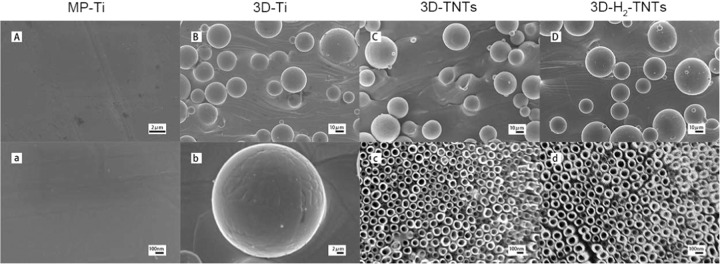
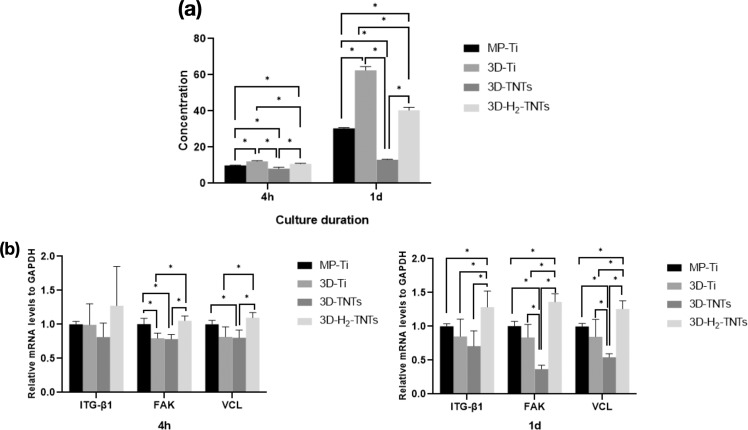
Selective laser melting (SLM), as one of the most common 3D-printed technologies, can form personalized implants, which after further surface modification can obtain excellent osseointegration. To study the surface properties of SLM titanium alloy (Ti6Al4V) with hydrogenated titanium dioxide (TiO)nanotubes (TNTs) and its influence on the biological behaviour of human gingival fibroblasts (HGFs), we used SLM to prepare 3D-printed titanium alloy samples (3D-Ti), which were electrochemically anodizing to fabricate 3D-TNTs and then further hydrogenated at high temperature to obtain 3D-H-TNTs. Polished cast titanium alloy (MP-Ti) was used as the control group. The surface morphology, hydrophilicity and roughness of MP-Ti, 3D-Ti, 3D-TNTs and 3D-H-TNTs were measured and analysed by scanning electron microscopy (SEM), contact angle metre, surface roughness measuring instrument and atomic force microscope, respectively. HGFs were cultured on the four groups of samples, and the cell morphology was observed by SEM. Fluorescence staining (DAPI) was used to observe the number of adhered cell nuclei, while a cell counting kit (CCK-8) was used to detect the early adhesion and proliferation of HGFs. Fluorescence quantitative real time polymerase chain reaction (RT-qPCR) and enzyme-linked immunosorbent assay (ELISA) were used to detect the expression of adhesion-related genes and fibronectin (FN), respectively. The results of this in vitro comparison study indicated that electrochemical anodic oxidation and high-temperature hydrogenation can form a superhydrophilic micro-nano composite morphology on the surface of SLM titanium alloy, which can promote both the early adhesion and proliferation of human gingival fibroblasts and improve the expression of cell adhesion-related genes and fibronectin. Graphical abstract.
选区激光熔化(SLM)作为最常见的 3D 打印技术之一,可以形成个性化植入物,进一步进行表面改性后可以获得优异的骨整合。为了研究氢化二氧化钛(TiO)纳米管(TNTs)修饰的选择性激光熔化钛合金(Ti6Al4V)的表面性能及其对人牙龈成纤维细胞(HGFs)生物学行为的影响,我们使用 SLM 制备 3D 打印钛合金样品(3D-Ti),然后对其进行电化学阳极氧化以制备 3D-TNTs,进一步在高温下氢化以获得 3D-H-TNTs。抛光铸造钛合金(MP-Ti)用作对照组。通过扫描电子显微镜(SEM)、接触角测量仪、表面粗糙度测量仪和原子力显微镜分别测量和分析 MP-Ti、3D-Ti、3D-TNTs 和 3D-H-TNTs 的表面形貌、亲水性和粗糙度。将 HGFs 培养在这四组样品上,通过 SEM 观察细胞形态。荧光染色(DAPI)观察细胞核附着数,细胞计数试剂盒(CCK-8)检测 HGFs 的早期附着和增殖。荧光定量实时聚合酶链反应(RT-qPCR)和酶联免疫吸附测定(ELISA)分别用于检测粘附相关基因和纤维连接蛋白(FN)的表达。这项体外比较研究的结果表明,电化学阳极氧化和高温氢化可以在 SLM 钛合金表面形成超亲水微纳复合形貌,可促进人牙龈成纤维细胞的早期附着和增殖,并提高细胞粘附相关基因和纤维连接蛋白的表达。图表摘要。