Department of Therapeutic Radiology, Yale School of Medicine, New Haven, CT 06520 USA.
Department of Genetics, Yale School of Medicine, New Haven, CT 06520 USA.
Nucleic Acids Res. 2022 Jun 10;50(10):e59. doi: 10.1093/nar/gkac095.
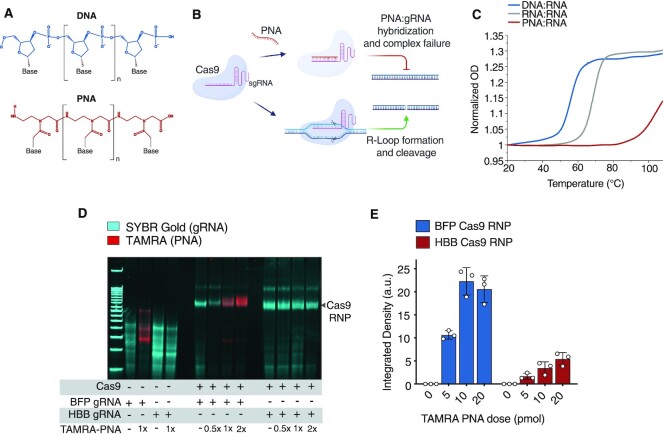
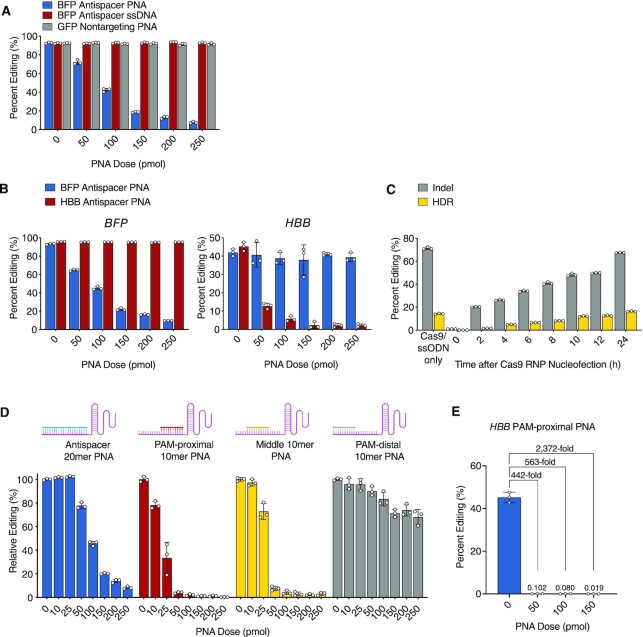
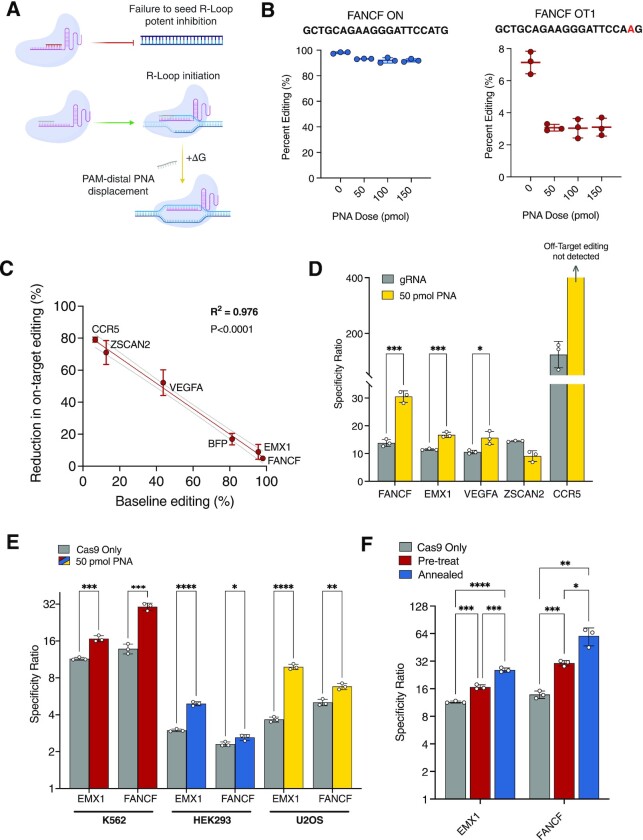
Despite the rapid and broad implementation of CRISPR-Cas9-based technologies, convenient tools to modulate dose, timing, and precision remain limited. Building on methods using synthetic peptide nucleic acids (PNAs) to bind RNA with unusually high affinity, we describe guide RNA (gRNA) spacer-targeted, or 'antispacer', PNAs as a tool to modulate Cas9 binding and activity in cells in a sequence-specific manner. We demonstrate that PNAs rapidly and efficiently target complexed gRNA spacer sequences at low doses and without design restriction for sequence-selective Cas9 inhibition. We further show that short PAM-proximal antispacer PNAs achieve potent cleavage inhibition (over 2000-fold reduction) and that PAM-distal PNAs modify gRNA affinity to promote on-target specificity. Finally, we apply antispacer PNAs for temporal regulation of two dCas9-fusion systems. These results present a novel rational approach to nucleoprotein engineering and describe a rapidly implementable antisense platform for CRISPR-Cas9 modulation to improve spatiotemporal versatility and safety across applications.
尽管基于 CRISPR-Cas9 的技术得到了快速广泛的应用,但调节剂量、时间和精度的便捷工具仍然有限。我们利用合成肽核酸(PNA)与 RNA 结合的异常高亲和力的方法,描述了靶向引导 RNA(gRNA)间隔区的“反间隔区”PNA,作为一种以序列特异性方式调节细胞中 Cas9 结合和活性的工具。我们证明,PNA 可以在低剂量下快速有效地靶向复杂的 gRNA 间隔序列,而不受序列选择性 Cas9 抑制的设计限制。我们进一步表明,短的 PAM 近端反间隔区 PNA 可实现有效的切割抑制(超过 2000 倍的降低),并且 PAM 远端 PNA 可修饰 gRNA 亲和力以促进靶标特异性。最后,我们将反间隔区 PNA 应用于两种 dCas9 融合系统的时间调节。这些结果提出了一种新的核蛋白工程合理方法,并描述了一种可快速实施的反义平台,用于 CRISPR-Cas9 调节,以提高应用中的时空多功能性和安全性。