Radboud Institute for Health Sciences, Departments of Physiology, Nijmegen, The Netherlands.
Research Institute for Sport and Exercise Sciences, Liverpool John Moores University, Leicester, UK.
J Physiol. 2022 Mar;600(6):1339-1355. doi: 10.1113/JP282000. Epub 2022 Mar 3.
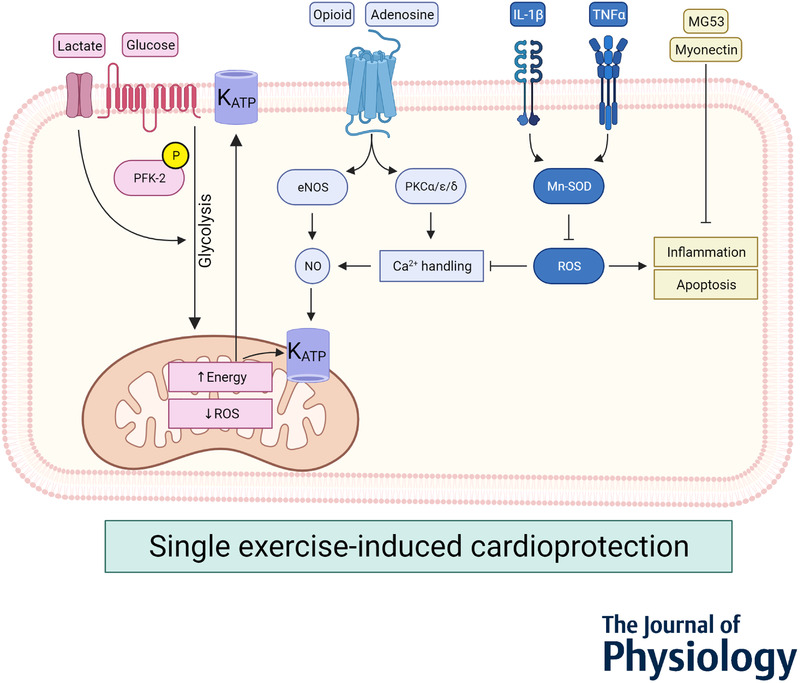
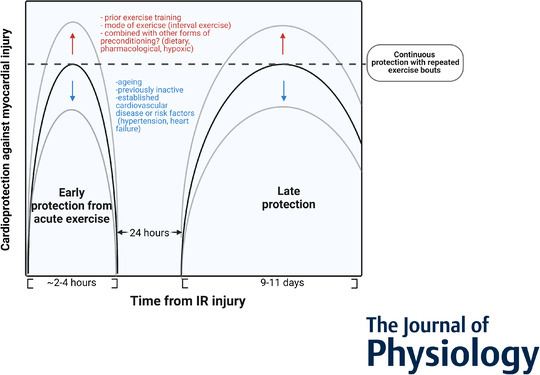
Regular exercise training has potent and powerful protective effects against the development of cardiovascular disease. These cardioprotective effects of regular exercise training are partly explained through the effects of exercise on traditional cardiovascular risk factors and improvement in cardiac and vascular health, which take several weeks to months to develop. This review focuses on the observation that single bouts of exercise may also possess an underrecognized, clinically useful form of immediate cardioprotection. Studies, performed in both animals and humans, demonstrate that single or short-term exercise-induced protection (SEP) attenuates the magnitude of cardiac and/or vascular damage in response to prolonged ischaemia and reperfusion injury. This review highlights preclinical evidence supporting the hypothesis that SEP activates multiple pathways to confer immediate protection against ischaemic events, reduce the severity of potentially lethal ischaemic myocardial injury, and therefore act as a physiological first line of defence against injury. Given the fact that the extent of SEP could be modulated by exercise-related and subject-related factors, it is important to recognize and consider these factors to optimize future clinical implications of SEP. This review also summarizes potential effector signalling pathways (i.e. communication between exercising muscles to vascular/cardiac tissue) and intracellular pathways (i.e. reducing tissue damage) that ultimately confer protection against cardiac and vascular injury. Finally, we discuss potential future directions for designing adequate human and animal studies that will support developing effective SEP strategies for the (multi-)diseased and aged individual. KEY POINTS: Single or short-term exercise-induced protection (SEP) attenuates the magnitude of cardiac and/or vascular damage in response to prolonged ischaemia and reperfusion injury (IR injury). SEP activates multiple pathways to confer cardiac protection, which develops remotely at the site of the activated muscle by release of circulating molecules, which transfer towards activation of intramyocardial signalling that promotes cell survival during episodes of IR injury. SEP represents an attractive intervention in aged individuals and in those with co-morbidities. The immediate protection, low cost and simplicity to increase the 'dose' of SEP offers unique opportunities in the clinical applications of SEP.
规律的运动训练对心血管疾病的发生具有强大而有效的保护作用。这种规律运动训练的心脏保护作用部分归因于运动对传统心血管危险因素的影响以及心脏和血管健康的改善,这些作用需要数周或数月才能显现。本综述的重点是观察到单次运动也可能具有未被充分认识的、具有临床应用价值的即时心脏保护作用。在动物和人体研究中都观察到,单次或短期运动诱导的保护(SEP)可减轻长时间缺血和再灌注损伤引起的心脏和/或血管损伤的程度。本综述强调了支持以下假说的临床前证据:SEP 通过激活多种途径来提供即时的缺血事件保护,减轻潜在致死性缺血性心肌损伤的严重程度,从而充当损伤的生理性第一道防线。鉴于 SEP 的程度可以通过与运动相关的和与受试者相关的因素来调节,因此重要的是认识到并考虑这些因素,以优化 SEP 的未来临床意义。本综述还总结了潜在的效应信号通路(即运动肌肉与血管/心脏组织之间的通讯)和细胞内通路(即减少组织损伤),这些通路最终提供了对心脏和血管损伤的保护作用。最后,我们讨论了设计充分的人体和动物研究的潜在未来方向,这将支持为(多)疾病和老年个体开发有效的 SEP 策略。关键点:单次或短期运动诱导的保护(SEP)可减轻长时间缺血和再灌注损伤(IR 损伤)引起的心脏和/或血管损伤的程度。SEP 通过激活多种途径来提供心脏保护作用,这种保护作用是在激活肌肉的部位通过释放循环分子远程产生的,这些分子转移到激活心肌信号,促进 IR 损伤期间的细胞存活。SEP 在老年个体和合并症患者中具有吸引力。SEP 的即时保护作用、低成本和简单易用性为增加 SEP 的“剂量”提供了独特的机会,为 SEP 的临床应用带来了独特的机会。