Department of Neurology, Medical University of Innsbruck, Innsbruck, Austria.
Department of Internal Medicine II, Medical University of Innsbruck, Innsbruck, Austria.
Eur J Neurol. 2022 Jun;29(6):1685-1696. doi: 10.1111/ene.15307. Epub 2022 Mar 23.
Neurological sequelae from coronavirus disease 2019 (COVID-19) may persist after recovery from acute infection. Here, the aim was to describe the natural history of neurological manifestations over 1 year after COVID-19.
A prospective, multicentre, longitudinal cohort study in COVID-19 survivors was performed. At a 3-month and 1-year follow-up, patients were assessed for neurological impairments by a neurological examination and a standardized test battery including the assessment of hyposmia (16-item Sniffin' Sticks test), cognitive deficits (Montreal Cognitive Assessment < 26) and mental health (Hospital Anxiety and Depression Scale and Post-traumatic Stress Disorder Checklist 5).
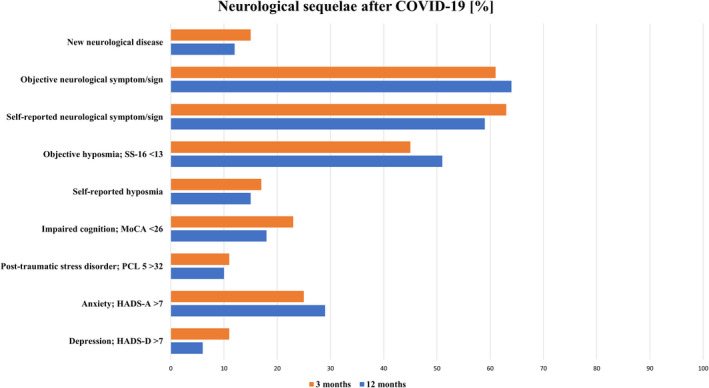
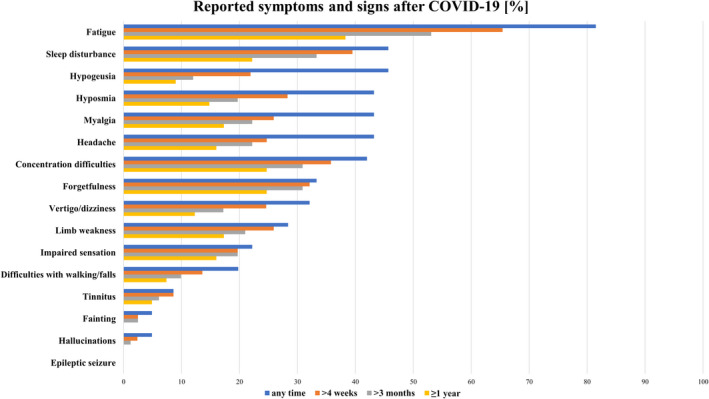
Eighty-one patients were evaluated 1 year after COVID-19, out of which 76 (94%) patients completed a 3-month and 1-year follow-up. Patients were 54 (47-64) years old and 59% were male. New and persistent neurological disorders were found in 15% (3 months) and 12% (10/81; 1 year). Symptoms at 1-year follow-up were reported by 48/81 (59%) patients, including fatigue (38%), concentration difficulties (25%), forgetfulness (25%), sleep disturbances (22%), myalgia (17%), limb weakness (17%), headache (16%), impaired sensation (16%) and hyposmia (15%). Neurological examination revealed findings in 52/81 (64%) patients without improvement over time (3 months, 61%, p = 0.230) including objective hyposmia (Sniffin' Sticks test <13; 51%). Cognitive deficits were apparent in 18%, whereas signs of depression, anxiety and post-traumatic stress disorders were found in 6%, 29% and 10% respectively 1 year after infection. These mental and cognitive disorders had not improved after the 3-month follow-up (all p > 0.05).
Our data indicate that a significant patient number still suffer from neurological sequelae including neuropsychiatric symptoms 1 year after COVID-19 calling for interdisciplinary management of these patients.
新冠病毒疾病 2019(COVID-19)后的神经系统后遗症可能在急性感染康复后仍持续存在。在这里,目的是描述 COVID-19 后 1 年以上神经系统表现的自然史。
对 COVID-19 幸存者进行了一项前瞻性、多中心、纵向队列研究。在 3 个月和 1 年的随访中,通过神经系统检查和包括嗅觉减退(16 项 Sniffin' Sticks 测试)、认知缺陷(蒙特利尔认知评估<26)和心理健康(医院焦虑和抑郁量表和创伤后应激障碍清单 5)评估的标准化测试组合,对患者进行神经损伤评估。
81 例患者在 COVID-19 后 1 年进行了评估,其中 76 例(94%)患者完成了 3 个月和 1 年的随访。患者年龄为 54 岁(47-64 岁),59%为男性。在 3 个月和 1 年时,分别发现 15%(3 个月)和 12%(10/81;1 年)的新发和持续神经系统疾病。81 例患者中有 48/81(59%)在 1 年随访时报告了症状,包括疲劳(38%)、注意力困难(25%)、健忘(25%)、睡眠障碍(22%)、肌痛(17%)、肢体无力(17%)、头痛(16%)、感觉障碍(16%)和嗅觉减退(15%)。神经系统检查显示 81 例患者中有 52 例(64%)存在异常,且无随时间改善(3 个月时为 61%,p=0.230),包括客观嗅觉减退(Sniffin' Sticks 测试<13;51%)。认知缺陷在 18%的患者中明显,而在感染后 1 年,分别有 6%、29%和 10%的患者出现抑郁、焦虑和创伤后应激障碍的迹象。这些精神和认知障碍在 3 个月的随访后并未改善(均 p>0.05)。
我们的数据表明,相当数量的患者仍患有神经系统后遗症,包括神经精神症状,这表明需要对这些患者进行跨学科管理。