Departments of Communication and Political Science, University of Delaware, Newark, DE, USA.
Department of Communication, University of Delaware, Newark, DE, USA.
Soc Sci Med. 2022 Apr;298:114836. doi: 10.1016/j.socscimed.2022.114836. Epub 2022 Feb 24.
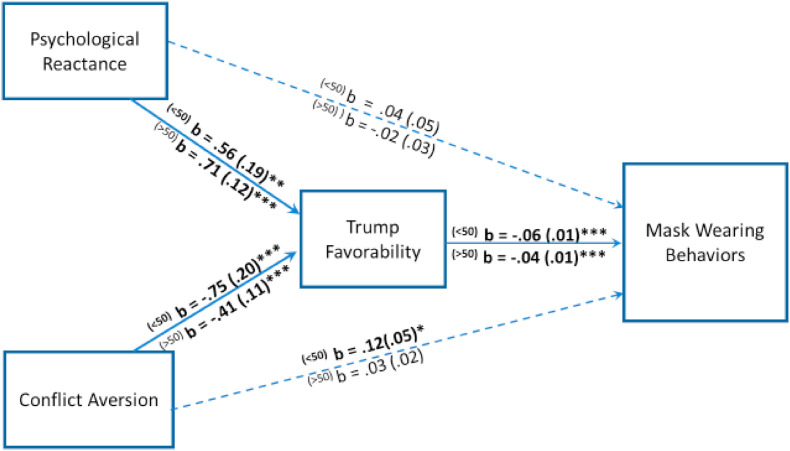
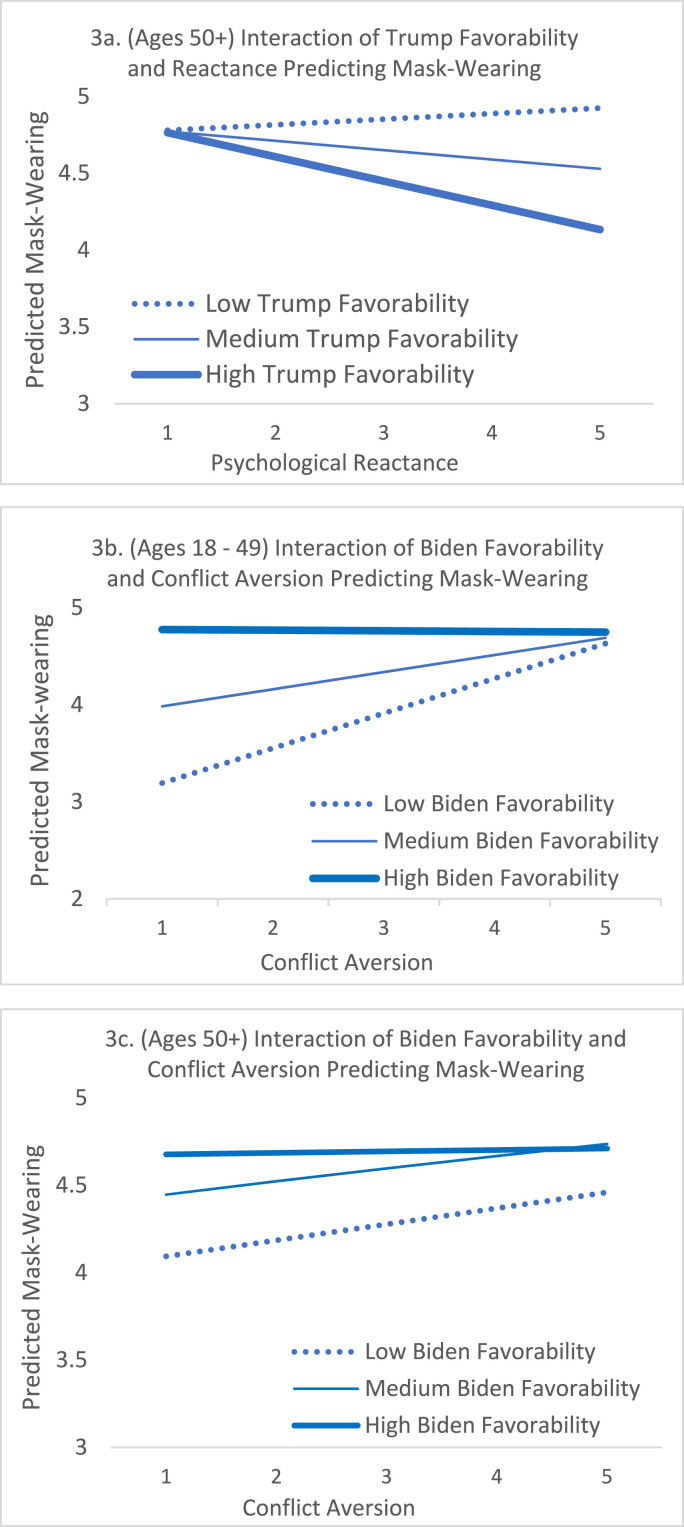
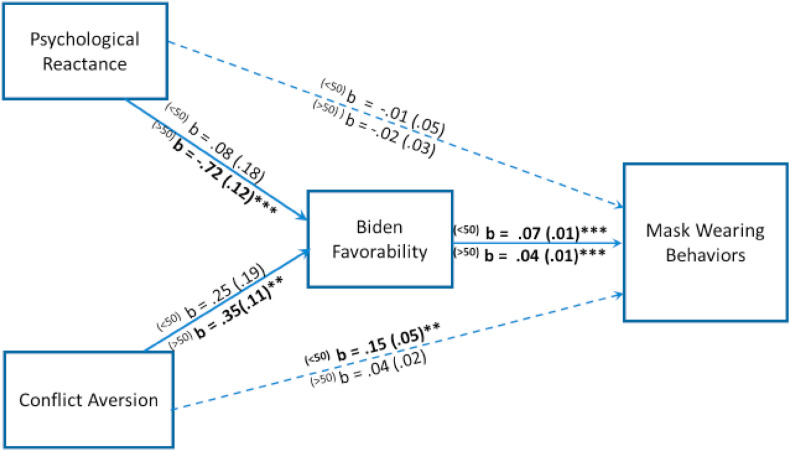
The current project examines how psychological reactance and conflict orientation relate to the highly politicized debate over mask-wearing in the U.S. during the COVID-19 pandemic. We explore how psychological reactance and conflict orientation are related to self-reported mask-wearing, and how these same predispositions are correlated with political beliefs. We then assess how favorability towards President Trump in the context of the 2020 Election was uniquely correlated with these traits and how Trump favorability both mediated and moderated the effects of conflict orientation and psychological reactance on individuals' likelihood of wearing masks. Results from a national survey of U.S. adults from Nov-Dec 2020 suggest that Trump favorability was positively associated with trait reactance, negatively associated with conflict aversion, and negatively associated with self-reported mask-wearing. The opposite was true of favorability towards Joe Biden. Moderation analyses indicate that conflict-approaching Biden detractors were especially unlikely to report wearing masks, while mediation analyses show that political preferences significantly mediated the relationships between both psychological traits and self-reported mask-wearing. Implications for the politicization of health messaging and health behavior are discussed.
当前的项目研究了心理抗拒和冲突倾向如何与 COVID-19 大流行期间美国关于戴口罩的高度政治化辩论相关。我们探讨了心理抗拒和冲突倾向如何与自我报告的戴口罩行为相关,以及这些相同的倾向如何与政治信仰相关。然后,我们评估了在 2020 年选举背景下对特朗普总统的好感度如何与这些特征独特相关,以及特朗普好感度如何调节和缓和冲突倾向和心理抗拒对个人戴口罩可能性的影响。对 2020 年 11 月至 12 月期间美国成年人进行的一项全国性调查的结果表明,特朗普的好感度与特质抗拒呈正相关,与冲突回避呈负相关,与自我报告的戴口罩行为呈负相关。而对乔·拜登的好感度则恰恰相反。调节分析表明,接近冲突的拜登反对者尤其不太可能报告戴口罩,而中介分析表明,政治偏好显著中介了这两种心理特征与自我报告的戴口罩行为之间的关系。讨论了这些发现对健康信息传递和健康行为政治化的影响。