Pir Mehr Ali Shah Arid Agriculture University, Rawalpindi, Pakistan.
National Agricultural Research Centre (NARC), Islamabad, Pakistan.
Sci Rep. 2022 Mar 4;12(1):3595. doi: 10.1038/s41598-022-07637-y.
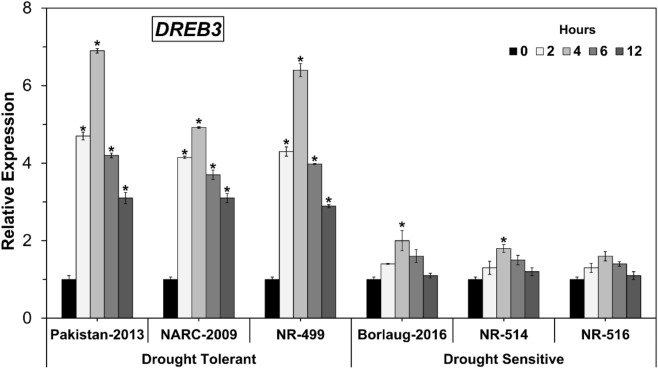
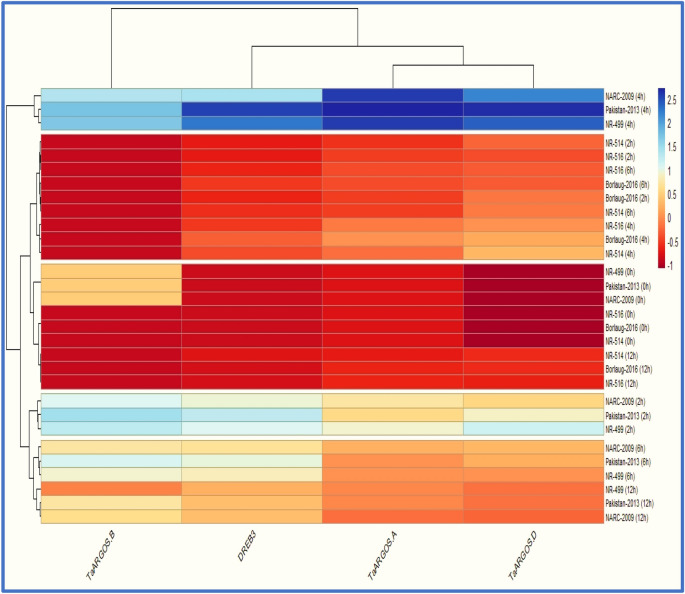
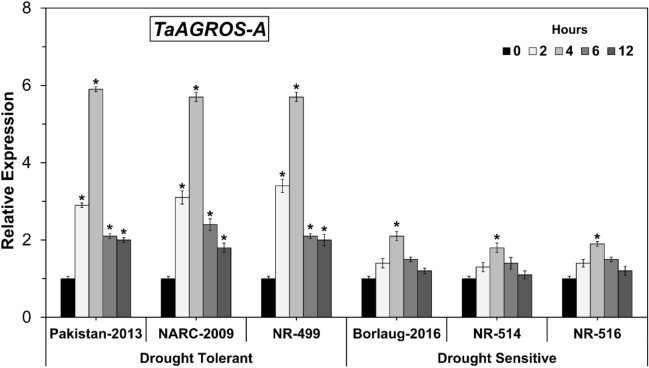
Drought tolerant germplasm is needed to increase crop production, since water scarcity is a critical bottleneck in crop productivity worldwide. Auxin Regulated Gene involved in Organ Size (ARGOS) is a large protein family of transcription factors that plays a vital role in organ size, plant growth, development, and abiotic stress responses in plants. Although, the ARGOS gene family has been discovered and functionalized in a variety of crop plants, but a comprehensive and systematic investigation of ARGOS genes in locally used commercial wheat cultivars is still yet to be reported. The relative expression of three highly conserved TaARGOS homoeologous genes (TaARGOS-A, TaARGOS-B, TaARGOS-D) was studied in three drought-tolerant (Pakistan-2013, NARC-2009 and NR-499) and three sensitive (Borlaug-2016, NR-514 and NR-516) wheat genotypes under osmotic stress, induced by PEG-6000 at 0 (exogenous control), 2, 4, 6, and 12 h. The normalization of target genes was done using β-actin as endogenous control, whereas DREB3, as a marker gene was also transcribed, reinforcing the prevalence of dehydration in all stress treatments. Real-time quantitative PCR revealed that osmotic stress induced expression of the three TaARGOS transcripts in different wheat seedlings at distinct timepoints. Overall, all genes exhibited significantly higher expression in the drought-tolerant genotypes as compared to the sensitive ones. For instance, the expression profile of TaARGOS-A and TaARGOS-D showed more than threefold increase at 2 h and six to sevenfold increase after 4 h of osmotic stress. However, after 6 h of osmotic stress these genes started to downregulate, and the lowest gene expression was noticed after 12 h of osmotic stress. Among all the homoeologous genes, TaARGOS-D, in particular, had a more significant influence on controlling plant growth and drought tolerance as it showed the highest expression. Altogether, TaARGOSs are involved in seedling establishment and overall plant growth. In addition, the tolerant group of genotypes had a much greater relative fold expression than the sensitive genotypes. Ultimately, Pakistan-2013 showed the highest relative expression of the studied genes than other genotypes which shows its proficiency to mitigate osmotic stress. Therefore, it could be cultivated in arid and semi-arid regions under moisture-deficient regimes. These findings advocated the molecular mechanism and regulatory roles of TaARGOS genes in plant growth and osmotic stress tolerance in contrasting groups of wheat genotypes, accompanied by the genetic nature of identified genotypes in terms of their potential for drought tolerance.
耐旱种质资源对于提高作物产量至关重要,因为水分短缺是全球作物生产力的关键瓶颈。生长素调节器官大小的基因(ARGOS)是一个大型转录因子家族,在器官大小、植物生长、发育和植物对非生物胁迫的反应中起着至关重要的作用。尽管 ARGOS 基因家族已在多种作物中被发现并具有功能,但在当地使用的商业小麦品种中,对 ARGOS 基因的全面系统研究仍有待报道。在渗透胁迫下,研究了三种高度保守的 TaARGOS 同源基因(TaARGOS-A、TaARGOS-B 和 TaARGOS-D)在三种耐旱(Pakistan-2013、NARC-2009 和 NR-499)和三种敏感(Borlaug-2016、NR-514 和 NR-516)小麦基因型中的相对表达,渗透胁迫由 PEG-6000 诱导,在 0(外源性对照)、2、4、6 和 12 h 时进行。使用β-肌动蛋白作为内参基因对靶基因进行归一化,而 DREB3 作为标记基因也被转录,这加强了所有胁迫处理中脱水的普遍性。实时定量 PCR 显示,在不同的小麦幼苗中,三种 TaARGOS 转录本在不同的时间点都受到渗透胁迫的诱导。总体而言,与敏感基因型相比,所有基因在耐旱基因型中的表达水平都显著升高。例如,在渗透胁迫 2 h 时,TaARGOS-A 和 TaARGOS-D 的表达谱增加了三倍以上,在渗透胁迫 4 h 后增加了六到七倍。然而,在 6 h 的渗透胁迫后,这些基因开始下调,在 12 h 的渗透胁迫后基因表达最低。在所有同源基因中,TaARGOS-D 对控制植物生长和耐旱性的影响更为显著,因为它的表达水平最高。总的来说,TaARGOSs 参与幼苗的建立和整个植物的生长。此外,耐旱基因型组的相对折叠表达比敏感基因型组高得多。最终,Pakistan-2013 比其他基因型表现出更高的研究基因的相对表达水平,这表明其缓解渗透胁迫的能力。因此,它可以在干旱和半干旱地区的水分不足的条件下种植。这些发现支持了 TaARGOS 基因在不同小麦基因型中植物生长和渗透胁迫耐受性的分子机制和调控作用,同时也说明了所鉴定基因型在耐旱性方面的遗传性质。