Oikonomou Evangelos, Souvaliotis Nektarios, Lampsas Stamatios, Siasos Gerasimos, Poulakou Garyphallia, Theofilis Panagiotis, Papaioannou Theodore G, Haidich Anna-Bettina, Tsaousi Georgia, Ntousopoulos Vasileios, Sakka Vissaria, Charalambous Georgios, Rapti Vasiliki, Raftopoulou Sylvia, Syrigos Konstantinos, Tsioufis Costas, Tousoulis Dimitris, Vavuranakis Manolis
3rd Department of Cardiology, National and Kapodistrian University of Athens, Medical School, Sotiria Chest Disease Hospital, Athens, Greece; 1st Department of Cardiology, National and Kapodistrian University of Athens, Medical School, Hippokration General Hospital, Athens, Greece.
3rd Department of Cardiology, National and Kapodistrian University of Athens, Medical School, Sotiria Chest Disease Hospital, Athens, Greece.
Vascul Pharmacol. 2022 Jun;144:106975. doi: 10.1016/j.vph.2022.106975. Epub 2022 Mar 3.
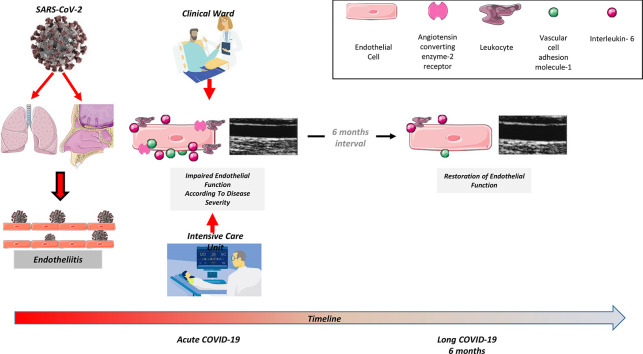
Coronavirus disease-19 (COVID-19) is implicated by active endotheliitis, and cardiovascular morbidity. The long-COVID-19 syndrome implications in atherosclerosis have not been elucidated yet. We assessed the immediate, intermediate, and long-term effects of COVID-19 on endothelial function.
In this prospective cohort study, patients hospitalized for COVID-19 at the medical ward or Intensive Care Unit (ICU) were enrolled and followed up to 6 months post-hospital discharge. Medical history and laboratory examinations were performed while the endothelial function was assessed by brachial artery flow-mediated dilation (FMD). Comparison with propensity score-matched cohort (control group) was performed at the acute (upon hospital admission) and follow-up (1 and 6 months) stages.
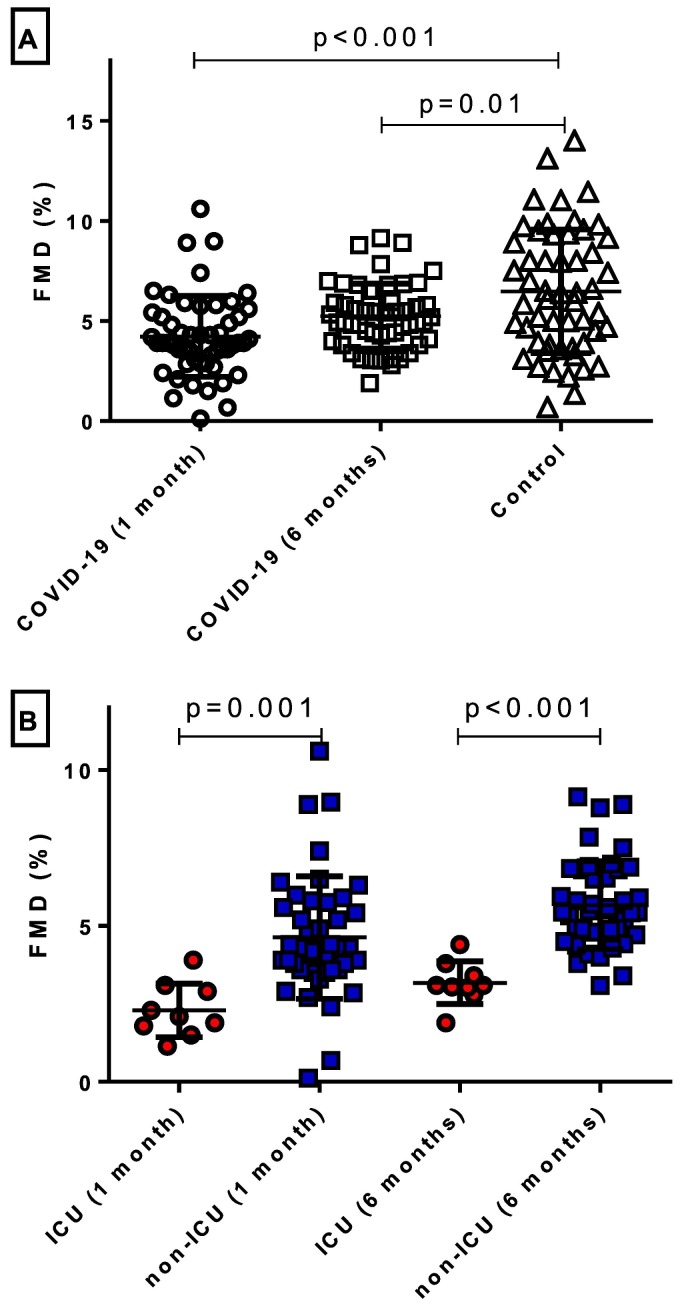
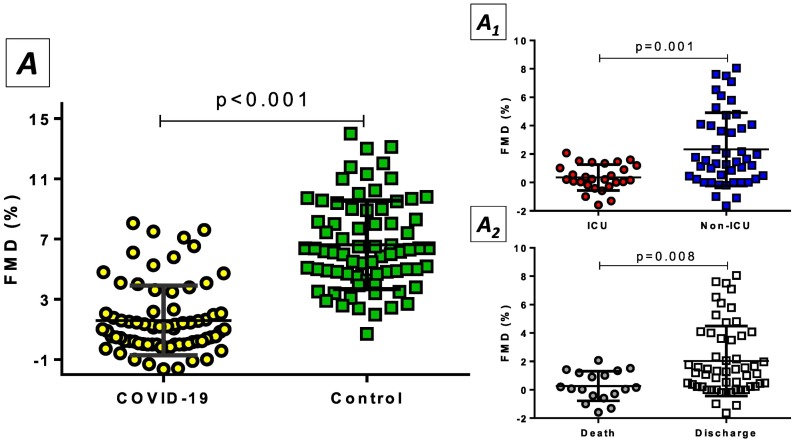
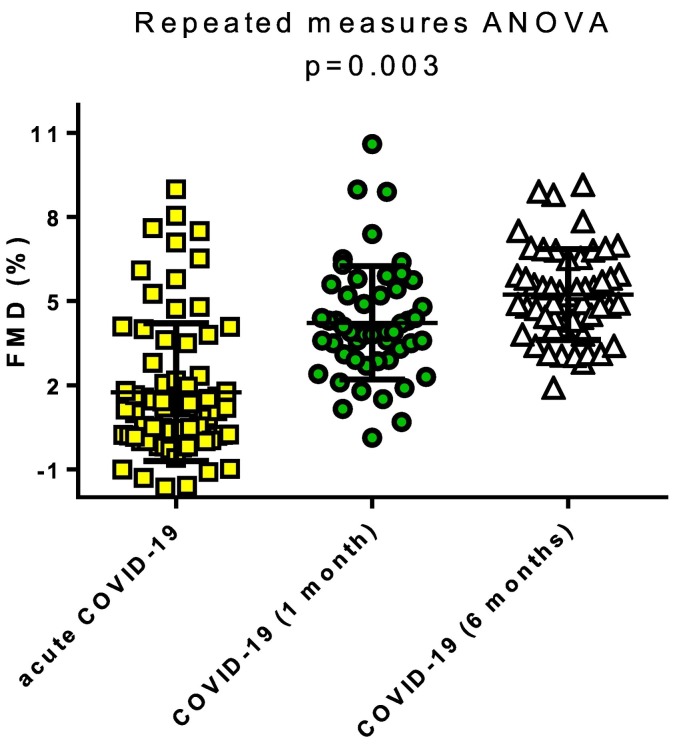
Seventy-three patients diagnosed with COVID-19 (37% admitted in ICU) were recruited. FMD was significantly (p < 0.001) impaired in the COVID-19 group (1.65 ± 2.31%) compared to the control (6.51 ± 2.91%). ICU-treated subjects presented significantly impaired (p = 0.001) FMD (0.48 ± 1.01%) compared to those treated in the medical ward (2.33 ± 2.57%). During hospitalization, FMD was inversely associated with Interleukin-6 and Troponin I (p < 0.05 for all). Although, a significant improvement in FMD was noted during the follow-up (acute: 1.75 ± 2.19% vs. 1 month: 4.23 ± 2.02%, vs. 6 months: 5.24 ± 1.62%; p = 0.001), FMD remained impaired compared to control (6.48 ± 3.08%) at 1 month (p < 0.001) and 6 months (p = 0.01) post-hospital discharge.
COVID-19 patients develop a notable endothelial dysfunction, which is progressively improved over a 6-month follow-up but remains impaired compared to healthy controls subjects. Whether chronic dysregulation of endothelial function following COVID-19 could be accompanied by a residual risk for cardiovascular and thrombotic events merits further research.
新型冠状病毒肺炎(COVID-19)与活动性血管内皮炎及心血管疾病相关。COVID-19长期综合征对动脉粥样硬化的影响尚未阐明。我们评估了COVID-19对内皮功能的即时、中期和长期影响。
在这项前瞻性队列研究中,纳入在内科病房或重症监护病房(ICU)因COVID-19住院的患者,并在出院后随访6个月。记录病史并进行实验室检查,同时通过肱动脉血流介导的血管舒张功能(FMD)评估内皮功能。在急性期(入院时)和随访期(1个月和6个月)与倾向评分匹配队列(对照组)进行比较。
招募了73例确诊为COVID-19的患者(37%入住ICU)。与对照组(6.51±2.91%)相比,COVID-19组的FMD明显受损(p<0.001)(1.65±2.31%)。与在内科病房治疗的患者(2.33±2.57%)相比,在ICU治疗的患者FMD明显受损(p=0.001)(0.48±1.01%)。住院期间,FMD与白细胞介素-6和肌钙蛋白I呈负相关(均p<0.05)。尽管在随访期间FMD有显著改善(急性期:1.75±2.19% vs. 1个月:4.23±2.02%,vs. 6个月:5.24±1.62%;p=0.001),但出院后1个月(p<0.001)和6个月(p=0.01)时,与对照组(6.48±3.08%)相比,FMD仍受损。
COVID-19患者出现明显的内皮功能障碍,在6个月的随访中逐渐改善,但与健康对照相比仍受损。COVID-19后内皮功能的慢性失调是否会伴有心血管和血栓事件的残余风险值得进一步研究。