Su Ruibing, Cai Lijun, Xiong Pan, Liu Zhiwei, Chen Shaobin, Liu Xi, Lin Runhua, Lei Zhijin, Tian Dongping, Su Min
Institute of Clinical Pathology, Department of Pathology, Shantou University Medical College, Shantou, Guangdong, People's Republic of China.
Department of Thoracic Surgery, Cancer Hospital of Shantou University Medical College, Shantou, Guangdong, People's Republic of China.
J Inflamm Res. 2022 Feb 28;15:1437-1456. doi: 10.2147/JIR.S348786. eCollection 2022.
Toll-like receptor 3 (TLR3) not only plays a crucial role in innate immune and inflammation but also in anti-cancer immunity. Nevertheless, the clinicopathological outcome of TLR3 in ESCC is still ambiguous.
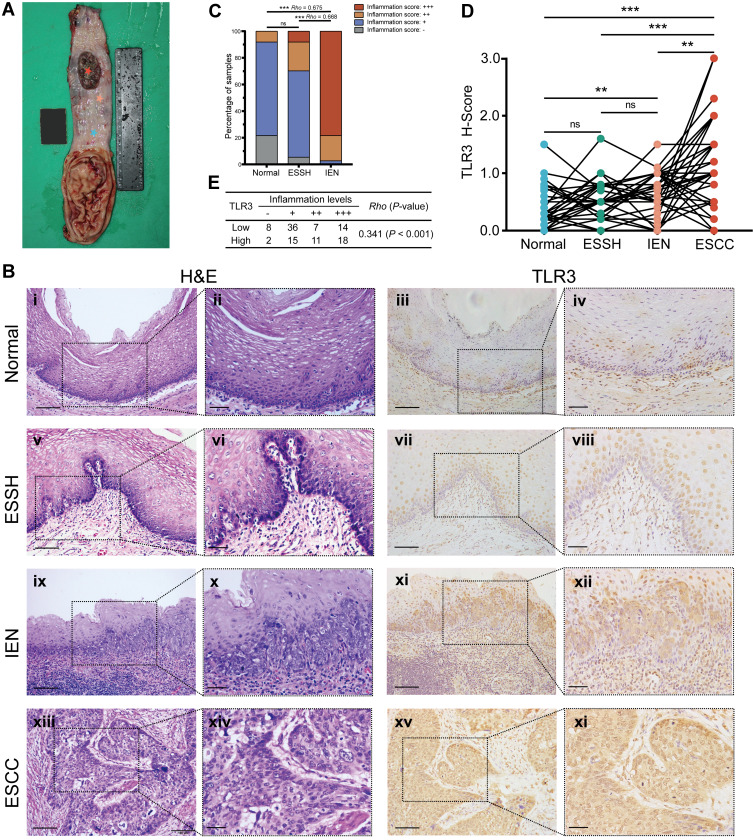
Immunohistochemistry was performed to investigate TLR3 expression and its impact on survival in 137 ESCC patients (including paired esophageal tissues with different stages of early lesions from 37 patients). Furthermore, we downloaded ESCC RNA-seq datasets (including phenotype and survival data) from The Cancer Genome Atlas (TCGA). The relationship between TLR3 and prognosis, biological landscape, and immune infiltration was assessed to verify the immunohistochemical results of our tissue samples, explore the possible mechanism of prognostic outcomes, and predict the sensitivity of immunotherapy.
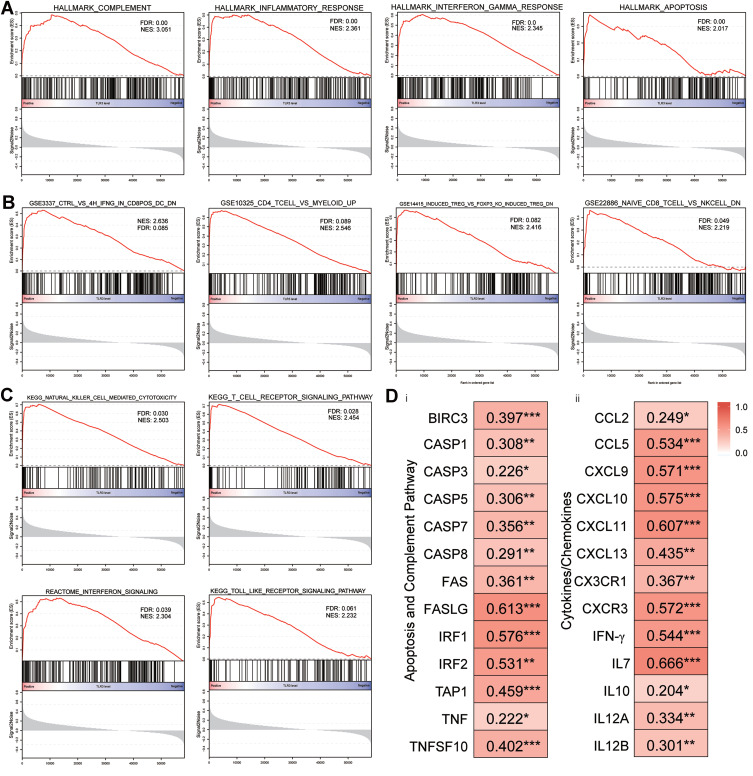
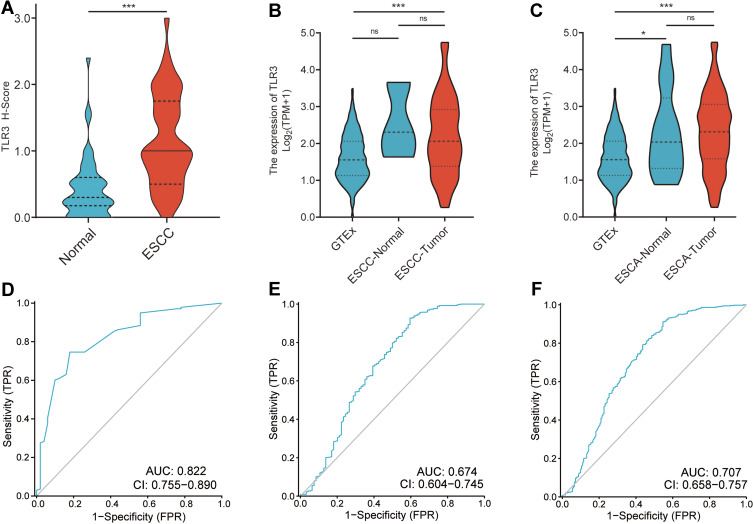
TLR3 protein expression displayed an increasing trend in the progression through different grades of cellular atypia, from normal, esophageal simple hyperplasia (ESSH), intraepithelial neoplasia (IEN) to ESCC ( < 0.0083). TLR3 protein had a positive association with inflammation level ( = 0.341, < 0.001). mRNA expression was significantly higher in comparison to adjacent normal tissues ( < 0.001). Cox regression analysis indicated high TLR3 protein and mRNA expression conferred good prognosis in our samples and TCGA, especially for advanced ESCC patients (TNM stage III and IV). Overexpression of resulted in an immune-active microenvironment via the recruitment of immune-active cells including cytotoxic lymphocytes (CTLs), CD8+ T cells, NK cells, dendritic cells, and M1-type macrophages. expression was correlated with the pro-inflammatory cytokines and chemokines relating to anti-tumor immunity. Moreover, GSEA analysis indicated upregulated expression of could activate the apoptotic pathway.
High TLR3 expression in ESCC patients was associated with a more favorable prognosis, immune-active cell infiltration, and an activated apoptotic pathway. TLR3 has potential applications for immunotherapy and immune response prediction in patients with ESCC.
Toll样受体3(TLR3)不仅在先天免疫和炎症中起关键作用,而且在抗癌免疫中也发挥作用。然而,TLR3在食管癌中的临床病理结果仍不明确。
采用免疫组织化学方法研究137例食管癌患者(包括37例患者不同早期病变阶段的配对食管组织)中TLR3的表达及其对生存的影响。此外,我们从癌症基因组图谱(TCGA)下载了食管癌RNA测序数据集(包括表型和生存数据)。评估TLR3与预后、生物学特征和免疫浸润之间的关系,以验证我们组织样本的免疫组化结果,探索预后结果的可能机制,并预测免疫治疗的敏感性。
TLR3蛋白表达在从正常食管、食管单纯性增生(ESSH)、上皮内瘤变(IEN)到食管癌的不同细胞异型性分级进展过程中呈上升趋势(<0.0083)。TLR3蛋白与炎症水平呈正相关(=0.341,<0.001)。与相邻正常组织相比,TLR3 mRNA表达显著更高(<0.001)。Cox回归分析表明,在我们的样本和TCGA中,高TLR3蛋白和mRNA表达赋予良好的预后,尤其是对于晚期食管癌患者(TNM III期和IV期)。TLR3的过表达通过招募包括细胞毒性淋巴细胞(CTL)、CD8 + T细胞、NK细胞、树突状细胞和M1型巨噬细胞在内的免疫活性细胞导致免疫活性微环境。TLR3表达与与抗肿瘤免疫相关的促炎细胞因子和趋化因子相关。此外,基因集富集分析(GSEA)表明TLR3表达上调可激活凋亡途径。
食管癌患者中高TLR3表达与更有利的预后、免疫活性细胞浸润和激活的凋亡途径相关。TLR3在食管癌患者的免疫治疗和免疫反应预测方面具有潜在应用价值。