Pietroletti R, Bishop A E, Carlei F, Bonamico M, Lloyd R V, Wilson B S, Ceccamea A, Lezoche E, Speranza V, Polak J M
Gut. 1986 Jul;27(7):838-43. doi: 10.1136/gut.27.7.838.
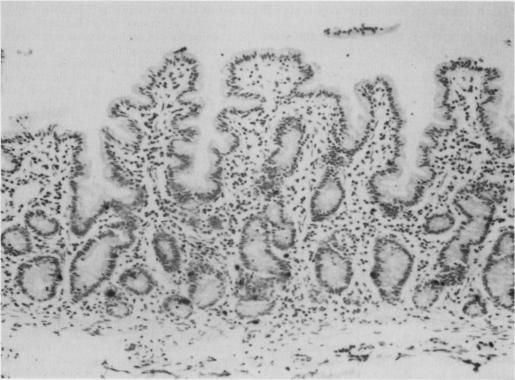
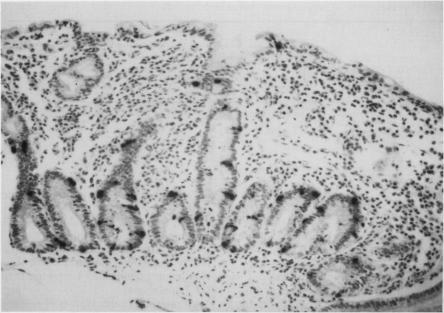
Abnormalities of gut endocrine responses, as well as changes in the number of different endocrine cell types, have been reported convincingly in coeliac patients. Nevertheless, no estimation of total numbers of gut endocrine cells has yet been made in well defined groups of coeliacs. In this study, we have visualised all endocrine cell types in jejunal biopsies from coeliac patients with active and quiescent disease as well as in controls, using a monoclonal antibody to chromogranin. This protein was purified originally from bovine adrenal medulla and is known to be a reliable marker for all endocrine cells of the gut. The following groups were considered: (a) nine coeliacs with active illness, (b) 10 coeliacs under gluten-free diet, (c) eight coeliacs receiving gluten challenge, (d) five non-coeliacs (controls). Histological (haematoxylin and eosin) and immunocytochemical (peroxidase anti-peroxidase) stains were applied to 3 micron paraffin sections. Quantitative estimation of endocrine cell density was made using four different methods in order to evaluate the results fully (number of cells/mm2, number of cells/visual field, number of cells/8 crypts-villi, number of cells/unit of length of muscularis mucosae). In patient groups (a) and (c), coeliacs with active disease and coeliacs on gluten challenge diet respectively, a significantly higher number of endocrine cells was observed in comparison with normal controls (group d). In group (b) patients, coeliacs on gluten-free diet, no significant changes in the number of endocrine cells were observed in comparison with controls. Our results show that a significant increase in endocrine cell density exists in coeliacs with active illness (groups a and c), in comparison with controls. This condition is resolved in coeliacs receiving a gluten-free diet (group b).
乳糜泻患者肠道内分泌反应异常以及不同内分泌细胞类型数量的变化已有令人信服的报道。然而,尚未对明确分组的乳糜泻患者的肠道内分泌细胞总数进行估计。在本研究中,我们使用抗嗜铬粒蛋白单克隆抗体,对患有活动期和静止期疾病的乳糜泻患者以及对照组的空肠活检组织中的所有内分泌细胞类型进行了可视化。这种蛋白质最初是从牛肾上腺髓质中纯化出来的,已知是肠道所有内分泌细胞的可靠标志物。研究考虑了以下几组:(a) 9名患有活动期疾病的乳糜泻患者,(b) 10名接受无麸质饮食的乳糜泻患者,(c) 8名接受麸质激发试验的乳糜泻患者,(d) 5名非乳糜泻患者(对照组)。对3微米厚的石蜡切片进行组织学(苏木精和伊红)和免疫细胞化学(过氧化物酶抗过氧化物酶)染色。为了全面评估结果,使用四种不同方法对内分泌细胞密度进行定量估计(每平方毫米细胞数、每个视野细胞数、每8个隐窝 - 绒毛细胞数、每单位黏膜肌层长度细胞数)。在患者组(a)和(c)中,分别为患有活动期疾病的乳糜泻患者和接受麸质激发试验饮食的乳糜泻患者,与正常对照组(组d)相比,观察到内分泌细胞数量显著增加。在组(b)的患者中,即接受无麸质饮食的乳糜泻患者,与对照组相比,未观察到内分泌细胞数量有显著变化。我们的结果表明,与对照组相比,患有活动期疾病的乳糜泻患者(组a和c)内分泌细胞密度显著增加。这种情况在接受无麸质饮食的乳糜泻患者(组b)中得到缓解。