Cell & Molecular Biology Department, Mental Health Program, QIMR Berghofer Medical Research Institute, Brisbane, QLD, Australia.
Faculty of Medicine, The University of Queensland, Brisbane, QLD, Australia.
Pharm Res. 2022 Mar;39(3):427-439. doi: 10.1007/s11095-022-03185-2. Epub 2022 Mar 7.
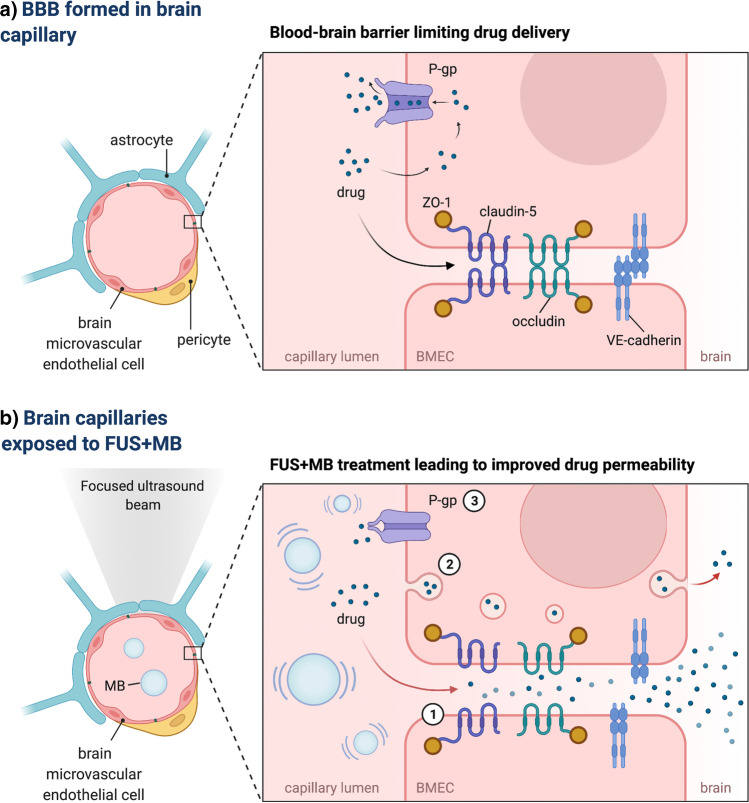
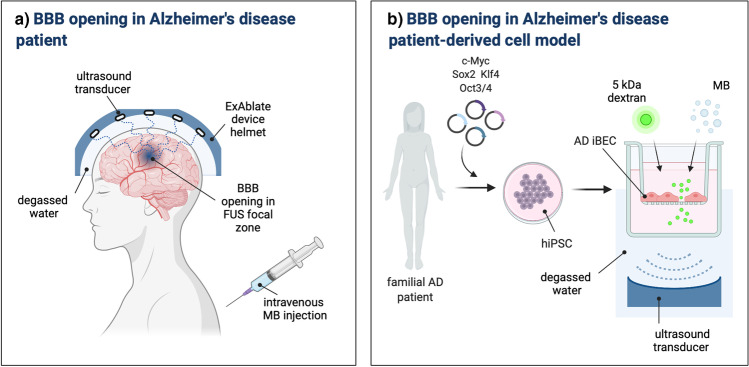
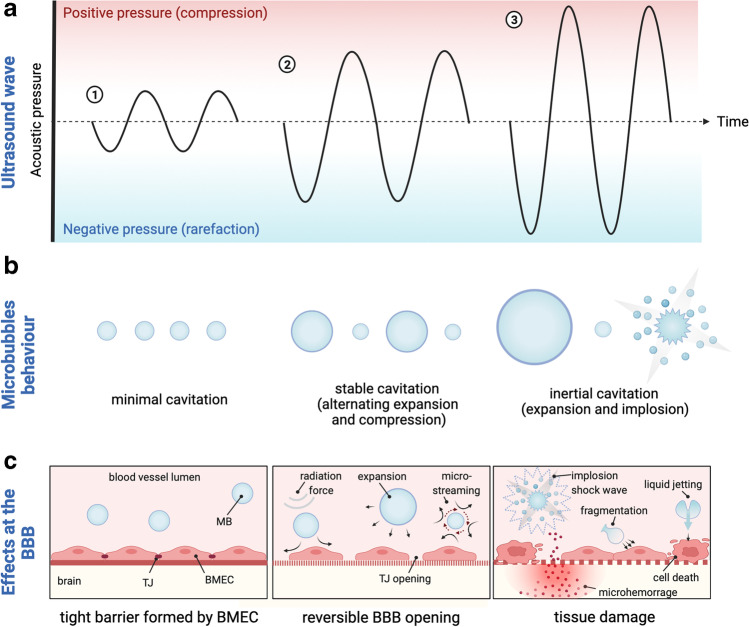
The blood-brain barrier (BBB) has a major protective function in preventing the entry of harmful molecules into the brain, but is simultaneously limiting the delivery of drugs, restricting their potential clinical application in neurodegenerative diseases. Recent preclinical evidence demonstrates that following application of focused ultrasound with microbubbles (FUS+MB), the BBB becomes reversibly accessible to compounds that normally are brain-impermeable, suggesting FUS+MB as a promising new platform for delivery of therapeutic agents into the central nervous system. As a step towards translation, small cohort clinical studies were performed demonstrating safe BBB opening in Alzheimer's disease, Parkinson's disease and amyotrophic lateral sclerosis (ALS) patients following FUS+MB, however improved drug delivery has not yet been achieved in human. Simultaneously, rapid progress in the human induced pluripotent stem cell (hiPSC) modeling technology allowed for development of novel Alzheimer's disease patient-derived BBB in vitro model that reacts to FUS+MB with BBB opening and can be used to answer fundamental questions of human BBB responses to FUS+MB in health and disease. This review summarizes key features of the BBB that contribute to limited drug delivery, recapitulates recent advances in the FUS+MB mediated human BBB opening in vivo and in vitro in the context of neurodegenerative disorders, and highlights potential strategies for fast-track translation of the FUS+MB to improve bioavailability of drugs to the human brain. With safe and effective application, this innovative FUS+MB technology may open new avenues for therapeutic interventions in neurodegenerative diseases leading to improved clinical outcomes for patients.
血脑屏障(BBB)在防止有害物质进入大脑方面具有重要的保护功能,但同时也限制了药物的输送,限制了它们在神经退行性疾病中的潜在临床应用。最近的临床前证据表明,在应用聚焦超声联合微泡(FUS+MB)后,BBB 可暂时对通常无法穿透大脑的化合物开放,这表明 FUS+MB 是一种有前途的向中枢神经系统输送治疗剂的新平台。作为向临床转化的一步,进行了小队列临床研究,结果表明在阿尔茨海默病、帕金森病和肌萎缩侧索硬化症(ALS)患者中,应用 FUS+MB 后 BBB 开放是安全的,但尚未在人类中实现改善药物输送。与此同时,人类诱导多能干细胞(hiPSC)建模技术的快速发展使得开发出了新型的体外阿尔茨海默病患者来源的 BBB 模型,该模型对 FUS+MB 反应开放 BBB,可用于回答人类 BBB 对 FUS+MB 在健康和疾病中的反应的基本问题。这篇综述总结了导致药物输送受限的 BBB 的关键特征,回顾了最近在神经退行性疾病中 FUS+MB 介导的体内和体外 BBB 开放的进展,并强调了快速转化 FUS+MB 以提高药物向人脑生物利用度的潜在策略。通过安全有效的应用,这项创新的 FUS+MB 技术可能为神经退行性疾病的治疗干预开辟新途径,从而改善患者的临床结局。