The Andlinger Center for Energy and the Environment, Princeton University, Princeton, United States.
Department of Chemical and Biological Engineering, Princeton University, Princeton, United States.
Elife. 2022 Mar 8;11:e71226. doi: 10.7554/eLife.71226.
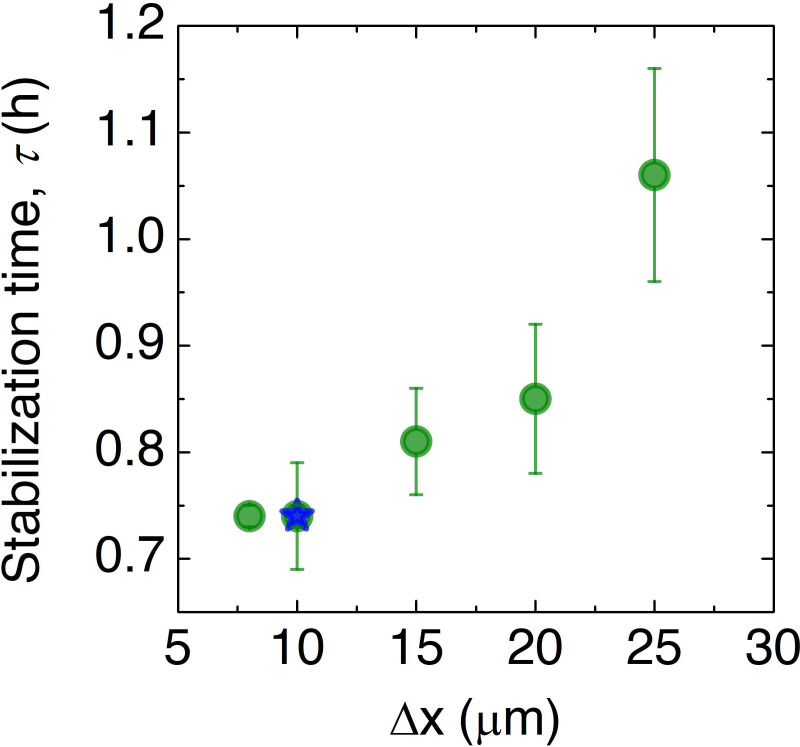
Collective migration-the directed, coordinated motion of many self-propelled agents-is a fascinating emergent behavior exhibited by active matter with functional implications for biological systems. However, how migration can persist when a population is confronted with perturbations is poorly understood. Here, we address this gap in knowledge through studies of bacteria that migrate via directed motion, or chemotaxis, in response to a self-generated nutrient gradient. We find that bacterial populations autonomously smooth out large-scale perturbations in their overall morphology, enabling the cells to continue to migrate together. This smoothing process arises from spatial variations in the ability of cells to sense and respond to the local nutrient gradient-revealing a population-scale consequence of the manner in which individual cells transduce external signals. Altogether, our work provides insights to predict, and potentially control, the collective migration and morphology of cellular populations and diverse other forms of active matter.
集体迁移——许多自主运动的个体的定向、协调运动——是一种具有功能意义的生物系统中活跃物质表现出的迷人的涌现行为。然而,当一个群体面临干扰时,迁移如何能够持续下去,这一点我们还知之甚少。在这里,我们通过研究细菌来解决这一知识空白,这些细菌通过定向运动或趋化性来响应自身产生的营养梯度进行迁移。我们发现,细菌群体能够自主地平滑其整体形态的大规模干扰,使细胞能够继续一起迁移。这个平滑过程源于细胞感知和响应局部营养梯度的能力的空间变化——揭示了个体细胞转导外部信号的方式所产生的群体尺度的后果。总的来说,我们的工作提供了预测和潜在控制细胞群体以及其他形式的活跃物质的集体迁移和形态的见解。