Sui Wuyou, Rush Jonathan, Rhodes Ryan E
Exercise and Health Psychology Lab, Western University, London, ON, Canada.
Department of Human Development and Family Studies, College of Health and Human Development, Pennsylvania State University, University Park, PA, United States.
JMIR Form Res. 2022 Mar 8;6(3):e25055. doi: 10.2196/25055.
The COVID-19 pandemic has drastically changed the physical activity (PA) landscape through the closures of gymnasiums, schools, and many outdoor spaces. Physical distancing guidelines have also reduced opportunity for PA. The popularity of free web-based home fitness videos on video hosting platforms (eg, YouTube and Instagram) has spiked during the pandemic. Many web-based fitness videos offer a convenient, accessible, and cost-effective means of engaging in PA through regularly posted videos or discrete programs. Notably, traditional PA programs often suffer from poor adherence and high dropout rates, despite many advantages over web-based workout programs (eg, equipment, feedback, and in-person engagement). Thus, notwithstanding clear advantages of these web-based fitness videos, their ability to maintain long-term engagement and adherence is unknown.
We explored patterns of engagement (ie, views, likes, and comments) for channels posting daily or program-based web-based fitness videos since the declaration of COVID-19 as a pandemic, over 4 months. Our secondary objective was to examine potential moderators of engagement metrics.
An environmental scan was used to identify eligible channels. Eligible channels were (1) freely available on YouTube or Instagram and (2) posted daily or weekday series workouts or offered quarantine-specific workout programs. Searches for eligible channels were conducted on June 1 and 4, 2020. Engagement metrics of views, likes, and comments were then collected from channels' videos posted between March 11 and June 26 or 30, 2020, inclusive, on June 26 or July 8, 2020. A series of multilevel modeling analyses were conducted to examine longitudinal changes in each of the 3 outcome variables.
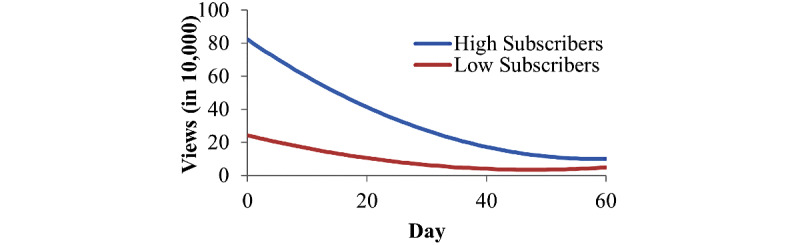
Ten channels were deemed eligible and included in analyses; 6 posted regularly, while the other 4 posted discrete workout programs. Multilevel models revealed that both views and likes significantly decreased across days. Visually, channels display the sharpest drop in engagement within the first week. Linear change estimate indicates that the number of views initially declined by 24,700 per day (95% CI -44,400 to -11,300, P=.01) on average across all the channels. Channels with more subscribers declined in their views, likes, and comments at a significantly higher rate than those with fewer subscribers (P≤.04). The day of the week a video is posted, "virality," and content of a video appear to influence engagement. Integrating behavior change techniques and posting new and varied videos often may help garner further engagement with these videos. Future research should examine common elements of videos, which drive engagement.
Despite raw engagement metrics, each channel demonstrated peak engagement with the initial video followed by decreased engagement with subsequent videos. As many countries maintain restrictions on traditional PA facilities owing to the COVID-19 pandemic, determining methods to improve engagement and adherence with web-based fitness videos becomes increasingly important.

新冠疫情通过关闭体育馆、学校和许多户外场所,极大地改变了体育活动(PA)的格局。社交距离指导原则也减少了进行体育活动的机会。在疫情期间,视频托管平台(如YouTube和Instagram)上免费的网络居家健身视频的受欢迎程度大幅上升。许多网络健身视频通过定期发布视频或离散课程,提供了一种方便、可及且经济高效的参与体育活动的方式。值得注意的是,尽管传统体育活动项目比网络健身课程有许多优势(如设备、反馈和面对面互动),但它们往往存在依从性差和辍学率高的问题。因此,尽管这些网络健身视频有明显优势,但其维持长期参与度和依从性的能力尚不清楚。
我们探讨了自新冠疫情宣布以来的4个多月里,发布每日或基于课程的网络健身视频的频道的参与模式(即观看量、点赞数和评论数)。我们的次要目的是研究参与度指标的潜在调节因素。
采用环境扫描来确定符合条件的频道。符合条件的频道需满足:(1)在YouTube或Instagram上免费提供;(2)每日发布或工作日系列锻炼视频,或提供特定的隔离锻炼课程。于2020年6月1日和4日搜索符合条件的频道。然后在2020年6月26日或7月8日收集2020年3月11日至6月26日或30日(含)期间这些频道发布的视频的观看量、点赞数和评论数等参与度指标。进行了一系列多层次建模分析,以检验这3个结果变量各自的纵向变化。
10个频道被认为符合条件并纳入分析;6个频道定期发布,另外4个频道发布离散的锻炼课程。多层次模型显示,观看量和点赞数在各天均显著下降。直观来看,各频道在第一周内参与度下降最为明显。线性变化估计表明,所有频道的观看量平均每天最初下降24700次(95%置信区间为-44400至-11300,P =.01)。订阅者较多的频道在观看量、点赞数和评论数方面的下降速度明显高于订阅者较少的频道(P≤.04)。视频发布的星期几、“传播力”和视频内容似乎会影响参与度。整合行为改变技巧并经常发布新颖多样的视频可能有助于提高对这些视频的进一步参与度。未来的研究应考察推动参与度的视频的共同要素。
尽管有原始的参与度指标,但每个频道在最初的视频中表现出最高的参与度,随后对后续视频的参与度下降。由于新冠疫情,许多国家对传统体育活动设施仍保持限制,因此确定提高对网络健身视频的参与度和依从性的方法变得越来越重要。