• 文献检索
  • 文档翻译
  • 深度研究
  • 学术资讯
  • Suppr Zotero 插件Zotero 插件
  • 邀请有礼
  • 套餐&价格
  • 历史记录
应用&插件
Suppr Zotero 插件Zotero 插件浏览器插件Mac 客户端Windows 客户端微信小程序
定价
高级版会员购买积分包购买API积分包
服务
文献检索文档翻译深度研究API 文档MCP 服务
关于我们
关于 Suppr公司介绍联系我们用户协议隐私条款
关注我们

Suppr 超能文献

核心技术专利:CN118964589B侵权必究
粤ICP备2023148730 号-1Suppr @ 2026

文献检索

告别复杂PubMed语法,用中文像聊天一样搜索,搜遍4000万医学文献。AI智能推荐,让科研检索更轻松。

立即免费搜索

文件翻译

保留排版,准确专业,支持PDF/Word/PPT等文件格式,支持 12+语言互译。

免费翻译文档

深度研究

AI帮你快速写综述,25分钟生成高质量综述,智能提取关键信息,辅助科研写作。

立即免费体验

生物过滤技术综述:去除受污染水中挥发性有机化合物和重金属的最新进展。

A review on biofiltration techniques: recent advancements in the removal of volatile organic compounds and heavy metals in the treatment of polluted water.

机构信息

Departamento de Ingeniería Mecánica, Facultad de Ingeniería, Universidad de Tarapacá, Arica, Chile.

Department of Physics, A.D.M. College for Women (Autonomous), Nagapattinam, 611001, India.

出版信息

Bioengineered. 2022 Apr;13(4):8432-8477. doi: 10.1080/21655979.2022.2050538.

DOI:10.1080/21655979.2022.2050538
PMID:35260028
原文链接:https://pmc.ncbi.nlm.nih.gov/articles/PMC9161908/
Abstract

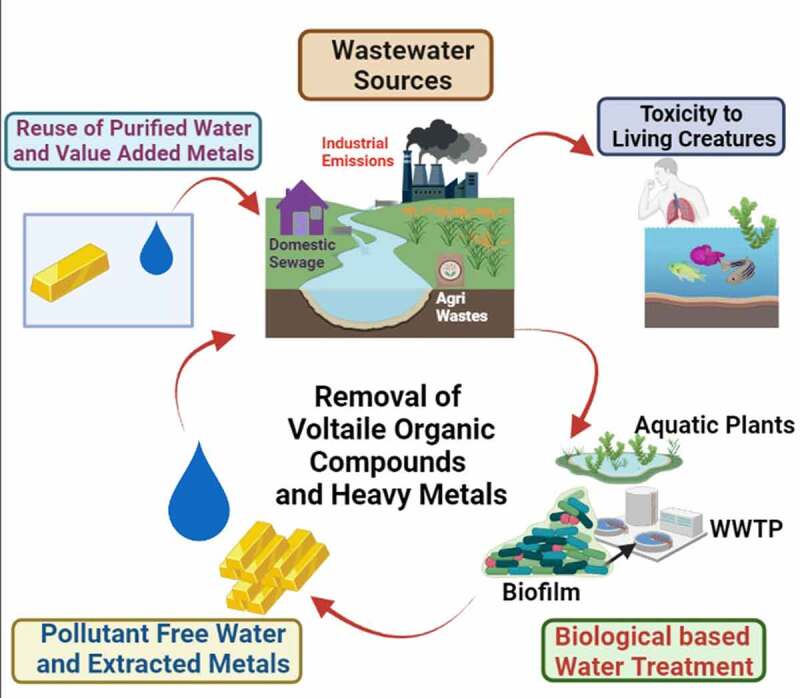
Good quality of water determines the healthy life of living beings on this earth. The cleanliness of water was interrupted by the pollutants emerging out of several human activities. Industrialization, urbanization, heavy population, and improper disposal of wastes are found to be the major reasons for the contamination of water. Globally, the inclusion of volatile organic compounds (VOCs) and heavy metals released by manufacturing industries, pharmaceuticals, and petrochemical processes have created environmental issues. The toxic nature of these pollutants has led researchers, scientists, and industries to exhibit concern toward the complete eradication of them. In this scenario, the development of wastewater treatment methodologies at low cost and in an eco-friendly way had gained importance at the international level. Recently, bio-based technologies were considered for environmental remedies. Biofiltration-based works have shown a significant result for the removal of volatile organic compounds and heavy metals in the treatment of wastewater. This was done with several biological sources such as bacteria, fungi, algae, plants, yeasts, etc. The biofiltration technique is cost-effective, simple, biocompatible, sustainable, and eco-friendly compared to conventional techniques. This review article provides deep insight into biofiltration technologies engaged in the removal of volatile organic compounds and heavy metals in the wastewater treatment process.

摘要

优质的水决定了地球上生物的健康生活。水的清洁度被人类活动产生的污染物所打断。工业化、城市化、人口密集和废物处理不当被认为是水污染的主要原因。在全球范围内,制造工业、制药和石化过程中释放的挥发性有机化合物 (VOCs) 和重金属的存在,已经造成了环境问题。这些污染物的毒性导致研究人员、科学家和工业界对它们的完全消除表示关注。在这种情况下,以低成本和环保的方式开发废水处理方法在国际上变得尤为重要。最近,生物基技术被认为是一种环境补救措施。基于生物过滤的工作已经显示出在处理废水中去除挥发性有机化合物和重金属方面的显著效果。这是通过几种生物来源如细菌、真菌、藻类、植物、酵母等来实现的。与传统技术相比,生物过滤技术具有成本效益高、简单、生物相容性好、可持续和环保等优点。本文综述了生物过滤技术在去除废水中挥发性有机化合物和重金属方面的应用。
https://cdn.ncbi.nlm.nih.gov/pmc/blobs/e92d/9161908/46a565ab8a84/KBIE_A_2050538_F0012_OC.jpg
https://cdn.ncbi.nlm.nih.gov/pmc/blobs/e92d/9161908/c41b051980f6/KBIE_A_2050538_UF0001_OC.jpg
https://cdn.ncbi.nlm.nih.gov/pmc/blobs/e92d/9161908/c70d2d7e439f/KBIE_A_2050538_F0001_OC.jpg
https://cdn.ncbi.nlm.nih.gov/pmc/blobs/e92d/9161908/ce8ad923f481/KBIE_A_2050538_F0002_OC.jpg
https://cdn.ncbi.nlm.nih.gov/pmc/blobs/e92d/9161908/5f52159383bb/KBIE_A_2050538_F0003_B.jpg
https://cdn.ncbi.nlm.nih.gov/pmc/blobs/e92d/9161908/0c106ea59348/KBIE_A_2050538_F0004_B.jpg
https://cdn.ncbi.nlm.nih.gov/pmc/blobs/e92d/9161908/37848de744ab/KBIE_A_2050538_F0005_OC.jpg
https://cdn.ncbi.nlm.nih.gov/pmc/blobs/e92d/9161908/d279a7faaee2/KBIE_A_2050538_F0006_B.jpg
https://cdn.ncbi.nlm.nih.gov/pmc/blobs/e92d/9161908/823806ca9e0d/KBIE_A_2050538_F0007_OC.jpg
https://cdn.ncbi.nlm.nih.gov/pmc/blobs/e92d/9161908/a409e126c081/KBIE_A_2050538_F0008_OC.jpg
https://cdn.ncbi.nlm.nih.gov/pmc/blobs/e92d/9161908/f4899ba02e9e/KBIE_A_2050538_F0009_OC.jpg
https://cdn.ncbi.nlm.nih.gov/pmc/blobs/e92d/9161908/b2ca562abec1/KBIE_A_2050538_F0010_OC.jpg
https://cdn.ncbi.nlm.nih.gov/pmc/blobs/e92d/9161908/a2a9c599b7a9/KBIE_A_2050538_F0011_OC.jpg
https://cdn.ncbi.nlm.nih.gov/pmc/blobs/e92d/9161908/46a565ab8a84/KBIE_A_2050538_F0012_OC.jpg
https://cdn.ncbi.nlm.nih.gov/pmc/blobs/e92d/9161908/c41b051980f6/KBIE_A_2050538_UF0001_OC.jpg
https://cdn.ncbi.nlm.nih.gov/pmc/blobs/e92d/9161908/c70d2d7e439f/KBIE_A_2050538_F0001_OC.jpg
https://cdn.ncbi.nlm.nih.gov/pmc/blobs/e92d/9161908/ce8ad923f481/KBIE_A_2050538_F0002_OC.jpg
https://cdn.ncbi.nlm.nih.gov/pmc/blobs/e92d/9161908/5f52159383bb/KBIE_A_2050538_F0003_B.jpg
https://cdn.ncbi.nlm.nih.gov/pmc/blobs/e92d/9161908/0c106ea59348/KBIE_A_2050538_F0004_B.jpg
https://cdn.ncbi.nlm.nih.gov/pmc/blobs/e92d/9161908/37848de744ab/KBIE_A_2050538_F0005_OC.jpg
https://cdn.ncbi.nlm.nih.gov/pmc/blobs/e92d/9161908/d279a7faaee2/KBIE_A_2050538_F0006_B.jpg
https://cdn.ncbi.nlm.nih.gov/pmc/blobs/e92d/9161908/823806ca9e0d/KBIE_A_2050538_F0007_OC.jpg
https://cdn.ncbi.nlm.nih.gov/pmc/blobs/e92d/9161908/a409e126c081/KBIE_A_2050538_F0008_OC.jpg
https://cdn.ncbi.nlm.nih.gov/pmc/blobs/e92d/9161908/f4899ba02e9e/KBIE_A_2050538_F0009_OC.jpg
https://cdn.ncbi.nlm.nih.gov/pmc/blobs/e92d/9161908/b2ca562abec1/KBIE_A_2050538_F0010_OC.jpg
https://cdn.ncbi.nlm.nih.gov/pmc/blobs/e92d/9161908/a2a9c599b7a9/KBIE_A_2050538_F0011_OC.jpg
https://cdn.ncbi.nlm.nih.gov/pmc/blobs/e92d/9161908/46a565ab8a84/KBIE_A_2050538_F0012_OC.jpg

相似文献

1
A review on biofiltration techniques: recent advancements in the removal of volatile organic compounds and heavy metals in the treatment of polluted water.生物过滤技术综述:去除受污染水中挥发性有机化合物和重金属的最新进展。
Bioengineered. 2022 Apr;13(4):8432-8477. doi: 10.1080/21655979.2022.2050538.
2
Biological-based methods for the removal of volatile organic compounds (VOCs) and heavy metals.基于生物的方法去除挥发性有机化合物(VOCs)和重金属。
Environ Sci Pollut Res Int. 2021 Jan;28(3):2485-2508. doi: 10.1007/s11356-020-11112-4. Epub 2020 Oct 23.
3
Novel biofiltration methods for the treatment of heavy metals from industrial wastewater.用于处理工业废水中重金属的新型生物过滤方法。
J Hazard Mater. 2008 Feb 28;151(1):1-8. doi: 10.1016/j.jhazmat.2007.09.101. Epub 2007 Sep 29.
4
An insight on pollutant removal mechanisms in phycoremediation of textile wastewater.浅析光生物修复纺织废水过程中的污染物去除机制。
Environ Sci Pollut Res Int. 2023 Dec;30(60):124714-124734. doi: 10.1007/s11356-022-21307-6. Epub 2022 Jun 16.
5
A review on algae biosorption for the removal of hazardous pollutants from wastewater: Limiting factors, prospects and recommendations.关于藻类生物吸附去除废水中有害污染物的综述:限制因素、前景和建议。
Environ Pollut. 2023 Jun 15;327:121572. doi: 10.1016/j.envpol.2023.121572. Epub 2023 Apr 5.
6
Algae as a green technology for heavy metals removal from various wastewater.藻类作为一种绿色技术,可从各种废水中去除重金属。
World J Microbiol Biotechnol. 2019 May 3;35(5):75. doi: 10.1007/s11274-019-2648-3.
7
Metal-organic frameworks based adsorbents: A review from removal perspective of various environmental contaminants from wastewater.基于金属有机骨架的吸附剂:从去除废水中各种环境污染物的角度综述。
Chemosphere. 2020 Nov;259:127369. doi: 10.1016/j.chemosphere.2020.127369. Epub 2020 Jun 12.
8
Current advancement and future prospect of biosorbents for bioremediation.生物吸附剂在生物修复中的当前进展和未来展望。
Sci Total Environ. 2020 Mar 20;709:135895. doi: 10.1016/j.scitotenv.2019.135895. Epub 2019 Dec 16.
9
Removal of toxic heavy metals using genetically engineered microbes: Molecular tools, risk assessment and management strategies.利用基因工程微生物去除有毒重金属:分子工具、风险评估与管理策略
Chemosphere. 2022 Jul;298:134341. doi: 10.1016/j.chemosphere.2022.134341. Epub 2022 Mar 17.
10
Polysaccharide nanocomposites in wastewater treatment: A review.多糖纳米复合材料在废水处理中的应用:综述。
Chemosphere. 2024 Jan;347:140578. doi: 10.1016/j.chemosphere.2023.140578. Epub 2023 Nov 6.

引用本文的文献

1
Xenobiotic Toxicants and Particulate Matter: Effects, Mechanisms, Impacts on Human Health, and Mitigation Strategies.外源毒物与颗粒物:影响、机制、对人类健康的影响及缓解策略
J Xenobiot. 2025 Aug 14;15(4):131. doi: 10.3390/jox15040131.
2
Seasonal variability, antibiogram and genetic diversity of Vibrio spp. recovered from effluent discharge of wastewater treatment plants and their receiving rivers in Durban, South Africa.从南非德班污水处理厂及其接纳河流的废水排放中分离出的弧菌属细菌的季节变化、抗菌谱和遗传多样性。
Environ Monit Assess. 2025 Jun 10;197(7):745. doi: 10.1007/s10661-025-14171-7.
3
Role of ammonia-oxidising bacteria in the removal of odorous gases by the use of plastic recycling waste as a biofilter.

本文引用的文献

1
Simultaneous removal of tetracycline and Cu(ii) by adsorption and coadsorption using oxidized activated carbon.利用氧化活性炭通过吸附和共吸附同时去除四环素和铜(II)
RSC Adv. 2018 Jan 8;8(4):1744-1752. doi: 10.1039/c7ra12402c. eCollection 2018 Jan 5.
2
3D-printed monolithic biofilters based on a polylactic acid (PLA) - hydroxyapatite (HAp) composite for heavy metal removal from an aqueous medium.基于聚乳酸(PLA)-羟基磷灰石(HAp)复合材料的3D打印整体式生物滤器,用于从水介质中去除重金属。
RSC Adv. 2021 Oct 1;11(51):32408-32418. doi: 10.1039/d1ra05202k. eCollection 2021 Sep 27.
3
Optimization of Aquaporin Loading for Performance Enhancement of Aquaporin-Based Biomimetic Thin-Film Composite Membranes.
氨氧化细菌在利用塑料回收废料作为生物滤池去除恶臭气体中的作用。
World J Microbiol Biotechnol. 2025 May 10;41(5):172. doi: 10.1007/s11274-025-04392-w.
4
New fruit waste-derived activated carbons of high adsorption performance towards metal, metalloid, and polymer species in multicomponent systems.新型水果废料衍生的活性炭对多组分体系中的金属、类金属和聚合物具有高吸附性能。
Sci Rep. 2025 Jan 7;15(1):1082. doi: 10.1038/s41598-025-85409-0.
5
Agro-industrial wastes and their application perspectives in metal decontamination using biocomposites and bacterial biomass: a review.农业工业废弃物及其在使用生物复合材料和细菌生物质进行金属去污中的应用前景:综述
World J Microbiol Biotechnol. 2024 Dec 23;41(1):16. doi: 10.1007/s11274-024-04227-0.
6
Application of Electrospun Nanofiber-Based Electrochemical Sensors in Food Safety.基于静电纺纳米纤维的电化学传感器在食品安全中的应用。
Molecules. 2024 Sep 17;29(18):4412. doi: 10.3390/molecules29184412.
7
Ecological landscape assessment of restored urban stream to guide adaptive management.对城市溪流恢复进行生态景观评估以指导适应性管理。
Heliyon. 2024 Jun 29;10(13):e33880. doi: 10.1016/j.heliyon.2024.e33880. eCollection 2024 Jul 15.
8
Multifaceted Assessment of Porous Silica Nanocomposites: Unraveling Physical, Structural, and Biological Transformations Induced by Microwave Field Modification.多孔二氧化硅纳米复合材料的多方面评估:揭示微波场改性引起的物理、结构和生物转变。
Nanomaterials (Basel). 2024 Feb 8;14(4):337. doi: 10.3390/nano14040337.
9
Approaches to mitigation of hydrogen sulfide during anaerobic digestion process - A review.厌氧消化过程中硫化氢的缓解方法——综述
Heliyon. 2023 Sep 4;9(9):e19768. doi: 10.1016/j.heliyon.2023.e19768. eCollection 2023 Sep.
10
Recent advances in microbial engineering approaches for wastewater treatment: a review.微生物工程方法在废水处理中的最新进展:综述。
Bioengineered. 2023 Dec;14(1):2184518. doi: 10.1080/21655979.2023.2184518.
用于增强基于水通道蛋白的仿生复合薄膜性能的水通道蛋白负载优化
Membranes (Basel). 2021 Dec 27;12(1):32. doi: 10.3390/membranes12010032.
4
Lead(II) ions adsorption onto amyloid particulates: An in depth study.铅(II)离子在淀粉样颗粒上的吸附:深入研究。
J Colloid Interface Sci. 2022 Mar 15;610:347-358. doi: 10.1016/j.jcis.2021.11.184. Epub 2021 Dec 3.
5
Bamboo charcoal powder-based polyurethane as packing material in biotrickling filter for simultaneous removal of n-hexane and dichloromethane.基于竹炭粉的聚氨酯作为生物滴滤器中的填充材料用于同时去除正己烷和二氯甲烷。
Bioresour Technol. 2022 Feb;345:126427. doi: 10.1016/j.biortech.2021.126427. Epub 2021 Nov 25.
6
A novel artificial intelligent model for predicting water treatment efficiency of various biochar systems based on artificial neural network and queuing search algorithm.一种基于人工神经网络和排队搜索算法的新型人工智能模型,用于预测各种生物炭系统的水处理效率。
Chemosphere. 2022 Jan;287(Pt 3):132251. doi: 10.1016/j.chemosphere.2021.132251. Epub 2021 Sep 20.
7
Amyloid Fibril Templated MOF Aerogels for Water Purification.基于淀粉样纤维模板的金属有机骨架气凝胶用于水净化。
Small. 2022 Jan;18(4):e2105502. doi: 10.1002/smll.202105502. Epub 2021 Nov 23.
8
Diatom microalgae as smart nanocontainers for biosensing wastewater pollutants: recent trends and innovations.微藻作为智能纳米容器用于生物传感废水中的污染物:最新趋势和创新。
Bioengineered. 2021 Dec;12(2):9531-9549. doi: 10.1080/21655979.2021.1996748.
9
The effect of temperature and styrene concentration on biogas production and degradation characteristics during anaerobic removal of styrene from wastewater.温度和苯乙烯浓度对废水中苯乙烯厌氧去除过程中沼气产量及降解特性的影响。
Bioresour Technol. 2021 Dec;342:125988. doi: 10.1016/j.biortech.2021.125988. Epub 2021 Sep 20.
10
The treatment of high-concentration garlic processing wastewater by UASB-SBR.UASB-SBR法处理高浓度大蒜加工废水
Environ Technol. 2023 Mar;44(7):921-935. doi: 10.1080/09593330.2021.1988150. Epub 2021 Oct 16.